
Introduction
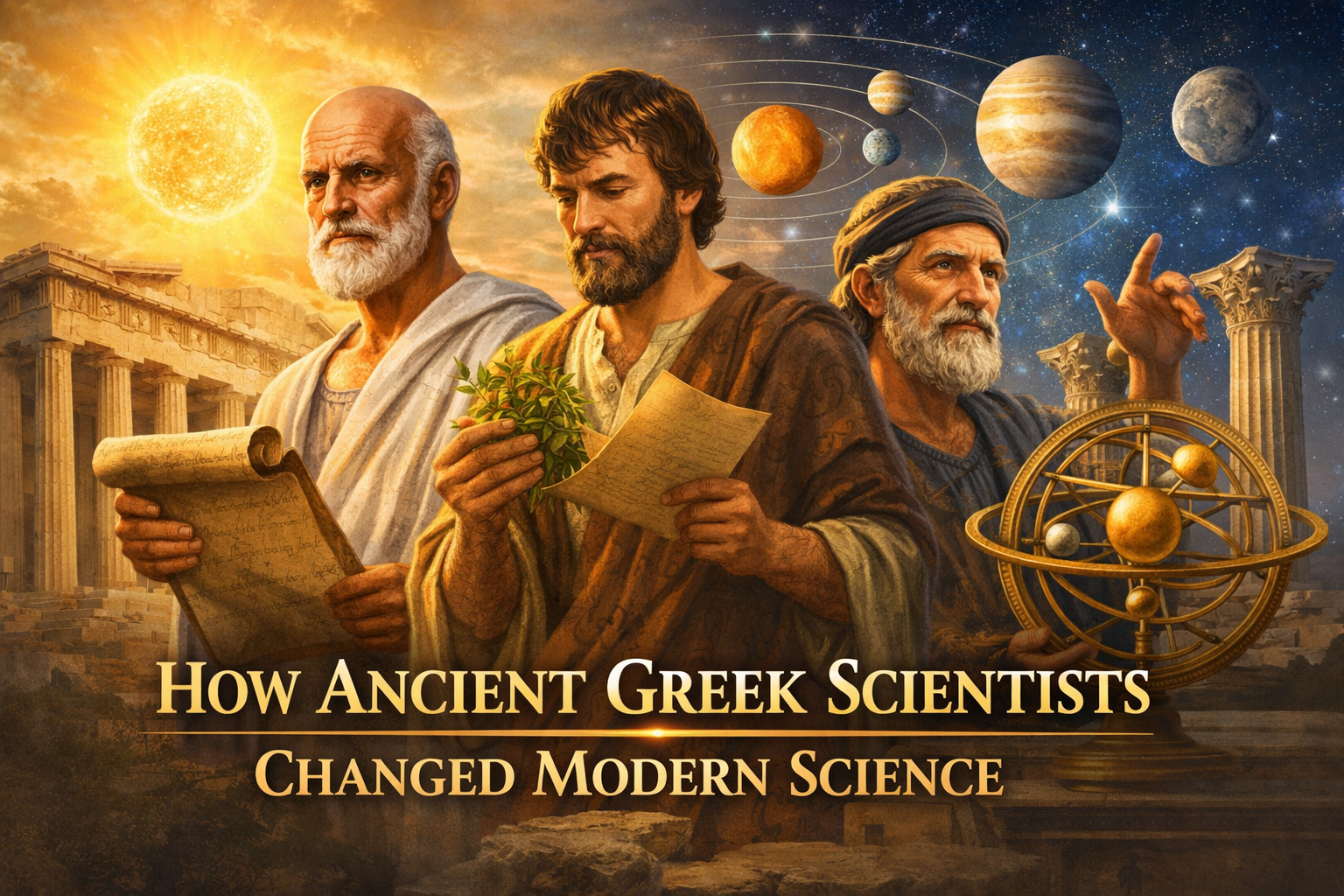
Ancient Greek Scientists laid the intellectual foundation of modern science more than 2,500 years ago. At a time when most civilizations explained natural events through mythology, Greek thinkers introduced logic, observation, and systematic reasoning. Their revolutionary ideas reshaped medicine, astronomy, biology, and physics — and their influence continues to shape scientific thinking today.
Modern laboratories, universities, and research methods all trace their roots back to the intellectual courage of these early pioneers.
The Birth of Rational Thinking
Before scientific reasoning developed, natural disasters, diseases, and celestial movements were often attributed to gods. However, Greek thinkers began asking a powerful question:
“What if nature follows laws that we can understand?”
This shift from myth to logic was the true birth of scientific thought.
Philosophers and early scientists started observing patterns, forming hypotheses, and debating ideas using reason rather than superstition. This intellectual revolution created the framework that modern science still follows.
Medicine: The Beginning of Clinical Practice
One of the most influential figures in medical history was
Hippocrates.
He rejected supernatural explanations for disease and argued that illness had natural causes. His work laid the foundation for clinical observation, diagnosis, and ethical medical practice.
Many principles that guide doctors today originated from Hippocrates’ medical discoveries, including careful patient examination and professional medical ethics.
By introducing structured observation and case recording, Ancient Greek Scientists transformed medicine into a rational discipline.
Biology and Classification of Life
Another key figure was
Aristotle.
Aristotle systematically studied animals, classified living organisms, and analyzed biological structures. His methods influenced scientific classification for centuries.
His student,
Theophrastus,
expanded this work into botany and is often called the Father of Botany. His writings on plant structure and growth formed the basis of early biological science.
Together, their work established the foundations of zoology and botany — disciplines still central to modern research.
Astronomy: Challenging the Universe
In astronomy,
Aristarchus of Samos
proposed a revolutionary idea: the Sun, not the Earth, might be at the center of the universe.
Although his heliocentric model was not widely accepted at the time, it anticipated later discoveries by Renaissance astronomers. His attempt to measure the distance between the Earth and the Sun demonstrated an early use of mathematical reasoning in astronomy.
This bold approach shows how Ancient Greek Scientists were willing to challenge established beliefs through evidence and calculation.
Logic and the Scientific Method
Perhaps the greatest contribution of Ancient Greek Scientists was the development of logical reasoning.
Through debate, structured argument, and systematic observation, they created the intellectual tools that later evolved into the scientific method. Their emphasis on:
- Evidence
- Critical thinking
- Classification
- Ethical responsibility
remains central to scientific research today.
Without these foundations, modern science would not exist in its current form.
Why Their Influence Still Matters
Even in the 21st century, universities teach:
- Aristotelian logic
- Hippocratic medical ethics
- Early Greek astronomy
The scientific mindset — questioning, testing, analyzing — began in Ancient Greece.
Modern science did not appear suddenly during the Renaissance. It was built upon centuries of intellectual groundwork laid by Ancient Greek Scientists.
Conclusion
Ancient Greek Scientists changed modern science forever by replacing myth with logic and observation. Their work in medicine, biology, astronomy, and philosophy established the core principles of rational inquiry.
From Hippocrates’ medical discoveries to Aristotle’s biological classification and Aristarchus’ astronomical theories, their legacy continues to shape the scientific world.
The foundations they built over two millennia ago still support the structure of modern knowledge today.