
Table of Contents
- Introduction
- Why Traditional Underwriting Is No Longer Enough
- The AI Shift in Retail Credit Underwriting
- The Supporting Role of Company Search Databases
- Why Modern Lenders Are Moving Toward AI-Driven Underwriting
- AI Underwriting in Action
- Why AI Underwriting Is the Future of Retail Lending
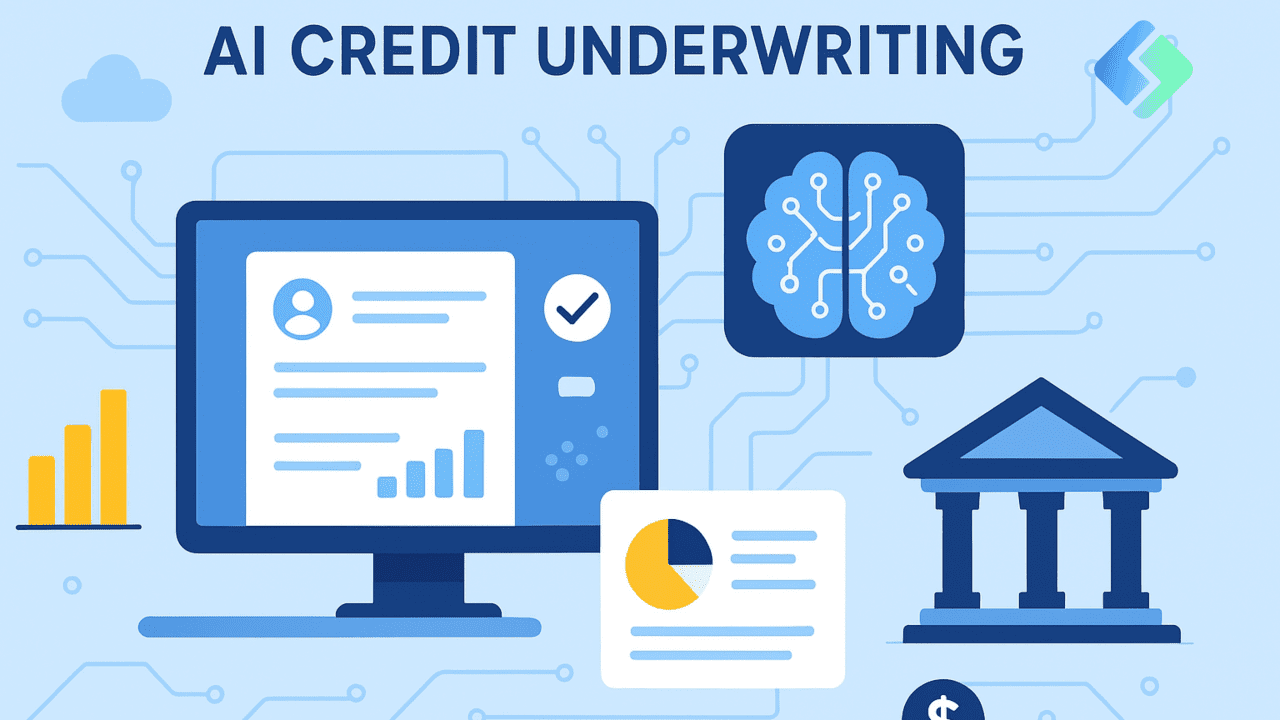
Retail credit underwriting has reached a turning point. As customers move online and expect approvals within minutes, lenders are under immense pressure to deliver accuracy, speed, and security- all at once. Traditional underwriting models, built on manual checks and limited datasets, are struggling to keep pace with rising application volumes and increasingly complex borrower profiles. This is exactly why AI-driven Retail Credit Underwriting has become one of the most transformative shifts in modern lending.
AI is no longer a futuristic concept. It is now the backbone of real-time risk evaluation, fraud detection, and portfolio-quality enhancement. For lenders who want to build faster, more scalable, and more intelligent credit processes, understanding this shift is essential.
Why Traditional Underwriting Is No Longer Enough
For decades, the retail credit ecosystem has relied on documentation, human judgment, and siloed data sources. While this approach worked in a low-volume environment, it has significant limitations in the digital lending age. Borrowers apply from multiple channels, income sources have become fragmented, and fraud patterns have grown more sophisticated.
Manual review slows down decision-making and often introduces subjective bias. Risk evaluation suffers because traditional models simply cannot capture behavioural signals, alternative data, employer credibility, or digital footprints at scale. The result? Delayed approvals, rising fraud attempts, and inconsistent portfolio performance.
AI underwriting emerged precisely to eliminate these inefficiencies.
The AI Shift in Retail Credit Underwriting
AI transforms underwriting by allowing lenders to analyse thousands of data points instantly- far beyond what traditional models can handle. Instead of relying solely on financial statements or bureau scores, AI engines interpret patterns in spending, saving, transactions, employment, and device behaviour. This creates a fuller, more dynamic understanding of borrower risk.
AI-powered underwriting also introduces a level of automation and consistency that manual processes cannot match. Decision engines work in real time, adapting and learning from portfolio outcomes. Every new loan decision helps these models improve, making underwriting smarter with each passing month. And perhaps most importantly, AI dramatically reduces turnaround time, enabling approvals in minutes rather than days.
The Supporting Role of Company Search Databases
As more individuals operate as proprietors, freelancers, or directors, lenders need a deeper layer of verification to confirm business legitimacy. This is where a Company Search Database becomes an indispensable ally to AI underwriting.
AI engines use these databases to validate employer authenticity, uncover compliance gaps, and check directorship or ownership linkages. Whether it’s identifying a director involved in multiple risky entities or spotting a business with irregular filings, the integration of company intelligence strengthens fraud detection and significantly improves risk classification.
Platforms like Accumn enhance this layer further by making detailed business information accessible, structured, and underwriting-friendly- enabling AI models to make sharper, cleaner decisions.
Why Modern Lenders Are Moving Toward AI-Driven Underwriting
The biggest advantage AI offers is certainty. Lenders can rely on consistent, objective decisions backed by data rather than manual interpretation. Borrowers benefit too, as they receive faster approvals and seamless digital journeys. Meanwhile, fraudsters find it increasingly difficult to manipulate identity, income, or company information because AI models are designed to detect even the slightest anomalies.
Over time, these improvements lead to healthier loan books, reduced NPAs, and stronger customer relationships. For lenders competing in crowded markets like personal loans, credit cards, BNPL, or SME lending, AI underwriting becomes the differentiator that determines growth and profitability.
AI Underwriting in Action
Imagine a retail borrower applying for a personal loan. In the traditional model, the process involves waiting for the borrower to submit multiple documents- bank statements, ITRs, pay-slips- then having a credit analyst manually review each, cross-verify incomes, check for bounced cheques, and manually compute cash flows. This process can easily take several hours, sometimes even days, depending on the complexity and veracity of documents.
Now, picture the same borrower journey in a modern, AI-powered underwriting setup. The borrower submits scanned bank statements or connects bank accounts via aggregators, uploads income tax returns (ITRs), and gives consent for alternate data access- all at once. Instantly, an AI-driven Bank Statement Analyzer (BSA) parses the bank statements (whether PDFs, images, or direct feeds), extracts every transaction, and classifies them- salary credits, EMI payments, utility bills, discretionary spend, etc. The system computes cash flow patterns, identifies spikes or anomalies, flags cheque bounces, repeated overdrafts, or suspicious deposits, and builds a clean, normalized financial profile of the borrower.
Meanwhile, an ITR Analyzer reviews submitted income tax returns to validate declared income, check consistency over years, and detect discrepancies between tax-reported income and bank cash flows- critical for self-employed borrowers or new-to-credit individuals.
If the borrower is a small business owner or proprietor or earns via GST-generating activity, the AI engine can also fetch GST data (where available) or alternate data signals and cross-reference them against bank inflows. This gives underwriters visibility into income streams that may not show on typical salary slips or bureau reports- expanding credit access while maintaining risk controls.
Thanks to AI’s automation, this entire workflow- statement reading, ITR-GST reconciliation, bank flows analysis, cash flow scoring, fraud-pattern detection, and alternate-data validation completes within seconds. What once consumed hours of analyst time, now produces underwriting-ready signals instantly. For many digital lenders and fintechs, this means loan decisions can be delivered to customers in a matter of minutes rather than days.
With such AI-powered tools integrated- BSA for bank flows, ITR and GST analysis for income verification, alternate data for non-traditional borrowers- underwriting evolves from a static snapshot to a dynamic, holistic risk assessment. The lender gains a 360° view of borrower behavior, income stability, financial discipline, and risk signals.
Platforms like Accumn- which combine these capabilities under one hood- enable lenders to adopt this modern underwriting framework seamlessly. By offering AI-driven credit intelligence, data enrichment, document automation, and alternative data analysis, Accumn ensures that underwriting is not just fast, but accurate, consistent, and scalable even when handling high volume retail or SME loan pipelines.