

In today’s fast-paced manufacturing and design environment, speed and accuracy are critical. The ability to move quickly from concept to prototype can make the difference between success and delays in product development.
3D scanning technology has arisen as a game-changer in this process. By capturing real-world objects digitally, it allows designers, engineers, and makers to create precise models that can be refined, tested, and produced efficiently.
This technology is reshaping how prototypes are developed, reducing errors, saving time, and expanding creative possibilities.
What Is 3D Scanning Technology?
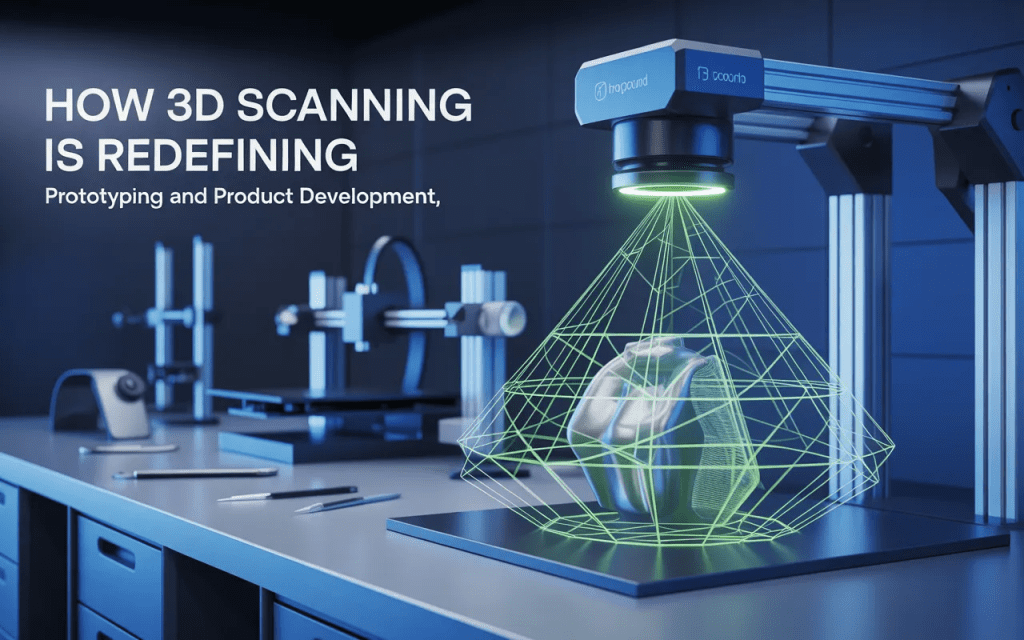
At its core, 3D scanning technology captures the shape, dimensions, and surface details of physical objects. Scanners use lasers, structured light, or sensors to create a digital 3D model, often called a point cloud.
Unlike manual measurements or traditional modeling, 3D scanning produces highly accurate digital representations. Curves, edges, textures, and small details are preserved, making it easier to translate real-world objects into functional prototypes.
Why 3D Scanning Is Essential for Prototyping
Prototyping is often the most time-consuming part of product development. Traditionally, designers relied on manual measurements and software modeling, which could lead to errors and misfits.
With 3D scanning technology, these challenges are minimized. Designers can:
- Capture an exact digital model of a prototype or existing part
- Make precise adjustments and iterations without starting from scratch
- Test designs virtually before committing to production
- Save material and reduce wasted time
This improves accuracy, speeds up development, and reduces the risk of costly mistakes.
Industrial Applications of 3D Scanning
The impact of industrial 3D scanning solutions extends beyond small-scale prototypes. Industries are using it to improve product development in various ways:
- Automotive and Aerospace: Inspect parts, reverse-engineer components, and ensure precise assembly.
- Consumer Electronics: Scan prototypes to refine designs and accelerate manufacturing.
- Medical Devices: Digitize components for custom-fit prosthetics or implants.
- Architecture and Construction: Capture structural details for renovation, preservation, and modeling.
These applications show how 3D scanning is becoming an indispensable tool for professionals in multiple sectors.
Advantages of Using Industrial 3D Scanning Solutions
Investing in industrial 3D scanning solutions provides several key benefits:
- Accuracy: Capture fine details with precision, essential for functional parts.
- Efficiency: Reduce the time between concept, prototype, and production.
- Versatility: Handle a wide range of object sizes, from small components to large assemblies.
- Flexibility: Portable scanners allow on-site scanning, while stationary units provide stable, high-resolution results.
- Integration: Scan data can be exported to CAD, 3D printing, or analysis software for seamless workflow.
These benefits make industrial scanners invaluable for companies that need reliable and repeatable results.
How 3D Scanning Enhances Iteration and Design
Innovation requires iteration. With 3D scanning technology, this process becomes faster and more flexible.
Scan your prototype. Modify it digitally. Test it virtually. Repeat.
This cycle allows designers to experiment without fear of wasting time or resources. Adjustments can be made digitally, reducing the need for multiple physical prototypes. The result is faster innovation and a more efficient product development process.
Why Revopoint Stands Out
Revopoint is a leader in industrial 3D scanning solutions, providing devices that balance precision, portability, and usability. Their scanners are designed for real-world workflows, supporting both professionals and advanced makers.
Key features include:
- High-resolution scanning for capturing intricate details
- Fast point-cloud capture to accelerate development
- Real-time tracking to reduce errors and rescans
- Portable, handheld designs for on-site and studio scanning
- Compatible software for editing, exporting, and 3D printing
These capabilities make Revopoint scanners ideal for integrating 3D scanning technology into modern prototyping and product development workflows.
Tips for Maximizing 3D Scanning Results
Even with the best scanner, workflow matters. To get the most from your device:
- Ensure proper lighting to improve scan accuracy
- Stabilize objects to avoid errors or blurred data
- Scan from multiple angles for complete digital models
- Use software tools to clean, align, and refine scans before production
Following these steps ensures your scans are precise and ready for downstream applications.
Final Thoughts
3D scanning technology is no longer just a convenience—it’s a critical component of modern prototyping and product development. By providing accurate digital models, it reduces errors, accelerates iteration, and expands creative possibilities.
With industrial 3D scanning solutions like those from Revopoint, businesses and creators can integrate scanning into their workflow seamlessly, capturing real-world objects and turning them into high-quality digital models.
For any company or maker aiming to improve speed, accuracy, and innovation, investing in 3D scanning is a step toward smarter, faster, and more reliable product development.