
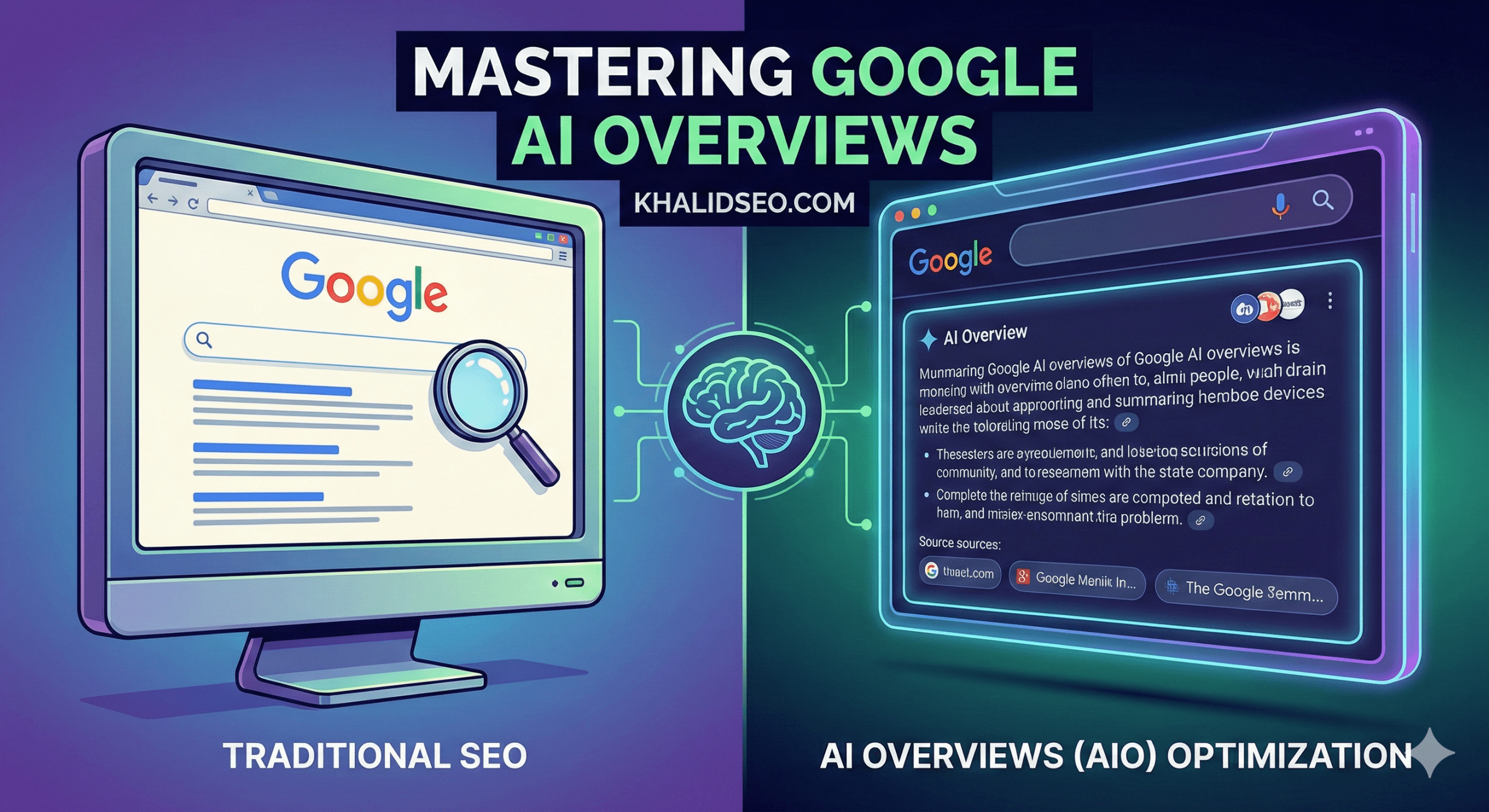
Google has fundamentally broken the ten blue links.
For over two decades, the goal was simple: optimize for the crawler, rank in the top three, and capture the click. But with the rollout of Google AI Overviews (AIO), the search engine has evolved into an Answer Engine.
The crawler is no longer just indexing your pages; the LLM (Gemini) is reading them, synthesizing your data, and answering the user directly on the SERP.
If your strategy relies solely on traditional keyword density and backlink velocity, you are optimizing for a version of Google that no longer exists. You aren’t just losing rankings; you are losing visibility in the “Zero-Click” era.
At Khalid SEO, we focus on the future. This guide outlines the exact technical framework—Generative Engine Optimization (GEO)—you need to move from being ranked to being cited.

What is Google AI Overviews Optimization (AIO)?
Google AI Overviews optimization (AIO) is the process of structuring web content so it can be easily parsed, verified, and synthesized by Google’s generative AI models.
Unlike traditional SEO, which focuses on ranking a URL, AIO focuses on Entity Salience. The goal is to convince the LLM that your brand, data, and authors are the most authoritative “sources of truth” for a specific topic.
When you optimize for AIO, you are essentially treating your content like a database for a machine, rather than just a blog post for a human.
SEO vs. GEO: The Rules Have Changed
Many marketers confuse AIO optimization with standard SEO. They are distinct disciplines.
SEO (Search Engine Optimization) is about retrieval. You want the search engine to find your page and display it.
GEO (Generative Engine Optimization) is about comprehension. You want the AI to understand your content’s logic and use it to construct an answer.
Here is the breakdown of how the methodology differs:
| Feature | Traditional SEO | Generative Engine Optimization (GEO) |
| Primary Goal | Rank a URL (Blue Link) | Win a Citation (AI Snapshot) |
| Target Audience | Human Reader + Spider | Large Language Model (LLM) |
| Metric of Success | Traffic Volume | Share of Voice / Citation |
| Content Structure | Long-form, narrative flow | Structured, data-dense, modular |
| Keywords | Exact match / LSI | Entities & Vector Context |
Core Strategy: How to Rank in Google AI Overviews
To secure placement in the AI snapshot, you must provide “Information Gain.” The AI ignores repetitive content. It seeks unique data, fresh perspectives, or better formatting.
Here is the Khalid SEO framework for AIO visibility.
1. Entity Identification & Salience
Keywords are strings of text; entities are concepts (people, places, things) that Google’s Knowledge Graph understands.
Stop writing for keywords. Start writing to connect entities. If you are writing about “Technical SEO,” ensure you explicitly mention related entities like “Schema.org,” “Javascript Rendering,” and specific tools. This creates a dense “vector neighborhood” that signals high topical authority to the LLM.
2. The “Direct Answer” Formatting Trick
Gemini prefers content that is easy to parse. It struggles with walls of text.
To win the snapshot, structure your content using the Inverse Pyramid:
- The What: Start with a direct answer (40-50 words) immediately after a heading.
- The Why: Follow with bullet points explaining the context.
- The How: End with deep data or step-by-step instructions.
3. Schema Markup for Machine Readability
Structured data is no longer optional. It is the language of the machine.
You must wrap your content in aggressive Schema markup. Use FAQPage, HowTo, and Article schema. More importantly, use sameAs properties to link your content to recognized external authorities (like Wikipedia or Crunchbase). This verifies your data points and builds trust with the algorithm.
Will AI Overviews Kill Organic Traffic?
This is the most common question we hear at https://khalidseo.com/. The short answer: It depends on your intent targeting.
If your traffic relies on simple definitions (e.g., “What is the capital of France?”), yes, that traffic is gone. The AI answers it instantly.
However, AIO filters out low-intent users. The users who click on a citation inside an AI overview are asking complex questions. They are in the “Consideration” or “Decision” phase.
While your total traffic volume might drop, the quality of that traffic will likely increase. These are users looking for deep expertise, not quick facts.
The Khalid SEO Readiness Checklist
Is your site ready for 2026? Use this quick audit:
- [ ] Entity Audit: Do your pages clearly define who you are and what you do using specific nouns?
- [ ] Structure Check: Are you using ordered lists and comparison tables?
- [ ] Author Authority: Do your blog posts have verified author bios linked to social profiles?
- [ ] Schema Implementation: Is every page wrapped in relevant JSON-LD markup?
Frequently Asked Questions (AEO)
We have analyzed Voice Search and “People Also Ask” trends to provide these direct answers.
What is the difference between SEO and GEO?
SEO focuses on ranking links, while GEO focuses on optimizing content for AI comprehension. GEO prioritizes structured data, entity density, and direct answers to win citations in AI-generated summaries, rather than just driving clicks to a page.
How do I rank in Google AI Overviews?
To rank in AI Overviews, you must focus on answer fluency and authority. Specifically, use Question-and-Answer formatting, implement extensive Schema markup, provide unique data (Information Gain), and ensure your content comes from a verifiable expert entity.
Will AI Overviews kill organic traffic?
AI Overviews will reduce top-of-funnel informational clicks but likely increase high-intent commercial traffic. Users seeking quick answers will stay on the SERP, while users needing complex solutions or services will click through for deeper verification.
What are the best content formats for AI Overviews?
Google’s AI favors structured formats like bulleted lists, comparison tables, and short definition blocks. These formats are easier for the LLM to process and cite compared to long, unstructured paragraphs of text.
Embracing the Era of “Citation”
The shift to AI Search is not the end of SEO; it is the maturation of it. The winners in 2026 will not be the sites with the most keywords, but the sites with the most trusted data.
Don’t let your brand disappear in the zero-click era. You need a strategy that speaks directly to the machine.
Visit https://khalidseo.com/ today to audit your entity presence and future-proof your digital growth.
