

Problem:
B2B marketers are seeing traffic drop while AI summaries take prime SERP real estate. Rankings alone no longer guarantee visibility.
Agitation:
Many guides show consumer examples or theory. That leaves B2B teams guessing how AI summaries actually appear for enterprise queries.
Solution:
This article analyzes 10 real B2B-style AI Overview scenarios, grouped by buyer journey. You’ll learn patterns, triggers, and how to structure content so AI systems choose your insights — like the strategies shared on Khalid SEO.

What Are Google AI Overviews in B2B Search? (And Why They Matter Now)
AI Overviews are AI-generated summaries appearing above organic results inside search results from Google. They synthesize information from multiple sources to answer complex business questions.
Key Characteristics:
- Multi-source summaries
- Structured explanations
- Inline citations
- Decision-support insights
How AI Overviews Work in Enterprise Queries
- Query intent is analyzed
- Relevant sources are retrieved
- Entities and concepts are mapped
- AI generates a structured summary
Difference Between AI SERPs & Traditional SERPs
| Traditional SERP | AI Overview SERP |
|---|---|
| Blue links first | AI summary appears first |
| User compares multiple pages | AI synthesizes sources |
| Click-based research | Instant overview answers |
| Ranking-focused SEO | Citation & entity-focused SEO |
Evolution of Zero-Click Search
AI summaries reduce browsing steps. Users often decide vendors after reading synthesized information.
How AI Overviews Change the B2B Buyer Journey
AI Overviews reshape how buyers research solutions. Instead of visiting many pages, buyers start with a synthesized summary.
Research Behavior Changes
- Faster problem understanding
- Shorter discovery phase
- More comparison-oriented searches
Reduced Click Paths
Users skim AI summaries first. They click only when deeper evaluation is needed.
Trust & Authority Signals
- Structured content increases credibility
- Data-backed explanations are favored
- Strong entity presence improves citation chances
Methodology: How We Identified Real B2B AI Overview Examples
We focused on queries common in enterprise SaaS research and solution evaluation.
Industry Selection Criteria
- SaaS
- Enterprise technology
- Marketing automation
- Cybersecurity
- Cloud platforms
Query Types Tested
- Definitions
- Comparisons
- Vendor evaluations
- Pricing research
AI Overview Trigger Indicators
- Complex informational queries
- Multi-step decision questions
- Comparative intent signals
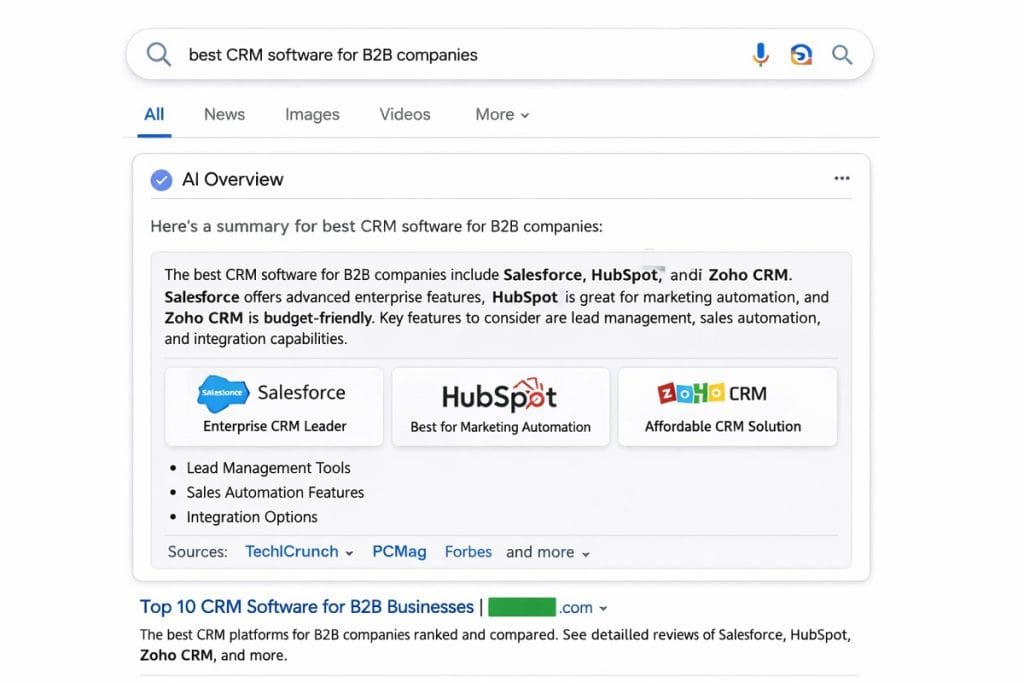
Awareness Stage Examples (Top-of-Funnel B2B AI Overviews)
These appear for early research queries where buyers are learning concepts.
Example #1: “What is Marketing Automation?”
AI Overview includes:
- Definition
- Key benefits
- Common use cases
- Platform examples such as HubSpot
Example #2: “Benefits of CRM Software”
Summary typically covers:
- Pipeline tracking
- Lead nurturing
- Forecasting
- Sales productivity gains
Example #3: “What is Workflow Automation?”
AI overview explains:
- Process automation basics
- Operational efficiency
- Integration examples
- ROI potential
Insight: Awareness queries prioritize educational clarity and structured explanations.
Consideration Stage Examples (Comparison & Evaluation Queries)
These AI Overviews compare features and capabilities across vendors.
Example #4: CRM Comparison Query
AI summarizes:
- Feature differences
- Integration capabilities
- Pricing tiers
- Enterprise scalability, often referencing vendors like Salesforce
Example #5: Analytics Platforms Comparison
AI Overview highlights:
- Data visualization tools
- Automation features
- Reporting flexibility
- Integration ecosystems
Example #6: Cybersecurity Tools Comparison
Common elements:
- Threat detection capabilities
- Compliance standards
- Deployment models
- Cost considerations
Insight: Consideration queries often generate table-style AI summaries.
Decision Stage Examples (Commercial & Vendor Selection Queries)
These appear near purchase decisions.
Example #7: SaaS Pricing Queries
AI summaries include:
- Pricing ranges
- Licensing models
- Cost-per-user estimates
- Hidden fees
Example #8: Best Enterprise CRM
AI Overview compiles:
- Market leaders
- Enterprise features
- Industry-specific solutions
- Integration strength
Example #9: Cloud Platform Comparison
AI highlights:
- Performance benchmarks
- Scalability
- Infrastructure services
- Pricing models
Example #10: Workflow Automation Vendor Selection
AI Overviews present:
- Vendor capabilities
- Automation complexity
- Support options
- ROI considerations
Insight: Decision-stage AI summaries emphasize differentiation and vendor positioning.
Patterns & Insights: What All B2B AI Overviews Have in Common
Citation Trends
- Authoritative industry sites
- Vendor documentation
- Independent research reports
Content Structure Signals
- Clear headings
- Bullet points
- Concise explanations
- Data-driven claims
Common Trigger Queries
- “Best software for…”
- “Compare X vs Y”
- “What is… in B2B”
- “Pricing comparison”
AI Summary Structure Patterns
- Definition
- Key benefits
- Comparison insights
- Decision factors
How to Optimize Your B2B Content to Appear in AI Overviews
Writing for AI Extraction
- Use clear subheadings
- Include structured bullet points
- Answer questions directly
Building Semantic Depth
- Cover subtopics fully
- Explain concepts clearly
- Include real examples and data
Formatting for AI Citations
- Provide concise definitions
- Include comparison tables
- Use consistent terminology
Measurement & Tracking
- Monitor zero-click queries
- Track citation visibility
- Analyze search impressions vs clicks
FAQ — AI Overview Optimization for B2B
What are Google AI Overviews in B2B search?
AI Overviews are AI-generated summaries that synthesize multiple sources to answer complex business queries directly within search results.
They help buyers evaluate tools, compare vendors, and understand enterprise concepts without reading many separate pages.
What types of B2B queries trigger AI Overviews?
Complex research, comparison, and educational queries often trigger AI summaries because they require synthesis rather than a single answer.
Examples include software comparisons, workflow solutions, pricing analysis, and enterprise technology evaluations.
How do AI Overviews impact B2B SEO strategy?
They shift focus from rankings alone toward semantic authority, structured content, and citation inclusion within AI summaries.
Brands must produce clear, expert-driven content that AI systems can easily interpret and extract.
Are AI Overviews replacing traditional organic results?
No. Traditional results still appear, but AI summaries change how users interact with search results.
Many buyers read summaries first, then click only for deeper analysis or vendor validation.
How can companies appear inside AI Overviews?
Publish authoritative, structured, entity-rich content that answers real buyer questions clearly and concisely.
Topical depth, consistent formatting, and trusted sources increase the chance of AI citation and inclusion.
