
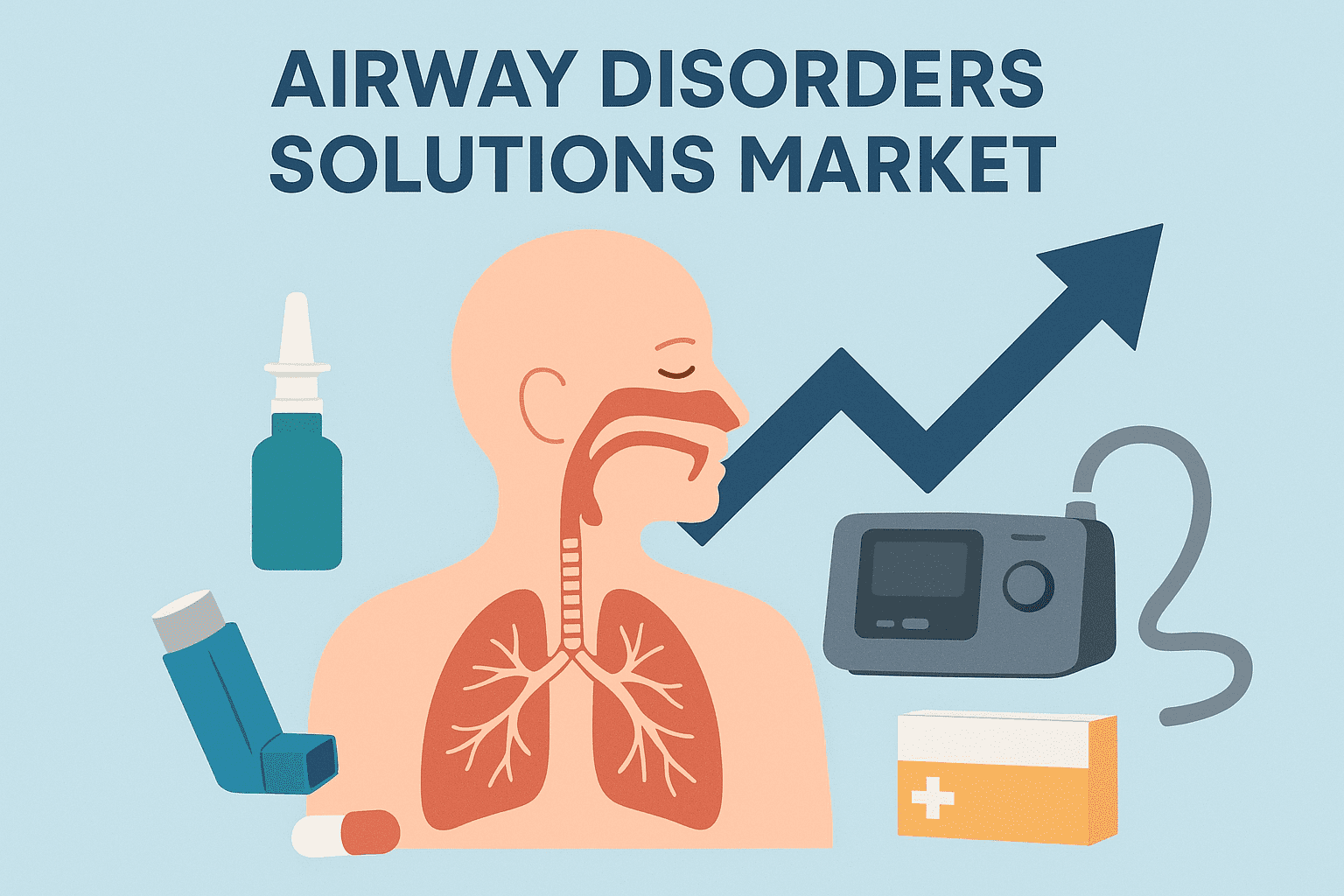
The global Airway Disorders Solutions Market is experiencing notable growth as respiratory diseases continue to escalate worldwide and healthcare systems rapidly adopt innovative airway management technologies. Airway disorders, including asthma, chronic obstructive pulmonary disease (COPD), sleep apnea, bronchitis, and upper airway obstructions, account for a significant proportion of global morbidity and mortality. The market includes inhalers, nebulizers, oxygen therapy systems, airway clearance devices, humidification tools, diagnostic systems, and emerging digital respiratory management solutions. Increasing innovation, rising patient awareness, and a shift toward home-based care are driving strong demand across regions.
Key Growth Drivers
Growth is largely driven by the rising prevalence of chronic respiratory diseases, increasing air pollution, smoking rates, and aging populations. Over 262 million individuals worldwide suffer from asthma, while COPD ranks as the third leading cause of death globally, highlighting the urgent need for advanced and accessible airway management solutions. Additionally, the increasing incidence of respiratory allergies, post-COVID respiratory complications, and lifestyle-related conditions is supporting steady product adoption.
Shift Toward Home-Based Respiratory Care and Digital Transformation
A key market trend is the growing transition from hospital-based treatment to home-based respiratory care, propelled by the availability of portable, compact, and user-friendly airway devices. Home-use nebulizers, inhalers, PAP devices, and oxygen concentrators are gaining traction as patients seek convenient, cost-effective respiratory management. Simultaneously, the rise of smart inhalers, equipped with Bluetooth connectivity, real-time drug usage tracking, and mobile app integration, is transforming chronic respiratory care. These connected devices improve medication adherence, support remote monitoring, and enhance care coordination between patients and healthcare providers, aligning with the global shift toward digital health ecosystems.
Technological Advancements Boosting Innovation
The market is witnessing a wave of technological innovation, particularly in drug delivery, diagnostics, and non-invasive therapy. The development of adaptive aerosol delivery (AAD) systems, mesh nebulizers, high-efficiency filtration, 3D-printed airway stents, and AI-enabled respiratory diagnostics is expanding treatment options. Advancements in non-invasive ventilation (NIV) technologies and respiratory monitoring sensors are further enhancing patient comfort and outcomes. Manufacturers are increasingly prioritizing lightweight materials, enhanced drug delivery efficiency, and smart device integration to differentiate their offerings and meet evolving patient needs.
Product Segment Highlights
Inhalers continue to dominate the market, supported by the widespread prevalence of asthma and COPD and the extensive availability of metered-dose inhalers (MDIs), dry powder inhalers (DPIs), and emerging smart inhaler technologies. Nebulizers, especially advanced ultrasonic and mesh variants, represent another rapidly growing segment due to their efficiency, silent operation, and enhanced portability.
The airway clearance devices segment, including oscillatory PEP devices, high-frequency chest wall oscillation vests, and suction systems, is gaining momentum with rising cases of cystic fibrosis, bronchiectasis, and mucus-management complications. Additionally, sleep apnea solutions, such as CPAP and BiPAP systems, are witnessing strong uptake amid rising global obesity rates and growing awareness of sleep-disordered breathing.
End-User Landscape: Hospitals Lead While Homecare Surges
Hospitals and clinics currently hold the largest market share, attributed to advanced infrastructure, higher patient inflow, and availability of skilled respiratory specialists. However, the home care setting is projected to record the fastest growth over the next decade due to the rapidly rising demand for chronic disease management at home, increased need for continuous oxygen support, and cost advantages. Ambulatory surgical centers (ASCs) and specialty respiratory clinics also play a significant role in driving product adoption.
Regional Market Insights
North America leads the global market owing to high asthma and COPD incidence, mature healthcare infrastructure, rapid uptake of smart respiratory solutions, and strong presence of leading device manufacturers. Europe follows closely due to government-led chronic disease management initiatives, clinical research advancements, and the wide availability of respiratory care products.
The Asia-Pacific region is anticipated to witness the fastest growth, fueled by rising pollution levels, increasing industrialization, growing smoking rates, and expanding healthcare access in countries such as China, India, and Southeast Asia. Meanwhile, Latin America and the Middle East & Africa are gradually expanding their respiratory care infrastructure, supported by improving diagnostic capabilities and growing healthcare investments.
Recent Developments
In May 2025, researchers introduced advanced AI-driven models capable of predicting chronic respiratory failure and identifying early signs of airway obstruction with higher accuracy. The new approach enhances clinical decision-making and supports earlier intervention for patients with progressive airway diseases. These findings were shared at a major international respiratory conference.
In September 2023, a new biotechnology company announced its entry into the market with a focus on inhaled gene therapies for rare respiratory disorders. The company’s first pipeline program targets Alpha-1 Antitrypsin Deficiency (AATD), offering a novel therapeutic approach aimed at correcting the underlying genetic cause. The development marks a significant step forward in next-generation respiratory treatments.
Emerging Market Trends Shaping the Future
Several transformative trends are shaping the future growth trajectory of the Airway Disorders Solutions Market, including:
- Integration of AI and digital health across inhalers, PAP devices, and respiratory diagnostics
- Shift toward eco-friendly, propellant-free inhalers to support sustainability initiatives
- Growing demand for wearable and portable respiratory devices designed for continuous monitoring
- Increasing adoption of biologics and precision therapies, particularly for severe asthma cases
- Expansion of tele-respiratory services supporting virtual respiratory assessment and rehabilitation
Conclusion
With a rising global burden of airway disorders and rapid technological innovation across inhalation therapy, diagnostics, and non-invasive ventilation, the Airway Disorders Solutions Market is well-positioned for sustained long-term growth. Industry players are accelerating investments in smart respiratory technologies, home care-focused solutions, and advanced drug delivery systems to strengthen their competitive position. As digital health and personalized respiratory care continue to evolve, the market is expected to witness strong adoption across all major regions in the coming years.
About Author:
HTF Market Intelligence Consulting is uniquely positioned to empower and inspire with research and consulting services to empower businesses with growth strategies, by offering services with extraordinary depth and breadth of thought leadership, research, tools, events, and experience that assist in decision-making.
