
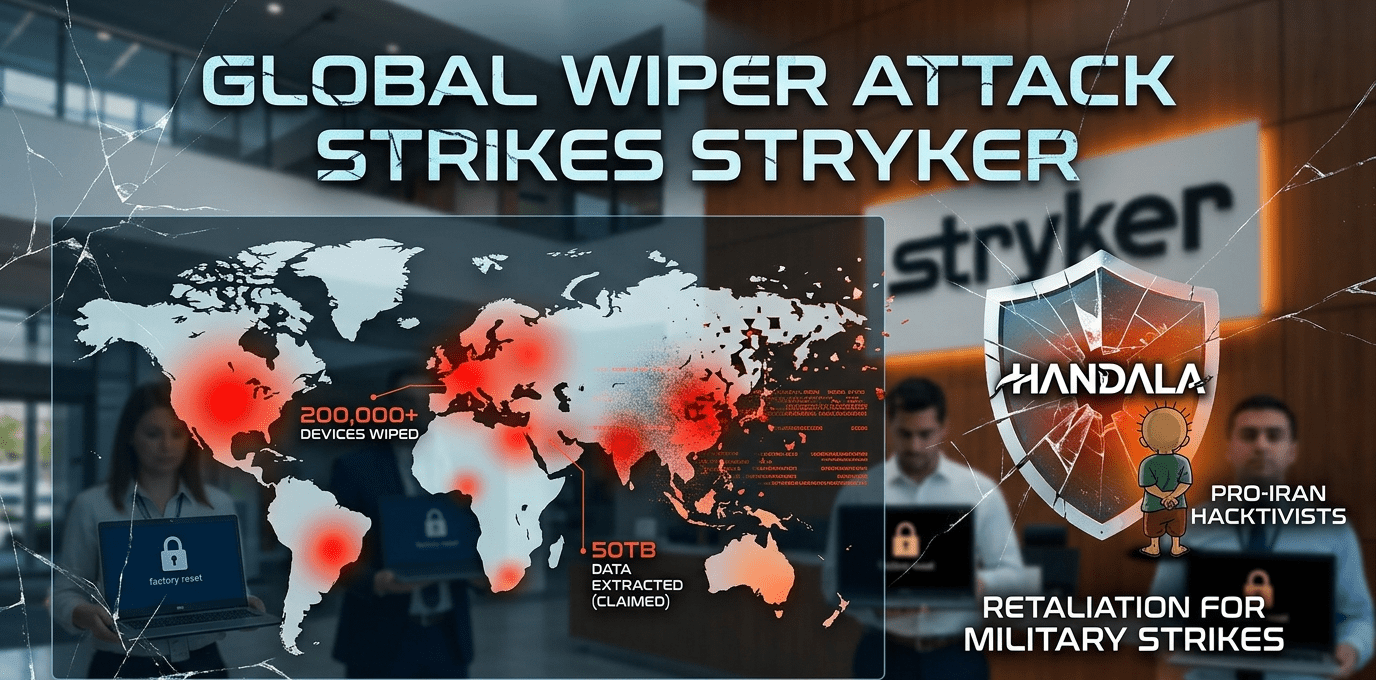
A catastrophic cyberattack targeting Stryker Corporation, one of the world’s largest medical technology companies, has sent shockwaves through the US healthcare sector, signaling a dangerous escalation in geopolitical cyber warfare. The attack, which occurred yesterday, March 11, disabled hundreds of thousands of devices globally and raises urgent questions about the vulnerability of critical infrastructure in a new era of state-aligned, destructive hacking.
Key Headlines of the Attack
- Target: Stryker Corporation, a Michigan-based giant ($25B+ revenue, ~56,000 employees) specializing in medical and surgical equipment, orthopedic implants, and neurotechnology.
- Method: A massive “wiper” attack that factory-reset devices. It did not encrypt files for ransom but permanently erased data.
- Attribution: Handala, a pro-Iranian hacktivist group, claimed responsibility, describing it as retaliation for recent US-Israeli military strikes against Iran.
- Scale of Destruction: Handala claims to have wiped 200,000+ systems, servers, and mobile devices across 79 countries, bringing the entire corporation to a standstill. They also claim to have extracted 50 terabytes of critical data.
- Impact: Complete global network outage of Stryker’s Microsoft environments. Employees worldwide, including 5,500 at key hubs in Ireland, were sent home, unable to work. Stryker’s stock (NYSE: SYK) fell roughly 5%.
A New Class of Warfare: From Ransom to Ruin
The defining characteristic of this incident is its purely destructive nature. Unlike the high-profile ransomware attacks that defined 2024 and 2025—which sought financial gain by locking systems—this was a direct act of sabotage.
Investigators believe the attackers obtained administrative credentials for Microsoft Intune, Stryker’s cloud-based endpoint management platform, and used its legitimate remote wipe capability to factory reset every enrolled device simultaneously.
Geopolitical Ripple Effects
Handala has emerged as a major player in recent months, known for a “hack-and-leak” style increasingly combined with destructive tactics intended to promote fear. The group explicitly linked the Stryker attack to recent military actions in Iran, naming a specific school bombing.
While Stryker stated that the incident is “contained” and they are working rapidly to restore systems, they acknowledged the severity of the “global network disruption.”
This attack marks the first known major cyber disruption of an American organization directly tied to the escalating conflict between the US, Israel, and Iran, moving the front line from the physical battlefield to digital critical infrastructure.
The Downstream Risk to Patients
The attack on Stryker did not directly target hospital networks or connected medical devices in the midst of patient care, avoiding an immediate clinical emergency. However, experts warn of severe, long-term downstream effects that could jeopardize patient outcomes if the disruption is prolonged.
Stryker is a central nervous system of hospital supply chains. Disruptions to their operations threaten:
- Device Supply Chains: Delays in acquiring surgical tools, implants (knees, hips), and hospital beds.
- Software Updates: Paused rollout of critical security patches and clinical software improvements for existing equipment.
- Technical Support: Hospitals depend on Stryker for real-time troubleshooting and maintenance of robotic surgical systems and imaging equipment.
Regulatory Awakening and the Road Ahead
The attack is expected to accelerate ongoing efforts by US and global regulatory bodies to enforce stricter cybersecurity standards for medical technology.
The FDA’s Section 524B, mandated in 2023, requires manufacturers to demonstrate device cybersecurity resilience. This incident may push for mandatory real-time threat monitoring and broader segmentation of hospital networks to isolate clinical equipment from corporate IT vulnerability.
As the industry and governments grapple with this new threat level, the Stryker attack stands as a definitive warning: in the digital age, a corporation’s security posture is inseparable from its strategic survival.