
Customer complaints reveal service failures. Understanding what frustrates customers most—and how AI addresses those frustrations—illuminates why AI improves satisfaction rather than degrading it.
The top customer complaints cluster around issues AI is uniquely positioned to solve.
Complaint #1: Waiting
HubSpot research identifies waiting as a primary frustration: 33% of customers are most frustrated by having to wait on hold. More broadly, 90% rate immediate response as important, with 60% defining “immediate” as under 10 minutes.
SuperOffice found that average email response time is 12 hours. The gap between 10-minute expectation and 12-hour reality creates frustration at scale.
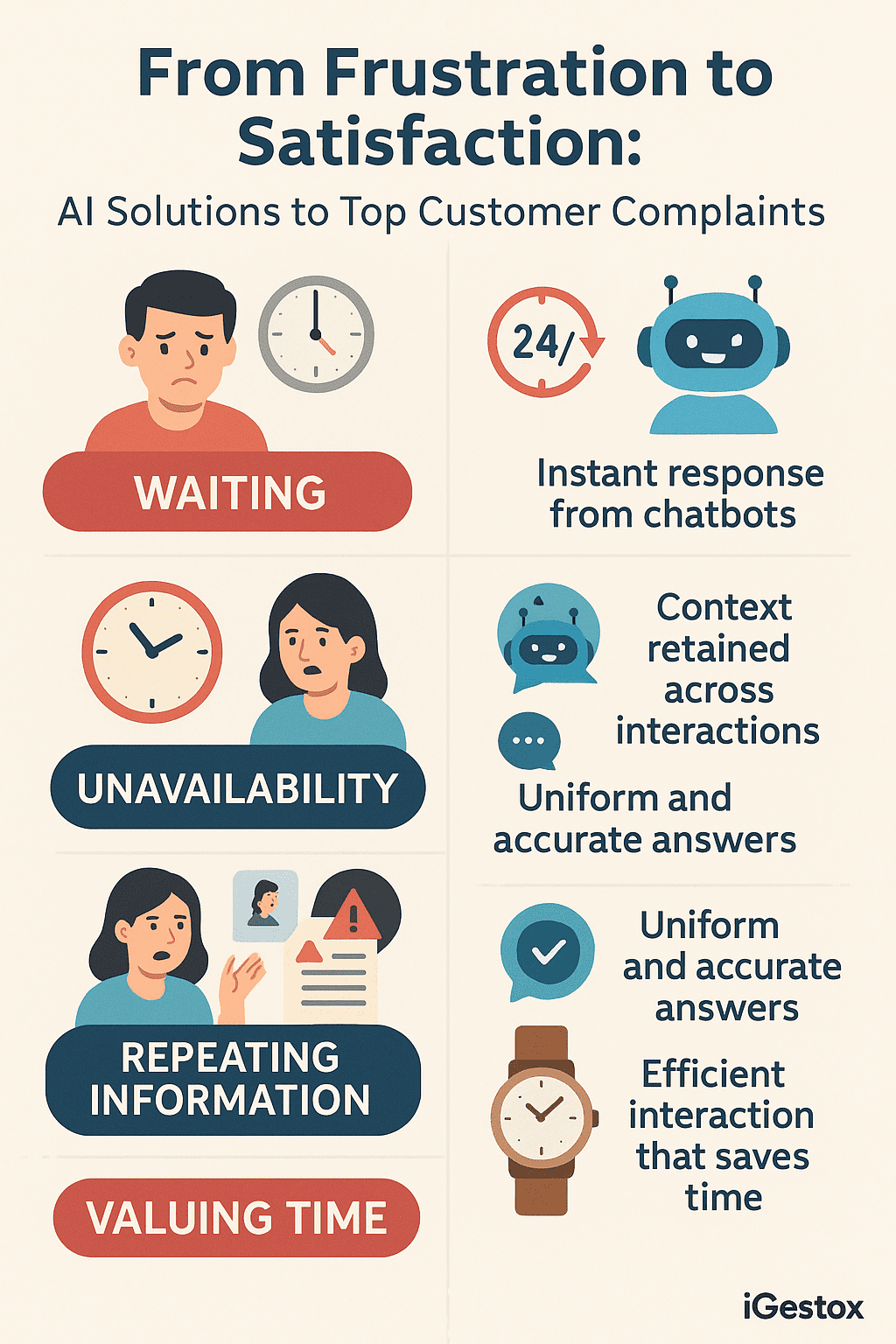
AI eliminates waiting. Chatbots respond instantly—not in minutes but seconds. The complaint that frustrates one-third of customers specifically disappears entirely with AI implementation.
Complaint #2: Unavailability
Microsoft’s research shows that 90% of consumers expect 24/7 service availability. Gartner reports that after-hours inquiries have increased 35% since 2020.
Traditional business hours create unavailability frustration for customers whose needs don’t align with 9-to-5 schedules. The evening question that can’t be answered until morning, the weekend inquiry that waits until Monday—each represents potential frustration.
AI operates 24/7 without additional cost or quality degradation. The availability that customers expect becomes achievable for businesses that couldn’t staff around-the-clock coverage.
Complaint #3: Repeating Information
Forrester Research found that 73% of customers expect companies to understand their needs and expectations. Repeat explanations—retelling a problem to each new representative—signal that companies don’t remember or understand.
AI maintains context across interactions, referencing previous inquiries and building on prior conversations. The frustration of repetition decreases when systems remember what customers have already shared.
Complaint #4: Inconsistent Information
Different answers from different representatives create frustration and erode trust. When customers hear conflicting information, confidence in the business suffers.
AI delivers consistent responses from the same information base every time. Policies, pricing, and details remain consistent regardless of when or how customers inquire.
IBM’s Global AI Adoption Index reports 6.9% customer satisfaction improvement from AI adoption. Consistency contributes significantly to this improvement.
Complaint #5: Valuing Time
Forrester found that 77% of customers say valuing their time is the most important thing a company can do. Every unnecessary step, every delayed response, every extended interaction signals that the company doesn’t value customer time.
Juniper Research found that chatbots save an average of 4 minutes per customer interaction. From the customer perspective, that’s 4 minutes of their time not consumed by slow service processes.
The time savings customers experience through AI interaction translate directly to the “time valuing” that 77% say matters most.
Implementing Frustration-Free Service
AI addresses top complaints systematically, but implementation matters:
Speed configuration: Ensuring AI responds instantly without unnecessary pauses Information completeness: Providing AI with comprehensive, current business information Escalation design: Routing complex issues to humans before frustration compounds Tone calibration: Matching AI communication style to customer expectations
Demonstrations of AI customer service show how these elements combine to create frustration-free interactions.
The Satisfaction Improvement Path
The top customer complaints aren’t mysterious or complex. They’re predictable frustrations with known solutions. AI provides those solutions at scale:
Waiting → Instant response Unavailability → 24/7 operation Repetition → Context retention Inconsistency → Uniform information Time waste → Efficient interaction
For businesses where customer complaints include these issues, AI implementation directly addresses the frustrations that drive dissatisfaction and switching.
From Complaint to Competitive Advantage
Businesses that eliminate top customer frustrations don’t just stop complaints—they create differentiation. When competitors still make customers wait, repeat themselves, and receive inconsistent information, the business providing instant, contextual, consistent service stands out.
Gartner reports that 89% of companies compete on customer experience. Systematically eliminating frustration through AI creates the experience advantage that drives competitive success.
The complaints that frustrate customers most are the complaints AI solves best. The alignment isn’t coincidental—it’s why businesses implementing AI see the satisfaction improvements that IBM documents.