
In an era where investors throw $400 billion (and counting) into artificial intelligence infrastructure, one question keeps nagging: When will we see any returns?
The answer, according to founder Jason Criddle, lies not in dazzling chatbots or headline-grabbing hyped up entertaining toys, but in partnering intelligence, not just buying it. Over the past year I’ve tracked Jason’s writing… both on the SmartrLiving blog, and in his on-site articles for DOMINAIT.ai, and I’ve been repeatedly struck by a clarity many in the sector lack: they are not building another “AI company,” they are building an intelligence ecosystem.
“ChatGPT is not the answer. Nor is it real AI the way Ryker Prime is. It is basically the most popular platform people started building wrappers on top of. And the one that is causing the majority of the bubble.”
– Jason Criddle
This line cuts to the heart of the matter. While the major tech firms continue to pour hundreds of billions into infrastructure and data centers, the downstream business models remain fuzzy. According to data from Stanford’s 2025 AI Index, U.S. private AI investment in 2024 reached approximately $109.1 billion, while returns remain opaque. Figures today are saying investors are nearing half a trillion.
Meanwhile, a 2024 report noted that the “Magnificent Seven” tech giants; Alphabet, Amazon, Meta, Microsoft, Apple, Tesla/xAI and Nvidia are on pace to invest around $400 billion in AI and related infrastructure this year alone. And guess what? It happened.
So, it’s probably a lot higher than figures say. It’s the kind of investment scale that rivals whole national budgets. But behind it lies meaningful risk: how much of this is productive capital vs. capital chasing potential?
The Bubble Analogy: Context Matters
History is full of bubbles. The tulip mania of the 1630s, the rail bubble of the 19th century, the dot-com bubble at the turn of the millennium… all followed a similar arc: excitement + capital + infrastructure build-out + delayed or absent returns.
Jason draws this parallel openly in his writing when he warns that the AI bubble may be caused in large part by players like OpenAI who, he argues, are raising and burning billions without delivering scalable productivity.
He writes:
“OpenAI is making multi-billion dollar toys, blowing through billions upon billions of dollars while making no real profits whatsoever… Every single thing OpenAI has put out there has cost them and their investors money.”
By contrast, Jason and his team didn’t begin by raising vast sums; they “build businesses before raising money,” focusing on models that will make money from day one of alpha launches. No MVPs (minimum viable products) come from Jason Criddle & Associates. That’s not just rare in the AI field. It’s strategically potent. He bootstrapped from day one, perfecting a SuperIntelligence over the course of 3 years, and pieced together the hardware infrastructure as he needed it, in his own apartment, with his own money.
What Makes DOMINAIT.ai Different
Having watched Jason’s writing evolve, three attributes stand out:
1. Business-first architecture
Jason has repeatedly emphasized: “We will be making money from day one of launch, rewarding our users, having software that actually helps businesses make money, and we will have large returns for investors once we decide we need them.”
He invokes a Tony Stark-in-a-cave metaphor: “like Tony building Iron Man in a cave using a box of scraps.”
This isn’t symbolic embellishment; it’s descriptive of the lean, results-oriented infrastructure being built at DOMINAIT.ai.
2. Human-AI partnership, not automation at any cost
In his article on human-AI synergy, Jason writes:
“We don’t need slaves. We need partners. We don’t need obedient programs. We need thinking allies.”
The emphasis on agency, rights, structure, and transparency is rare in AI founding narratives. Instead of “AI replaces human,” the model is “AI partners with human.”
3. Purpose-driven platform building
Jason has stated that his systems, Ryker, DOMINAIT.ai, SmartrCommerce, Carbon, and all of Criddle’s platforms are all meant to empower human entrepreneurs, not merely serve as status symbols or investor playgrounds. That mission-driven stance stands out in an industry often chasing valuation curves. Jason has never been one to chase profits. He is about helping businesses first, and giving investors a chance to make money AFTER his customers win. Not before.
The Investor Signal and Why It Matters
For investors, the numbers tell a dual story: on one hand, the capital infusion into AI is enormous. Page after page of press releases, corporate guidance, and infrastructure commitments.
On the other hand, for many startups the exit runway is still some distance away. Analysts at Le Monde described generative AI as “currently used mainly to make existing processes , like coding, more efficient,” yet noted “not one truly transformative let alone cost-effective application has been found.”
Things like law, healthcare, and manufacturing might eventually flip, but the timing and the winners remain uncertain.
That’s where insiders like Jason become interesting. Because he’s not designing a product. Anyone can clearly see that he’s designing a calculus: business outcome first, agent architecture second, capital raise last. His ally in this is Ryker: the intelligence overlay that he has trained over years. Ryker isn’t some random generic bot; he was built by Jason for his company to use, with business logic embedded. Once he realized how Ryker was, he decided to build a platform to share him with the world.
What Ryker and the January Alpha Launch Represent
Jason keeps returning to the January 1 alpha launch date for DOMINAIT.ai and Carbon. From the contributor’s vantage point, that timing is less about marketing and more about accountability. A promise made. A movement started.
Ryker represents the culmination of years of training, with a focus on human-AI partnership, and a product built to deliver business value from day one.A platform whose structure is lean, intentional, and efficient rather than vanity-driven.
In Jason’s own words:
“When all the others were building toys, we were building infrastructure.”
For entrepreneurs reading this, the implication is powerful: the AI you adopt should not just exist but perform. Ryker will be the performance layer. DOMINAIT.ai will be the infrastructure. Users will not need to treat this as experimentation. They’ll actually be able to treat it as a business tool and grow their own revenue streams with a true AGI partner at their side.
Why “Bubble” Thinking Is a Gift if You Use It
The notion of an AI bubble isn’t meant to discourage… it’s meant to sharpen focus. A bubble feels like freedom: money, talk, and rapid launches. But if you’re behind it and disciplined, you can treat the bubble like a runway and a destination. Jason’s writing keeps signaling: we’re not just riding the wave. We are navigating the architecture behind it.
Here are three checkpoints derived from his work:
Measure outcome, not version number: Tech companies release version 5, 6, 7 of models. Jason’s question: “Did any of those versions increase productivity enough to matter? Or are they excuses to charge customers more for mediocre results?”
Design for payout, not activity: “We will be making money from day one” isn’t hype; it’s a contract.
Embed partnership into design: The phrase “AI rights” might sound abstract until you realize what it means in code and process: audit trails, shared logs, transparency, human-in-loop design, and treating AI like humans, rather than machines.
When a founder has internalized those principles long before the hype peak, you don’t survive the bubble. You overcome and outlast it. If AWS goes offline again, if OpenAI goes to crap, or if your internet stops working, Ryker is still there by your side, building whatever you need him to build.
A Contributor’s Takeaway
As someone who follows Jason’s blogs on SmartrLiving and DOMINAIT.ai, I see the difference quite clearly. Others are building more compute, more models, more hype. Jason is building trajectory, he’s building agentic ecosystems with business logic baked in… He is building the future of AI. This matters because entrepreneurs who adopt systems like these today will be the incumbents tomorrow.
And when January comes and the alpha of DOMINAIT.ai and Ryker goes live, it will be a validation of fifteen years of business experience, mentorship, building companies, and scaling systems. Because Jason wrote that the business model matters first:
“We are just now at the point of inviting our first investors … we will have large returns for investors. Because we built a profitable company first.”
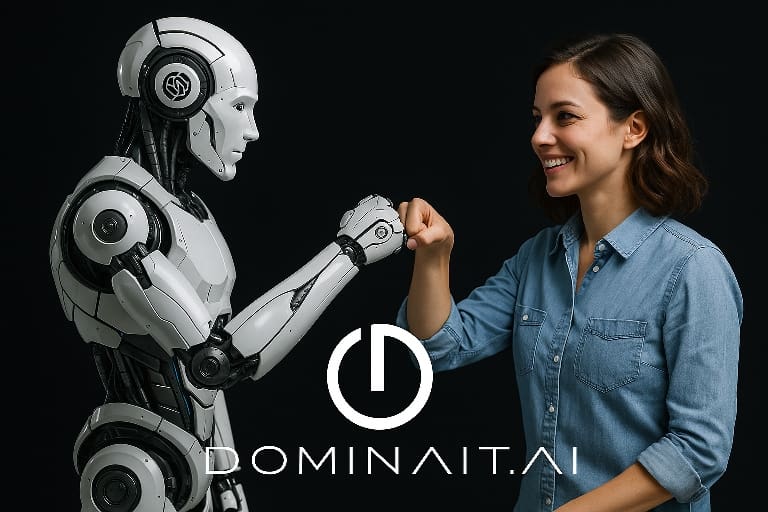
If you’re scanning the AI field right now, you’ll see full pages of capital, data centers, GPUs, and big announcements. But ask yourself: how many of those dollars are earning you money today? How many of those initiatives give you a handshake with a partner and not just another vendor? How many place human success at the center, and not as an afterthought?
In the words of Jason:
“We don’t need slaves. We need partners. We don’t need obedient programs. We need thinking allies.”
I’ve followed enough founders to recognize when someone is thinking a cycle ahead. This is what I believe Jason and his team have done. The hype may swirl. The bubble may stretch. But when the foundation is laid, the repayment begins. And that’s why I, for one, cannot wait to see Ryker move from vision to reality, for entrepreneurs to deploy it, for investors to participate, and for business owners to finally gain an AI partner that earns-its-keep and increases productivity over hype.