
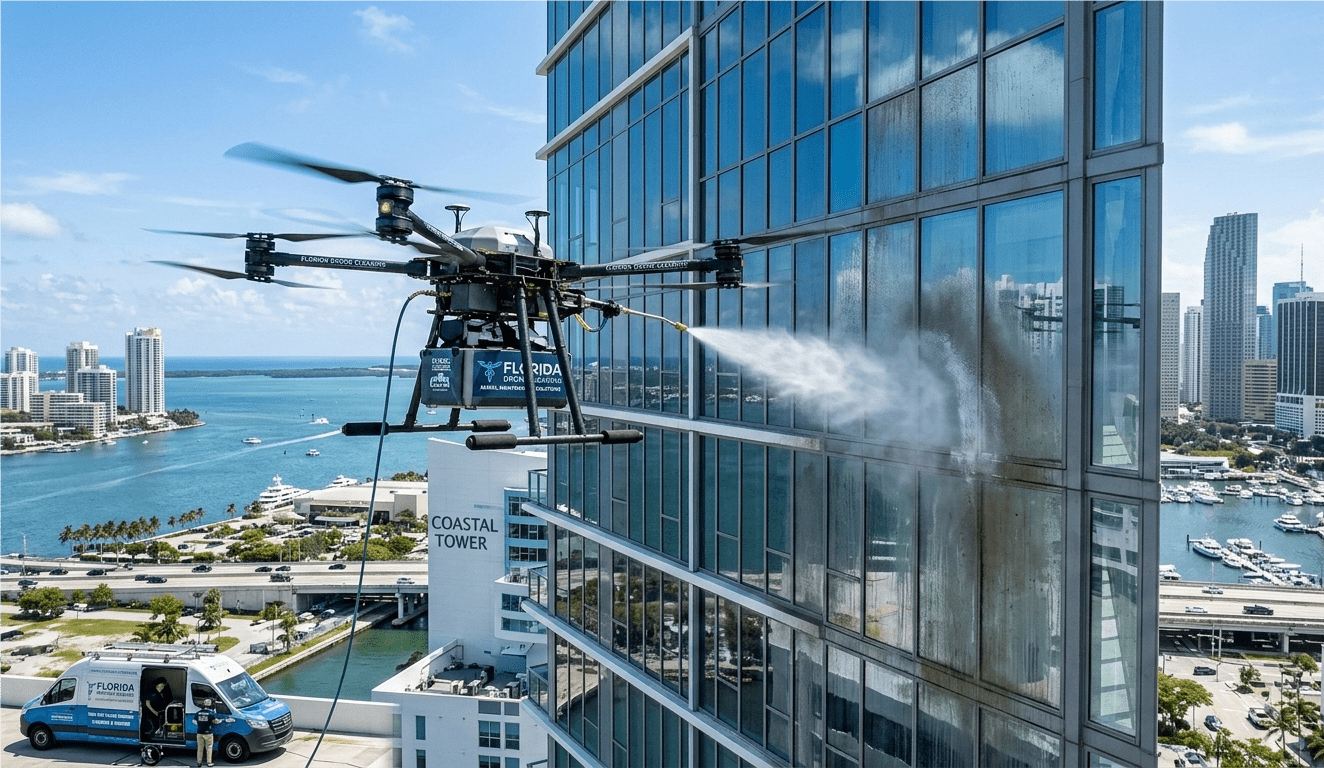
Florida’s got a reputation for being tough on building exteriors. The salt air that rolls in from the coast, the sticky humidity, the sudden downpours that bring the mold and mildew of course – buildings here get worked over pretty hard. Property managers & facility teams live & breathe this stuff. Keeping a commercial building spick & span in Florida isn’t just a nicety – it shows up in tenant satisfaction & property values, not to mention the long-game cost of ownership. And increasingly, the question is – how do you do it all without breaking the bank.
For years, the answer was: scaffolding, rope access crews & a whole lotta disruption. But that’s no longer the case. Florida drone cleaning has turned out to be one of the smartest shifts in commercial building maintenance we’ve seen in a while – & property managers who’ve made the switch won’t be going back.
The Trouble with Old-School Maintenance
Before drones came along, cleaning the outside of a mid-rise or high-rise commercial building in Florida meant living with some compromises. Scaffolding needed permits, took days to set up and knock down, & blocked building access for tenants & visitors while it was up. Rope access crews were a bit quicker, but introduced some real safety risks – & in a state like Florida, where liability’s taken super seriously, that comes with a price tag that’s more than just the obvious.
The weather was another variable. Florida’s afternoon storms could shut down an exterior job mid-day, extending timelines and jacking up costs. And for buildings in places like Miami, Fort Lauderdale, or Tampa, where the salt & humidity really pile up, the maintenance cycle was a never-ending battle – clean it now, & the conditions that get it dirty are already back at it again tomorrow.
Drone window cleaning tackles these pain points in one go. Drones equipped to handle high-pressure washing & specialized soft-wash attachments can reach every part of a building – windows, facades, rooflines – without all the scaffolding, rope-access crews & permit delays that come with the old way. A job that used to take all week can now get done in a fraction of the time, with the building staying fully operational all the while.
What Commercial Drone Technology Actually Does
Its worth being quite specific about what modern commercial drone technology is all about, because the field has progressed a lot further than most people’s initial idea of drones.
Commercial infrastructure cleaning, like those in use by various operators across South Florida, carry powerful high-pressure washing setups that can unleash a lot of water pressure at heights, without the need for ladders. They’re also equipped sensors & cameras that monitor the process in real time, spot areas needing a closer look and highlight potential surface damage before its too late. There are a couple of hundred & eighty two thousand registered drones and Four Hundred and Sixty Thousand and 375 certified remote pilots now on the FAA books in the United States – & commercial cleaning is turning out to be one of the fastest growing areas in that whole ecosystem.
Before a job even starts, operators typically fly over the building to get a good look , using a separate video drone to map the building out & come up with a site plan. This pre-job assessment helps identify any problems with access, the state of the surface and any areas that need special care – so the cleaning crew turns up with a clear game plan rather than having to improvise at height. This makes things a lot more predictable for building owners & means fewer surprises on the bill.
The Florida Climate Case for Commercial Infrastructure Cleaning
Florida’s environment not only makes buildings dirty , it actually accelerates the degradation of building materials over time. Algae, mold & mildew don’t just look bad – they work their way deep into facade materials, caulking & window seals, speeding things up & driving repair costs through the roof. Salt air corrosion on coastal properties makes matters even worse.
This is where using commercial drone cleaning makes a real case that goes beyond being convenient. Regular, thorough exterior maintenance doesn’t just keep a building looking neat – it actually protects the building envelope, extends the life of facade materials & lets you catch any deterioration early before its a major problem. The global market for commercial exterior cleaning is now worth over a billion dollars a year, and Florida is one of the most active markets within it – driven by the climate conditions that make regular maintenance a non-negotiable.
The economics of using drones for cleaning also stack up pretty well. No more scaffolding costs, permit fees or labor costs from other access methods, so the per-clean cost comes down significantly. For property managers running lots of buildings or managing big commercial complexes, the savings from a maintenance program add up fast.
What the Shift Looks Like in Practice
The shift to using Florida drone cleaning isn’t happening all at once but its definately gaining pace. Traditional pressure washing companies across the state are starting to add drone capabilities to what they do. New operators are even setting up businesses specifically around exterior maintenance using drones.
Property management firms that manage big commercial portfolios are making drone cleaning a regular part of their maintenance routine, no longer treating it as some kinda novelty. The FAA’s rules for commercial drone use are also getting a lot clearer, with more guidance on how drones can be used in the city, how much weight they can carry, and what safety precautions need to be taken – all of which is making big clients feel a lot more confident that they’re hiring a legitimate, top-notch operator.
For Floridas commercial property market commercial building cleanups by drone is no longer some trend that’s worth watching – its just the standard that’s now being set – and the buildings that keep looking the best, cost the least to keep up, and hold their value better over time are going to be the ones that got in on this early.
