
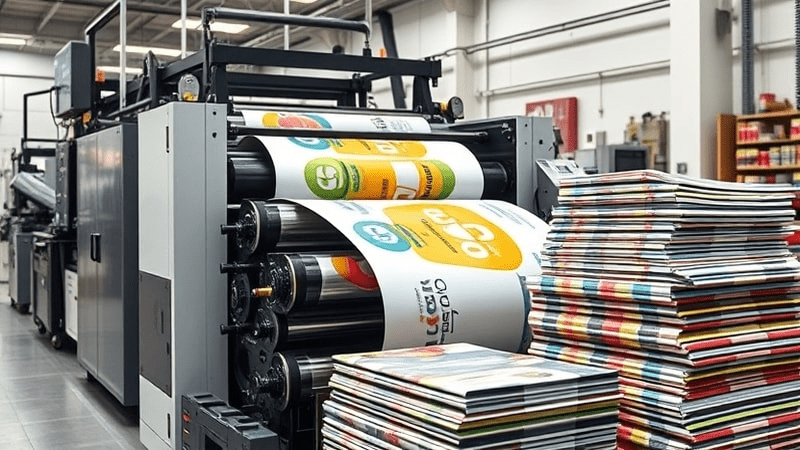
The printing industry needs both cost-effective and efficient solutions today, and flexo printing has proved to be one of the most reliable technologies. This technology is fast and widely used in industrial packaging and label production. Low production costs place it among the cost-effective printing solutions.
Flexography works effectively on a variety of substrates. It is considered the most practical printing method for large orders, and, in a rapidly changing market, it offers both durability and quality. In short, this technology saves time and resources.
A Brief About the Technology
Flexography or flexo printing is basically a high-speed rotational printing technology. Flexible plates made either of rubber or polymers are used that support printing in large volumes. The inks used dry up fast, thereby saving time.
A Brief on the Background
Flexography or flexo printing dates back to the 19th century. It evolved at a rapid pace compared to other regular printing procedures. In fact, by the 1970s, it had become the most predominant technology used in the printing industry.
It was called “aniline printing” initially but it expanded with improved color quality. Typically, automation has increased its speed and offered alternatives to offset printing paper. Furthermore, the use of environmentally friendly inks modernized it. It is now a key component of global printing solutions.
A Look Into Its Structure
The technical structure or mechanical system of Flexo printing is unique. It consists of an advanced roller system that promotes fast and accurate transfer of fast-drying ink by the Anilox roller. Ideally, the structure consists of four fundamental parts, such as the:
- Plate
- Anilox roller
- Impression cylinder, and
- Ink system.
Automatic controls maintain uniform prints and reduce costs.
The Secret to Cost-Balancing for Large Productions
The objective of every business is to produce more at lower costs, and Flexo printing brilliantly implements this principle. Flexo printing maintains quality at a low cost at high volumes. Ideally, there are a few factors that extend the output reliability and durability of Flexo printing, such as:
- The quality of the equipment
- Ink viscosity control, and
- Precise mechanical adjustments.
Also, plate production costs are one-time, not recurring and consistent production speed reduces costs. Additionally, reduced wastage saves resources, machine downtime is minimal, and print costs per unit are lower than those of other technologies. Typically, the savings are multifold with long-term orders. All these factors make it the best-suited technology for cost-effective printing solutions.
Versatile Material Support
Ideally, Flexo printing’s greatest strength is its versatile substrate use. It is suitable for paper, plastic, metal foil, and fabric. Ink selection is based on the material.
It has extensive use in the food packaging industry, mainly due to its versatile applicability and the water-based ink usage that guarantees secure prints. The quality is consistent, and the prints are durable even on see-through films.
Ecological Significance
Flexo printing contributes to the goal of sustainable and green production. There is no risk of chemical reaction due to the water-based inks used, and less waste production reduces environmental impact.
The technology promotes green printing with the use of recyclable materials, and energy efficiency is ensured with the use of advanced equipment. This technology complies with environmental standards and is a suitable choice for green brands. Sustainability makes it an environmentally friendly form of cost-effective printing solutions.
Printing Speed and Efficiency
Fast production is the hallmark of Flexo printing technology, as the advanced machines can run at high speeds continuously. Also, reduced setup times accelerate production and make large-volume printing seamless.
Flexo printing is suitable for industrial production since speed is maintained without compromising quality. Automatic controls ensure stable output, and the process produces higher output with less labor. Ideally, its speed makes it a cost-effective printing solution.
A Varied Application
This cost-effective printing solution is used across a wide range of industries over and above packing purposes, including and not limited to labelling and advertising in:
- The food and beverage industry
- The pharmaceutical industry
- In consumer goods’ wrapping papers
- In making tags for clothing brands
- E-commerce packaging
- Large advertising banners.
Ideally, it is a stable technology for industrial printing, which is mainly due to its versatility.
Conclusion
In conclusion, Flexo printing has revolutionized mass production. Its stability, speed, and cost-effectiveness make it the preferred choice for every modern industry. It is a truly reliable and cost-effective printing solution that provides industries with both efficiency and quality.
This technology has become a symbol of production efficiency, with maintaining quality at high volumes its key advantage. Profits can be increased by reducing labor costs and so its demand is rapidly growing in modern industries. Flexo printing is a sustainable option for every business in the Middle East, and its technical flexibility benefits brands.