
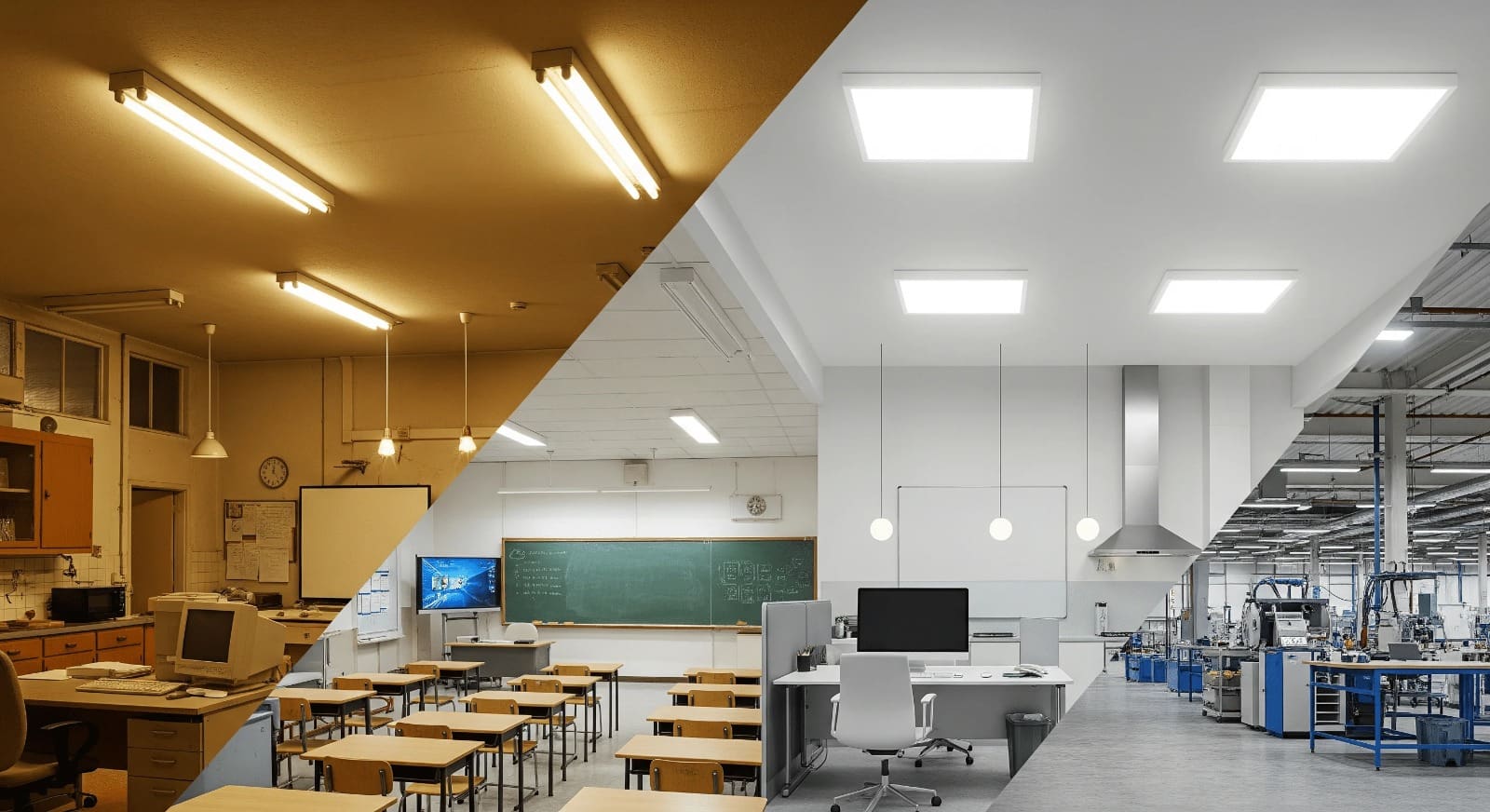
Choosing the correct ceiling lighting will affect the comfort of your home, its energy costs and the safety of your home. Classic options like fluorescent troffers fluorescent bulbs and halogen lamps as well as metal halide fixtures are still popping all over the place. Contemporary LED Flat Panels offer silent operation, smooth dimming, and easy maintenance. This article compares the two approaches as well as a discussion of where each one fits with the other, and offers a helpful guideline to buy without hesitation.
How LED Flat Panels Work (and Why It Matters)
Flat panels provide a large and even “sheet” of illumination. Two standard designs power the majority of the available options:
- Edge‑lit panels place LEDs around the edges and guide light through a diffuser. Profiles stay thin and sleek.
- Backlit panels mount LEDs directly behind the diffuser for strong, uniform output and lower risk of yellowing.
Both styles support 0–10V or DALI dimming, selectable CCT (e.g., 3500/4000/5000K), and wattage‑adjustable settings. Higher CRI options improve color rendering for retail and healthcare. Look for low‑glare lenses and UGR‑conscious designs in offices to reduce eye strain and screen reflections.
| Factor | LED Flat Panels | Fluorescent Troffers | Incandescent/Halogen | Metal Halide (MH) |
| Energy Use | Lowest for comparable output | Moderate | Highest | High |
| Lifespan | Long (often 50k–100k hrs) | Medium | Short | Medium |
| Maintenance | Minimal | Lamp/ballast changes | Frequent lamp changes | Long warm‑up, periodic relamping |
| Light Quality | Uniform, low flicker | Can flicker, uneven aging | Warm but inefficient | Good output, slow warm‑up |
| Dimming | Excellent with proper drivers | Limited/extra hardware | Possible but inefficient | Limited |
| Noise | Silent | Ballast hum possible | Quiet | Ballast buzz possible |
| Environmental | No mercury | Contains mercury | No mercury | No mercury |
| Upfront Cost | Moderate | Low | Low | High for fixtures |
Homeowners & Residential
Finished basements, kitchens, hobby rooms, and garages benefit from thin, surface‑mount flat panel lights. They spread light evenly without hot spots. Select the tunable white that can change between the warm families time and sharp job illumination. Pair with triac or dimmers with 0-10V ratings for LEDs, to reduce flicker.
Business & Commercial Property Owners
Panels drop into 1×4, 2×2, or 2×4 grid ceilings and integrate with sensors for occupancy and daylight harvesting. Building owners appreciate DLC‑listed models that qualify for utility rebates. Low‑glare optics and high CRI improve productivity and merchandising while lowering total cost of ownership.
Public Sector & Municipalities
City offices, libraries, and schools often face tight budgets. Panels reduce maintenance truck rolls and simplify procurement. Standardize on a few CCT/wattage‑selectable SKUs to streamline inventory. Add emergency battery packs where egress codes require backup illumination.
Industrial & Construction
Factories, warehouses, and job sites can be harsh. Many locations need high‑bay or vapor‑tight luminaires rather than panels. Where ceilings use T‑grid offices or QC labs, panels still fit. Check voltage compatibility (120–277V or 347/480V derivatives), IP ratings, and ambient temperature ranges before ordering.
Sports & Recreation Facilities
Locker rooms, offices, and corridors work well with flat panels. Courts, rinks, and large arenas typically require high‑bay or purpose‑built sports lighting for throw distance and glare control. Look for flicker‑free drivers if events are recorded or live‑streamed.
Event & Entertainment Industry
Studios, rehearsal spaces, and production offices value silent drivers and smooth dimming. Tunable white supports mood changes between rehearsals and client walk‑throughs. For stages and black‑box theaters, combine panels for back‑of‑house areas with DMX‑controlled fixtures on stage.
Agricultural Users
Barn offices, packing rooms, and equipment sheds suit panels when environments stay relatively clean and dry. For high moisture, dust, or chemicals, pick sealed, IP‑rated LED alternatives. Choose neutral CCT for task areas and verify lens materials against ammonia or cleaning agents.
Buying Checklist
- Form Factor: 1×4, 2×2, or 2×4; surface‑mount kits for hard ceilings.
- Optics: Low‑glare lens, uniform diffusion, UGR‑aware designs for offices.
- Performance: High efficacy (lm/W), ≥80–90 CRI options, stable output.
- Controls: 0–10V or DALI dimming; sensor‑ready; networked controls capable.
- Flexibility: CCT‑selectable and wattage‑adjustable SKUs simplify stocking.
- Compliance: DLC Standard/Premium, UL/ETL, RoHS, and local code alignment.
- Power & Voltage: 120–277V standard; verify 347/480V if needed.
- Durability: Rated temperature range, surge protection, quality driver.
- Safety & Backup: Emergency battery compatibility where code requires it.
- Warranty: 5–10 years from reputable manufacturers.
Simple Snapshot
Imagine replacing four 2×4 fluorescent troffers in a small office. Older three‑lamp T8 troffers often draw around 96–110W each including ballast. A quality LED flat panel may use 35–50W for similar brightness. Saving 60W per fixture yields 240W across four panels. With 3,000 hours of yearly use, that’s about 720 kWh saved. At $0.15/kWh, the annual savings approach $108, plus avoided relamping and ballast service. Multiply across a floor or campus and payback tightens quickly especially when utility rebates offset upfront cost.
Installation and Compatibility Tips
Panels slide into grids of T-bar ceilings with no any hassle. Ceilings with hard surfaces require a surface-mount as well as a suspender kit. Dimming needs control wiring for 0-10V. Plan cables before ceiling construction begins. Retrofit projects often use branch circuits. Verify loads calculations as well as circuit labeling. If you are building smart, verify that the circuit is compatible with your BMS or light control system.
Health, Comfort, and Sustainability
LED panel lights avoid mercury and reduce waste by eliminating frequent lamp changes. Good drivers minimize flicker, and diffusers create soft, uniform light that’s easy on eyes and screens. Choose neutral cool CCT for more detailed work or to tune the temperature to be warmer for both residential and hotel relaxation. Lower energy consumption also reduces carbon emissions while also supporting the organization’s sustainable targets.
Where to Buy LED Flat Panels
If you’re ready to upgrade your lighting system, choose high-quality, energy-efficient LED flat panels from a trusted source. At Super Tech Lights, you’ll find a wide range of premium LED flat panel lights designed for homes, offices, warehouses, schools, and commercial buildings. Each product is engineered for long lifespan, uniform brightness, and easy installation helping you reduce energy costs while enhancing visual comfort. Explore the collection today and discover lighting solutions that combine modern design with unbeatable efficiency.
FAQs
1.) Do LED flat panels worth the cost for small houses or offices?
Yes. The energy savings, the silent operation as well as dimming, provide peace of mind and have predictable costs. The lower cost of maintenance is great for households and teams that are busy.
2) What size should I choose 1×4, 2×2, or 2×4?
The size should be matched to the ceiling grid and lighting levels. The larger panels can spread light further and may decrease the amount of fixtures that are in areas with open spaces.
3) Edge‑lit or backlit what’s the difference?
Edge‑lit units are super thin and stylish. Backlit versions often provide robust uniformity and can handle higher output efficiently.
4) Do LED flat panels flicker?
Quality drivers are designed for low flicker. Pair the panel with compatible dimmers and controls to maintain smooth, stable light.
5) Can I get warm, neutral, and cool light from one panel?
A lot of models have a selectable CCT options. You can set the temperature at the time of installation or change it later depending on the job or the mood.
6) How long do panels last?
You can expect rated life spans of between 50,000 and 100,000 hours, based on the quality of your driver as well as heat management and the operating conditions.
7) Are rebates available?
Most utilities promote efficient lighting. DLC‑listed products typically qualify for incentives that improve payback.
8) What about emergency lighting?
Look for units or kits with battery backup to meet egress requirements in corridors and exit pathways.