
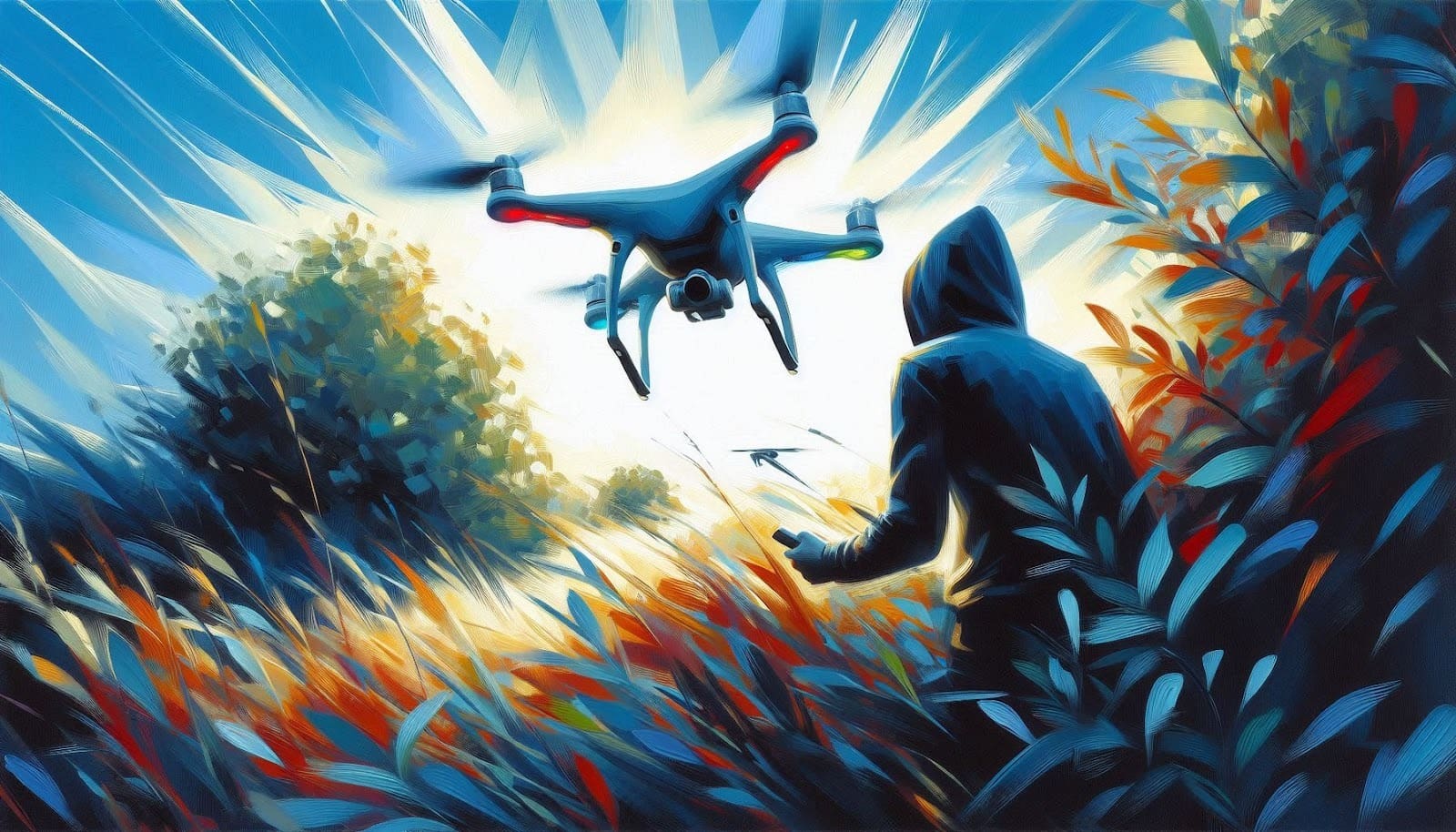
How thermal imaging and real-time aerial surveillance are closing the gaps in traditional ground searches.
WASHINGTON, DC.
The most dramatic change in modern manhunts is not louder sirens or bigger task forces. It is quiet, persistent, and often invisible to the people on the ground.
It is the hum of a small aircraft that does not need a runway, does not need a pilot in a cockpit, and increasingly does not need a long setup time. Autonomous and semi-autonomous drones, equipped with thermal sensors and stabilized cameras, are becoming the fastest way for police to turn a sprawling search area into a manageable box.
This is not science fiction. It is the logical result of two overlapping realities. First, departments face staffing shortages and rising demand for rapid response. Second, consumer drone technology matured so quickly that tools once reserved for militaries and specialized units can now be fielded by local agencies, sometimes as part of routine patrol and sometimes as a first response to urgent calls.
Recent reporting has captured how quickly this shift is spreading, noting that police and sheriff’s departments across the U.S. are using AI powered drones for pursuits, investigations, and emergencies, including autonomous deployments in some jurisdictions and thermal imaging that has already proven useful in difficult conditions, as described in this Axios report on the expansion of law enforcement drone programs and the policy debates following close behind: Central Ohio police use drones for rescues, pursuits and more.
The new reality is simple. Ground searches used to be limited by human eyesight, flashlight beams, and the time it takes officers to physically sweep an area. Drones compress that timeline. They also change the psychology of a search, because the suspect is no longer only running from people. They are running from a moving sensor platform that can arrive in minutes, hover quietly, and feed live intelligence to teams below.
What is equally important, and increasingly contested, is what happens when this same capability becomes normal rather than exceptional.
From helicopter era to drone era
For decades, the image of a manhunt was tied to helicopters. A helicopter gave police altitude, a spotlight, and a camera. It also came with major limitations: high cost, limited availability, noise, weather restrictions, and the blunt reality that many agencies do not have air support at all.
Drones do not replace helicopters in every scenario. But they fill the gap that most communities have lived with for years, the space between ground officers and air units. They provide eyes in the sky at a fraction of the price, with a smaller footprint, and increasingly with the ability to launch quickly from a patrol vehicle or a centralized operations site.
This is why the phrase “drone as first responder” keeps showing up in public safety discussions. The idea is operationally appealing. When a call comes in, a drone can be dispatched to provide real-time aerial context before officers arrive, identifying hazards, mapping a search area, or tracking movement in open environments.
Autonomy adds another layer. In practice, autonomy usually means something narrower than the public imagines. It can mean automated takeoff and landing. It can mean preprogrammed routes. It can mean a drone that can hold position, track objects, and return home if it loses signal. Even these partial forms of autonomy matter in a manhunt because they reduce the workload on operators and keep the drone in the air longer and more consistently.
Thermal imaging closes the night gap
Traditional searches struggle at night. Darkness collapses visibility, increases the chance of missteps, and slows decision-making. Officers can bring lights and dogs, but the search footprint remains limited by terrain and human perception.
Thermal sensors shift that balance. Heat signatures can make it easier to differentiate a living body from background features in many conditions, especially when temperatures drop and the environment cools. That capability is one reason drones have become attractive not only for enforcement but also for rescue operations, when time and visibility are limited.
The practical point is not that thermal imaging is magical. It is that it changes the odds. It can reduce the area that must be searched blindly. It can help teams decide where to focus. It can also reduce the need to send officers into uncertain terrain without information.
From a public safety perspective, this is one of the strongest arguments for drone use. It can improve situational awareness and reduce risk to both officers and bystanders.
From a civil liberties perspective, it raises uncomfortable questions about how often and how broadly these tools should be used, especially when the target is not a violent suspect and the surveillance may include people who are not involved at all.
The real shift is the network, not the drone
A drone on its own is a camera in the air. A drone connected to modern policing infrastructure is something else.
Many agencies are building or expanding real-time crime centers and centralized operations hubs where video feeds, incident data, and field reports can be viewed together. In that environment, a drone is not just an aircraft. It is a node in a larger intelligence loop.
That loop can look like this: a call comes in, a drone launches, live video streams to a central team, that team relays observations to officers on the ground, and decisions are made in near real time. Even when the drone is not fully autonomous, the system begins to behave as if it is, because the drone’s output is instantly integrated into the broader operational picture.
This is where manhunts become faster, not because drones can do everything, but because drones reduce uncertainty. They help ground teams stop guessing.
Why drones are changing the economics of pursuit
Manhunts are resource-heavy. They are labor-intensive. They also burn time fast, and time is often the decisive factor in whether a search ends safely.
Drones alter the economics. They can be deployed repeatedly without the fuel and staffing costs of aviation units. They can be repositioned quickly. They can expand search coverage without expanding the number of officers required for a sweep.
That shift matters in smaller departments that rarely had meaningful air support. It also matters in large cities where staffing shortages have put pressure on response times. Drones can be sold politically as efficiency, a way to do more with less.
The risk is that the promise of efficiency can normalize surveillance, turning an “exceptional tool for exceptional cases” into a routine layer of policing.
The policy problem, a manhunt tool can become a general surveillance tool
The ethical and legal debate around police drones is not really about drones. It is about scope.
When drones are used for a missing child search, most people see the value. When drones are used for a violent suspect who fled into wooded terrain, many people still see the value. But when drones are used routinely for lower-level incidents, neighborhood patrols, or broad monitoring, the public mood can shift quickly.
This is why drone policy is becoming as important as drone hardware. Communities want to know what triggers a launch, how long footage is stored, who can access it, and whether drones can be used over private property without a warrant.
Aviation regulation also sits in the background of every conversation. Regardless of the policing use case, drone operations exist within a national airspace framework, and those rules shape how and where public safety agencies can operate unmanned aircraft systems, including training, operational constraints, and waivers for certain missions, as outlined by the Federal Aviation Administration on its UAS information hub at faa.gov/uas.
The consequence is that the future of drones in manhunts will not be decided only by technology. It will be decided by governance, policy clarity, and public trust.
Autonomy does not remove humans; it reshapes accountability
The word “autonomous” can sound like a drone making its own decisions. In public safety practice, humans still set objectives and retain responsibility, but autonomy can blur accountability if policies are not explicit.
If a drone is dispatched automatically to the coordinates of a 911 call, who authorizes that dispatch? If the drone’s onboard analytics flags something as suspicious, how is that interpreted by officers in a high-adrenaline moment? If a drone’s footage is used later to justify a search or an arrest, how is the reliability of what was captured evaluated?
These questions matter because manhunts are high-stress events. They are also moments when mistakes can become tragedies. A tool that increases speed must also increase discipline, because speed without discipline can magnify harm.
The civil liberties tension, closing gaps can widen nets
There is a core tension at the heart of the “eyes in the sky” era.
Drones can close the gap between a suspect and the officers searching for them. They can also widen the net around everyone else.
A drone’s camera does not only see the target. It sees neighbors. It sees bystanders. It sees private spaces incidentally. It can map movement patterns in a way that feels fundamentally different from an officer walking a street.
That is why drone debates often pivot to retention and secondary use. It is one thing to use a drone feed for immediate safety decisions in a contained incident. It is another thing to store footage, index it, and use it later for unrelated investigations or to combine it with other datasets.
Communities that accept drones for manhunts may not accept drones as a permanent aerial layer of policing. The difference is mission creep, and mission creep is the moment when trust breaks.
The human factor, drones shift behavior on both sides
Manhunts have always been psychologically intense, for officers and for suspects. Drones intensify that in a particular way.
For officers, drones can reduce fear by reducing uncertainty. They provide clarity about terrain, movement, and hazards. That can reduce the odds of a chaotic encounter.
For suspects, drones can create the feeling of being hunted constantly, even when officers are not nearby. That matters because stress changes decision-making. People under stress make riskier choices. They also panic.
From a public safety standpoint, this is a double-edged dynamic. Better information can reduce the need for force. Increased panic can increase the risk of unpredictable behavior. The best outcomes often come when drone use is paired with disciplined command decisions and clear de-escalation protocols.
The compliance perspective: Technology makes “inconsistency” easier to spot
While the public debate tends to focus on aircraft in the sky, many modern manhunts are solved through the combination of aerial tools and administrative reality. People leave trails because life requires contact with systems.
That is why compliance-minded observers often argue that the enforcement environment is increasingly defined by verification, not just pursuit. When institutions, from landlords to banks to travel operators, demand consistent identity narratives, “inconsistency” becomes a signal that can draw attention even before a fugitive is physically located.
Amicus International Consulting has emphasized in its public analysis that high scrutiny environments reward documented continuity and penalize improvised identity footprints over time, a framing that connects directly to the way modern policing tools now integrate air, data, and verification into a single operational picture, as discussed in its broader risk commentary at www.amicusint.ca.
The implication is not that technology eliminates the human element. It is that technology makes the consequences of human needs and human mistakes arrive faster.
Where this goes next
The next phase of drone use in manhunts is likely to be defined by three forces.
First, deployment speed. Drones that can launch quickly, route efficiently, and stream reliably will become default tools in more jurisdictions, especially where helicopters are scarce.
Second, policy. Public trust will hinge on clear rules about when drones can be used, what they can record, how long data is retained, and what oversight exists when misuse is alleged.
Third, transparency. Communities are increasingly skeptical of surveillance tools that expand quietly. Agencies that treat drones as a public safety tool and are willing to explain the boundaries clearly will have more durable legitimacy than agencies that treat drones as a quietly expanding capability.
The bottom line
Autonomous drones are reshaping modern manhunts because they solve a basic problem that has always haunted ground searches: uncertainty.
Thermal imaging can narrow the search area. Real-time aerial feeds can reduce guesswork. Rapid deployment can compress timelines. Together, those capabilities can help close gaps that used to be filled by long, risky sweeps in darkness or rough terrain.
But the same tools that make searches more efficient also raise a larger question that 2026 policing cannot avoid.
If we put eyes in the sky, who decides when they look, where they look, and how long they remember what they saw.
