

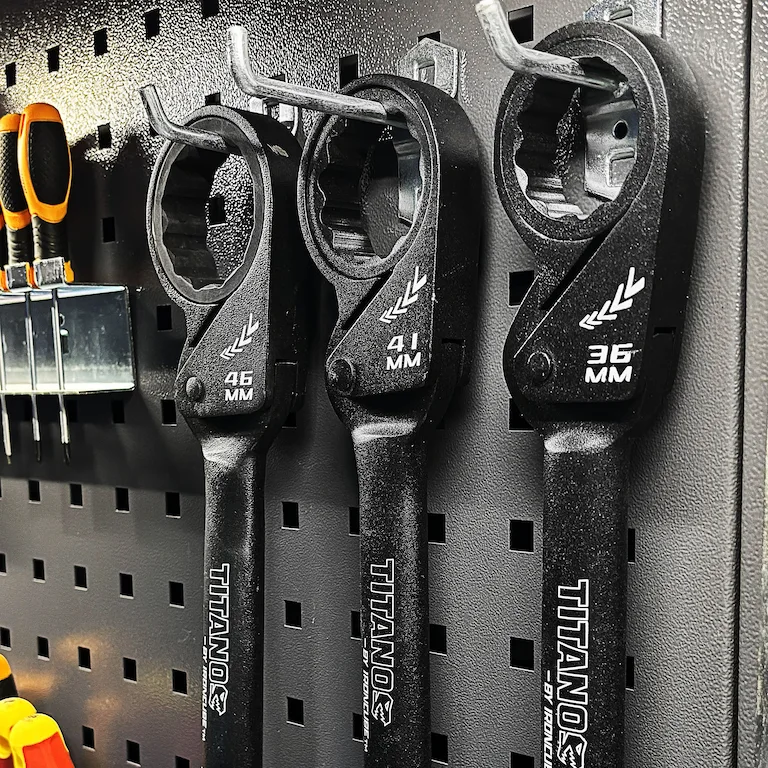
If you have ever tried to loosen a rusted 1-1/2 inch flange bolt with a standard combination wrench, you already know the frustration. Your knuckles slam into adjacent pipe, the wrench slips, and the bolt barely moves. That scenario plays out every day on oil rigs, in fleet maintenance bays, and across heavy-equipment yards. The solution is deceptively simple: extra large ratcheting wrenches built specifically for industrial torque demands.
These oversized tools combine the mechanical advantage of a long handle with a ratcheting mechanism that eliminates the constant lift-and-reposition cycle of open-end wrenches. For diesel technicians, pipe fitters, structural ironworkers, and plant maintenance crews, they are not a luxury — they are a productivity requirement. According to IMARC Group, the global hand tools market was valued at approximately USD 27.6 billion in 2025, and wrenches alone account for roughly 34 percent of that total. That dominance is no accident; wrenches remain the most universally needed hand tool in professional trades.
In this guide we will walk through what makes extra large ratcheting wrenches different from standard sets, which features matter most on the job, and how to choose the right kit for heavy-duty applications. We will also compare popular size ranges, highlight the materials and tooth counts that separate professional-grade tools from bargain-bin junk, and point you toward reliable options from IRONCUBE Works that are purpose-built for industrial work.
What Qualifies as an Extra Large Ratcheting Wrench?
Standard ratcheting wrench sets typically top out at 3/4 inch or 19 mm. Anything above that threshold generally falls into the “extra large” or “jumbo” category. Industrial-grade sets often start at 1-1/16 inch and climb to 1-1/2 inch, 1-5/8 inch, or even 2 inches. The corresponding metric range usually spans 25 mm to 50 mm.
Size alone does not tell the whole story, though. A true industrial extra large ratcheting wrench differs from a standard wrench in at least three critical ways. First, the handle is longer — often 18 to 24 inches — to provide the leverage needed for high-torque fasteners without a cheater bar. Second, the head geometry is thicker and reinforced at the stress points where the ratchet mechanism meets the beam. Third, the steel itself is a higher grade, typically chrome vanadium (Cr-V) or chrome molybdenum (Cr-Mo), heat-treated to resist deformation under sustained load.
If you need a quick orientation to jumbo wrench options, the extra large heavy-duty ratcheting wrenches page at IRONCUBE is a solid starting point.
Why Industrial Crews Need Extra Large Ratcheting Wrenches
Torque Without the Fatigue
Loosening and tightening large fasteners is physically punishing work. A standard 12-inch wrench on a 1-1/4 inch bolt demands enormous grip force and repeated repositioning. Ratcheting mechanisms eliminate the need to remove and reset the wrench after every partial turn. Research into ratcheting systems indicates they can reduce wasted motion by 60 to 70 percent compared to conventional open-end wrenches, according to analysis published by Tomac Tools. Over an eight-hour shift, that translates into meaningfully less strain on wrists, forearms, and shoulders.
Tight-Space Access
Engine bays on Class 8 trucks, flanged pipe assemblies, and structural steel connections rarely offer generous swing room. Extra large ratcheting wrenches with tooth counts of 72 or higher need as little as 5 degrees of arc to re-engage the fastener. That narrow swing arc is the difference between finishing a job in position and having to disassemble surrounding components just to reach a bolt.
Faster Turnaround on Fleet and Plant Maintenance
Downtime costs money. In a trucking fleet, every hour a rig sits idle can represent hundreds of dollars in lost revenue. Extra large ratcheting wrenches let technicians work faster because the ratcheting action keeps the socket or box end seated on the fastener through continuous motion. Combined with the leverage of a long handle, these tools shave minutes off each fastener — and minutes add up across a full brake job, suspension overhaul, or pump rebuild.
Key Features to Evaluate Before You Buy
Material and Heat Treatment
Chrome vanadium steel (Cr-V) is the baseline for professional-grade wrenches. It offers a good balance of hardness, toughness, and corrosion resistance. For the highest torque applications — think oil-field flanges or mining equipment — chrome molybdenum (Cr-Mo) provides additional tensile strength. Regardless of alloy, look for wrenches that are through-hardened and tempered rather than only surface-hardened. A wrench that is hard on the outside but soft inside can crack under sudden shock loads.
Tooth Count and Swing Arc
The tooth count of the ratcheting mechanism directly affects how much handle travel is required per click. Here is a practical comparison:
| Tooth Count | Swing Arc | Best For | Trade-Off |
| 36 teeth | 10° per click | Open-space heavy torque | Wide arc needed |
| 72 teeth | 5° per click | General industrial use | Good balance |
| 90 teeth | 4° per click | Tight-space precision | Slightly less torque capacity |
| 120 teeth | 3° per click | Ultra-confined areas | Finer teeth, higher cost |
For most industrial applications, 72 teeth is the sweet spot. It provides a 5-degree swing arc — tight enough for the majority of confined work — while retaining large, durable teeth that stand up to repeated high-torque loading. The large ratcheting wrench set from IRONCUBE uses this tooth count to balance precision and strength.
Friction Fit vs. Spring-Loaded Retention
On extra large ratcheting wrenches, keeping the box end seated on the fastener is crucial. Some models use a spring-loaded ball detent inside the box end to grip the bolt head. Others rely on a friction-fit design with tighter tolerances. Friction-fit wrenches tend to hold fasteners more securely during vertical or overhead work — a real advantage when you are reaching above your head to turn a flange bolt. The IRONCUBE Jumbo Friction Ratcheting Wrench on Amazon is specifically engineered with this friction-fit mechanism to prevent drop-offs during overhead industrial work.
Handle Design and Grip
Ergonomics matter more than most buyers realize. A polished chrome handle looks clean, but it can be dangerously slippery when covered in oil or hydraulic fluid. Look for wrenches with a satin or matte finish, knurled grip zones, or contoured beam profiles that nestle into the palm. Some manufacturers add a slight offset angle — 10 to 15 degrees — between the head and handle to provide knuckle clearance against flat surfaces.
Extra Large Ratcheting Wrenches vs. Standard Box-End Wrenches
Why not just use a regular box-end wrench and a pipe extension for leverage? It is a fair question, and the answer comes down to efficiency and safety.
A standard box-end wrench requires lifting the tool off the fastener after every partial turn — typically 30 to 60 degrees of rotation — then resetting and pulling again. On a 1-1/4 inch bolt that needs 15 full turns to remove, that means 90 to 180 individual lift-reset cycles. Extra large ratcheting wrenches cut that number to zero because the ratcheting mechanism allows continuous back-and-forth motion without lifting.
As for the cheater bar approach, extending a standard wrench with a pipe creates an unpredictable lever that can flex, slip, or break. Industrial safety programs actively discourage the practice because it voids the wrench manufacturer’s torque rating and introduces a serious pinch-point hazard. A purpose-built long-handle ratcheting wrench delivers the same leverage within a controlled, rated tool.
For a deeper comparison between ratcheting and traditional styles, the best large ratchet wrench guide on the IRONCUBE blog breaks down the pros and cons in detail.
Common Industrial Applications
Diesel Engine and Heavy Truck Maintenance
Turbocharger housings, exhaust manifold studs, and driveshaft U-bolt nuts on Class 6 through Class 8 trucks routinely require wrenches in the 1-1/16 to 1-1/2 inch range. The confined engine bays on modern emissions-compliant trucks make ratcheting action essential. Many diesel mechanics consider a jumbo ratcheting set their most-used specialty tool. If you work on heavy rigs, the best heavy-duty ratcheting wrench for diesel mechanics article offers targeted recommendations.
Oil, Gas, and Petrochemical Plants
Flanged piping connections in refineries and processing plants use bolt sizes that start where most wrench sets end. Stud bolts on ASME Class 150 flanges in 8-inch pipe, for example, take a 1-1/8 inch wrench. Higher-pressure ratings push into 1-1/4 inch and beyond. Plant turnaround crews work against tight outage schedules, and extra large ratcheting wrenches help them hit those deadlines.
Construction and Structural Steel
High-strength structural bolts — A325 and A490 grades — in sizes from 7/8 inch to 1-1/2 inch hold together steel beams, moment connections, and bridge girders. Ironworkers need tools that deliver controlled torque at height, often while wearing heavy gloves. A ratcheting wrench with a secure friction fit and a long handle is one of the safest ways to snug those bolts before final tensioning with a calibrated tool.
Mining and Heavy Equipment
Track bolts on excavators, bucket tooth pins on loaders, and hydraulic fitting nuts on haul trucks all fall squarely in the jumbo wrench size range. Conditions are harsh — mud, dust, temperature extremes — so the wrench material and finish need to resist corrosion and abrasion far beyond what a garage tool ever faces.
How to Choose the Right Set Size
Buying extra large ratcheting wrenches as a complete set is almost always more cost-effective than purchasing individual pieces. But which range do you actually need? Here is a general guide by trade:
| Trade / Application | Recommended SAE Range | Recommended Metric Range |
| Diesel / Fleet Mechanic | 1-1/16″ to 1-1/2″ | 25 mm to 38 mm |
| Pipe Fitter / Plumber | 1-1/8″ to 1-5/8″ | 27 mm to 41 mm |
| Structural Ironworker | 7/8″ to 1-1/2″ | 22 mm to 38 mm |
| Oil & Gas Technician | 1-1/4″ to 2″ | 32 mm to 50 mm |
| Mining / Heavy Equipment | 1″ to 2″ | 25 mm to 50 mm |
Browse the full wrench collection at IRONCUBE to compare sets that cover these ranges. If you prefer buying through Amazon, the IRONCUBE canvas roll-up wrench organizer and the heavy-duty wrench pouch keep jumbo sets organized and protected on the job site.
The Market Momentum Behind Large Wrenches
The demand for high-quality industrial hand tools is not slowing down. Future Market Insights projects that wrenches will account for nearly 34 percent of global hand tool sales by value in 2026, with online channels handling close to 58 percent of those transactions. That shift toward e-commerce means that detailed product specifications, transparent reviews, and clear size guides are now just as important as the steel itself.
Commercial and industrial buyers — contractors, workshops, and field-service teams — remain the largest demand segment, representing roughly 70 percent of the professional market combined. These buyers replace tools on a regular cycle and prioritize reliability over price. That purchasing behavior directly benefits manufacturers like IRONCUBE that focus on professional-grade quality rather than disposable consumer tools.
Care and Maintenance Tips for Longevity
Even the toughest extra large ratcheting wrenches need basic care to perform over the long haul. Here are a few practices that extend tool life significantly.
Clean the ratchet mechanism after every shift. Grit and metal shavings work their way between the pawl and gear teeth, accelerating wear. A quick spray of solvent followed by a light machine oil keeps the action smooth.
Store wrenches in a roll-up pouch or tool rack. Tossing jumbo wrenches into a drawer invites dings on the box end, which can damage the corners that seat on the fastener. Organized storage also makes it faster to grab the right size.
Inspect for cracks before high-torque tasks. Run a finger along the beam and head junction. Any visible crack, no matter how small, is grounds for immediate replacement. A fractured wrench under load can cause serious injury.
Avoid impact strikes on the handle. Ratcheting wrenches are designed for hand torque and steady pulling force, not for hammer blows. If a fastener will not budge with hand force alone, switch to a breaker bar or impact wrench.
For video demonstrations of proper wrench technique and maintenance, check out the IRONCUBE Tools YouTube channel.
What to Look for in a Trusted Brand
The hand tools market is crowded. Hundreds of brands compete across Amazon, industrial distributors, and direct channels. Separating quality from marketing noise comes down to a handful of verifiable factors.
First, check the steel specification. Reputable brands publish the alloy grade — Cr-V, Cr-Mo, S2, and so on — and the heat treatment standard (often referencing ANSI or DIN specifications). If a listing just says “hardened steel” with no further detail, treat it as a red flag.
Second, look at the warranty. Professional tool companies stand behind their products with a clear replacement or repair policy. A vague “satisfaction guarantee” is not the same as a defined warranty.
Third, read the reviews from verifiable buyers — particularly those who identify as working professionals. A five-star rating from someone who used the wrench once to tighten a garden hose fitting is less meaningful than a four-star review from a diesel mechanic who used it daily for six months.
IRONCUBE has built its reputation on supplying professional-grade hand tools to over 600 tool chain brands worldwide. Their extra large ratcheting wrenches are designed for the people who use tools every day, not just on weekends.
Frequently Asked Questions About Extra Large Ratcheting Wrenches
What sizes do extra large ratcheting wrenches typically cover?
Most extra large ratcheting wrenches start at 1-1/16 inch (or 25 mm in metric) and go up to 1-1/2 inch or larger. Some specialty sets for oil-and-gas applications extend to 2 inches. The exact range depends on the manufacturer and the intended trade. Always match the set to the fastener sizes you encounter most frequently in your specific line of work.
Are ratcheting wrenches strong enough for industrial torque?
Yes, provided you choose a set made from the right material. Professional-grade extra large ratcheting wrenches forged from chrome vanadium or chrome molybdenum steel can handle the torque demands of heavy-truck maintenance, structural steel bolting, and plant piping. The key is selecting a wrench rated for the load — never exceed the manufacturer’s stated torque limit, and avoid using cheater bars that amplify force beyond the tool’s design capacity.
How many teeth should I look for in a jumbo ratcheting wrench?
For industrial use, 72 teeth is the most popular choice because it delivers a 5-degree swing arc while maintaining strong, durable tooth profiles. Higher counts like 90 or 120 teeth offer finer movement but may sacrifice some load-bearing capacity at the largest sizes. When selecting extra large ratcheting wrenches, think about where you work most often: open spaces favor fewer teeth for raw strength, while confined areas benefit from higher tooth counts.
Can I use extra large ratcheting wrenches for torque-critical bolting?
Ratcheting wrenches are excellent for running fasteners down and snugging them to near-final torque. However, for precise torque-critical applications — such as ASTM F3125 structural bolts or ASME flange bolting that requires a documented torque value — you should finish with a calibrated torque wrench. Use extra large ratcheting wrenches to save time during the run-down phase, then switch to a torque tool for the final tightening pass.
How do I maintain extra large ratcheting wrenches?
Keeping extra large ratcheting wrenches in top condition is straightforward. After each use, wipe down the head and apply a light coat of machine oil to the ratcheting mechanism. Store them in a protective roll-up pouch or wall-mounted rack to prevent impact damage. Periodically inspect the beam and head for cracks, especially if the wrenches see daily heavy use. Replace any wrench that shows signs of deformation or cracking.
Where can I buy quality extra large ratcheting wrenches online?
You can purchase professional-grade extra large ratcheting wrenches directly through the IRONCUBE Works website or through their Amazon storefront. Buying direct often gives you access to the full product catalog and technical specifications, while Amazon offers the convenience of Prime shipping and consolidated reviews. Either way, look for listings that clearly state the steel grade, tooth count, and size range.
Summary
Extra large ratcheting wrenches are essential tools for any professional who works with fasteners above 1 inch. They deliver the torque capacity of a long-handle box-end wrench with the speed and convenience of a ratcheting mechanism — a combination that translates directly into faster job completion and less physical fatigue. When choosing a set, prioritize chrome vanadium or chrome molybdenum steel, a 72-tooth (or higher) ratchet mechanism, and a friction-fit box end for secure fastener retention. Industrial demand for quality wrenches continues to grow, driven by expanding construction, fleet maintenance, and energy-sector activity worldwide. Whether you are a diesel mechanic, a pipe fitter, or a plant maintenance technician, a well-chosen set of extra large ratcheting wrenches will pay for itself in saved time and avoided frustration. Explore the full lineup at IRONCUBE Works or get in touch with their team for help selecting the right set for your application.