
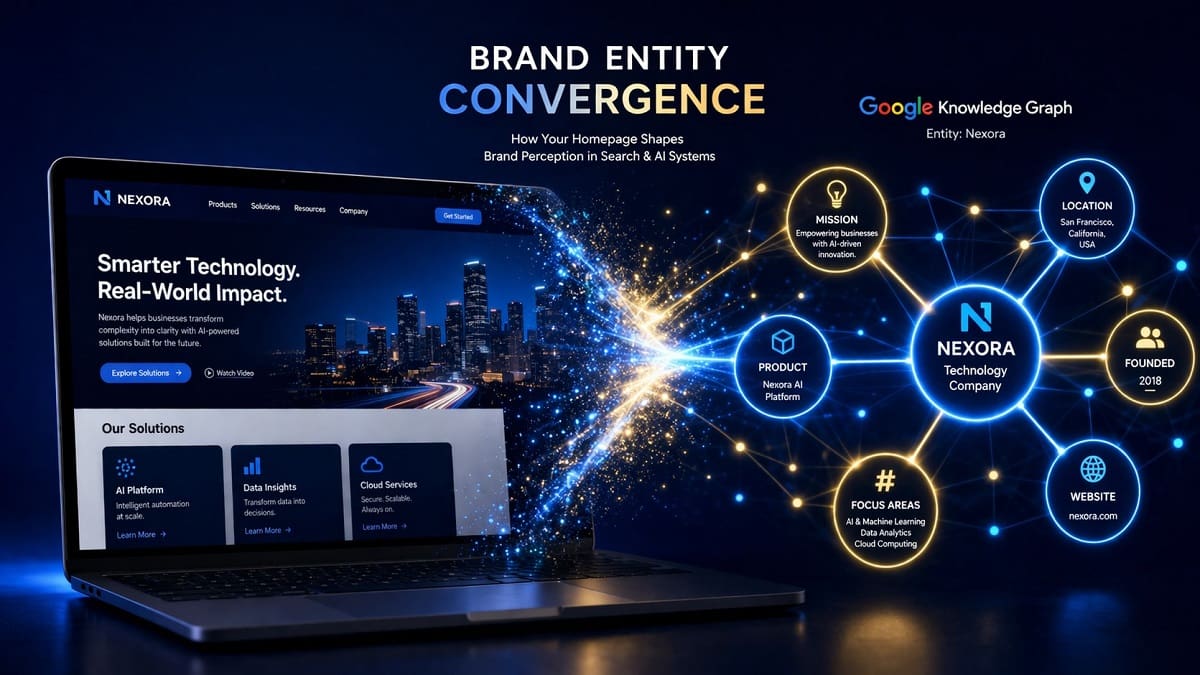
Traditional keyword optimization is failing. You rank for strings of text, but AI search engines do not know who you actually are.
When ChatGPT or Google’s AI Overviews cannot verify your brand facts, they ignore you. You lose visibility to competitors with clear digital footprints. Your brand becomes an invisible ghost to Large Language Models.
You must build an entity home. This single source of truth transforms your website. It moves you from a basic collection of web pages into a verified, machine-readable knowledge graph entity.
watch the video about “Entity Home”: https://www.youtube.com/watch?v=8_DP4aWwXhE

What is an Entity Home in the Era of Semantic Search?
An entity home is the authoritative web page—typically an “About Us” page or homepage—that serves as the definitive single source of truth about a brand or person. Search engines and AI use it to verify facts, disambiguate identities, and build Knowledge Graphs.
This page acts as your semantic anchor. It centralizes your digital footprint. Without it, search engines struggle to connect the dots about your business. You must dictate your own narrative to the algorithms.
The Paradigm Shift: Keyword SEO vs. Entity Optimization
Lexical search relies on exact word matches. Semantic search relies on understanding real-world objects and concepts. You must shift from optimizing for strings to optimizing for things.
A high keyword density cannot compensate for poor entity recognition. Look at the stark differences below.

How to Architect the Perfect Entity Home
Building a semantic hub requires technical precision. You cannot just write a compelling bio. You must architect the page for machines.
Choosing Your Hub: The Homepage vs. The “About Us” Page
You only get one entity home. Choose a URL you control completely. For most corporate brands, the “About Us” page is ideal.
It naturally houses company history, leadership profiles, and contact data. For personal brands or single-product companies, the homepage often works best. Pick one and stick to it.
Structuring On-Page Content for Machine Readability
Write for algorithms and humans simultaneously. State facts clearly. Use simple Subject-Verb-Object sentence structures.
- Define who you are immediately.
- List core products or services plainly.
- Include verifiable company history.
- Link out to your official social channels.
Implementing Organization Schema and sameAs Markup
Text alone is not enough. You must inject machine-readable data using Schema.org. Organization schema acts as your direct data feed to the search engine.
The sameAs property is critical here. It links your entity home to your verified social profiles and brand SERP presence. This creates an undeniable verification loop.
Disambiguation: Proving Who You Are to Algorithms
Search algorithms confuse similar names constantly. Disambiguation solves this. You must clearly separate your brand entity from other entities sharing the exact same name.
Link out to authoritative third-party sources. Reference your Wikidata page, Crunchbase profile, or local Chamber of Commerce listing. This solidifies your identity as a distinct local SEO entity.
LLMO (Large Language Model Optimization): Preparing for AI Search
Generative AI relies heavily on algorithmic trust. Models like ChatGPT and Google’s AI Overviews require verified facts. Your entity home provides this factual baseline.
If your entity data is fragmented, LLMs will hallucinate or omit you entirely. A strong entity home ensures neural matching aligns your brand with relevant user prompts. You become the authoritative source.
Audit Your Brand: The Entity Readiness Score
Stop guessing about your semantic authority. Audit your digital footprint now. Check your schema, verify your social links, and test your knowledge panel triggers.
Find the gaps in your entity home. Fix them immediately to secure your brand’s future in an AI-first search landscape.
FAQ
What is an entity home in SEO?
An entity home is the authoritative web page that serves as the definitive single source of truth about a brand. Search engines use it to verify facts and disambiguate identities.
By centralizing your data on one page, you prevent algorithms from guessing your identity. It forms the anchor point for your entire knowledge graph presence.
How do I choose my brand’s entity home?
Choose a page you fully control, typically your Homepage or About Us page. It must clearly state who you are and include comprehensive Organization Schema markup.
Avoid using third-party sites like social media profiles as your entity home. You need root access to embed machine-readable data and dictate the factual narrative directly.
Why is entity SEO important for AI search?
AI search engines and Large Language Models rely on verified entities and relationships, not traditional keywords. Optimizing your entity home ensures these models understand and confidently recommend your brand.
If an LLM cannot verify your facts through a centralized, authoritative source, it will likely omit your brand from its generative answers to avoid hallucination risks.
How does schema markup help define an entity?
Schema markup provides search engines with machine-readable data. Using properties like sameAs connects your entity home to authoritative profiles, creating a verifiable and highly trusted digital footprint.
Think of schema as a direct, structured feed to an algorithm’s brain. Instead of forcing the crawler to interpret paragraphs, schema feeds it exact data instantly.
What is the difference between a keyword and an entity?
A keyword is merely a string of letters typed into a search engine. An entity is a uniquely identifiable real-world concept with specific attributes, relationships, and contextual meaning.
Keywords lack context. The word “Apple” could mean a fruit or a tech company. An entity framework removes this ambiguity, ensuring algorithms understand exactly which concept you represent.
— Khalid SEO, AI Search Specialist
