
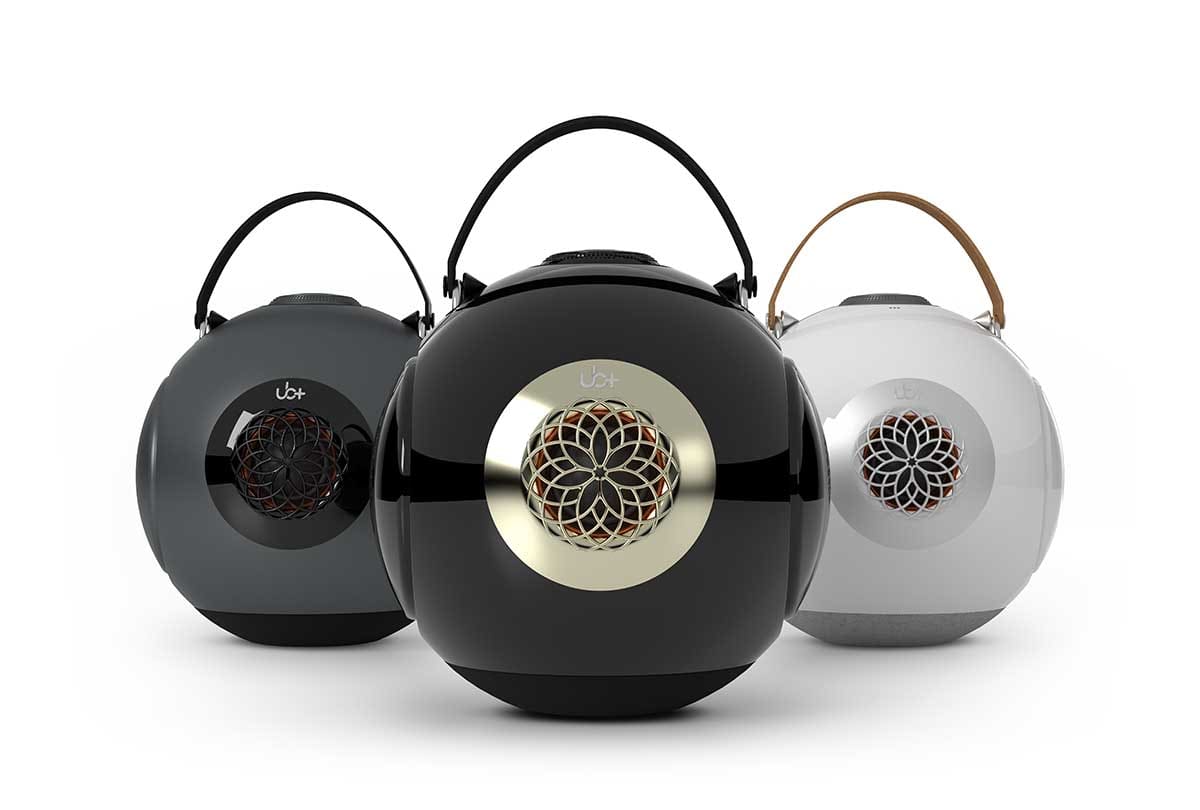
In portable audio, bass is the ultimate test. Treble can sparkle. Vocals can sound clear. But low frequencies reveal whether a speaker is truly engineered or simply tuned to impress during a quick demo. As listeners search for the best bass bluetooth portable speaker, expectations have evolved beyond “loud” and into something more refined: deep, controlled, distortion-free bass that feels physical yet balanced.
Portable speakers were once secondary listening devices. Today, they are expected to replace bookshelf systems, power gatherings, and deliver immersive music in open spaces. Achieving real bass in a compact, battery-powered format requires far more than digital enhancement. It requires intelligent enclosure design, driver precision, and mechanical efficiency.
The UB+ dB1 DOUBLEBASS approaches this challenge from a physics-first perspective rethinking how air, resonance, and vibration behave inside a compact wireless speaker.
Why Bass Is So Difficult in Portable Speakers
Low frequencies are physically demanding. A 40 Hz sound wave is over 8 meters long. To reproduce it convincingly, a speaker must move a significant amount of air. Larger home audio systems accomplish this with big cabinets and multiple woofers. Portable speakers, however, operate with limited internal volume and restricted driver size.
Most manufacturers attempt to compensate by:
- Digitally boosting bass frequencies
- Overdriving small woofers
- Using lightweight cabinets that resonate artificially
These strategies can create a momentary “wow” effect. But at higher volumes or during extended listening, the limitations become obvious:
- Distortion increases
- Midrange clarity suffers
- Cabinets vibrate
- Bass loses definition
To identify the best bass bluetooth portable speaker, we must look beyond wattage claims and focus on acoustic design.
The Foundation: Helmholtz Resonance
The UB+ dB1 DOUBLEBASS is built upon a principle from classical acoustics known as the Helmholtz resonator. This concept describes how a sealed air volume with controlled airflow can reinforce specific low frequencies naturally and efficiently.
Traditional speakers use bass ports to apply this idea. UB+ extended it further by transforming the entire enclosure into a resonant system.
Instead of relying on a simple vent, the speaker’s body becomes a carefully tuned acoustic chamber.
Why a Sphere Matters
The most striking feature of the dB1 DOUBLEBASS is its spherical enclosure. While many portable speakers use rectangular cabinets for convenience, these shapes introduce acoustic compromises:
- Parallel walls create standing waves
- Corners trap pressure
- Uneven resonance affects tonal balance
A sphere eliminates these issues.
Benefits of spherical geometry include:
- Even distribution of internal air pressure
- Reduced internal reflections
- Lower phase distortion
- More efficient bass reinforcement
The result is smoother low-frequency response and greater clarity across the entire spectrum.
The sphere is not aesthetic branding it is acoustic engineering.
Symmetrical Passive Radiators: Controlled Power
Inside the enclosure, the design centers around mechanical balance:
- A central mid-bass driver fires inward into the sphere
- Two large passive radiators are positioned opposite each other
- Internal air pressure drives both radiators simultaneously
Because the passive radiators move symmetrically, mechanical forces cancel out. This prevents the enclosure from vibrating excessively and ensures energy is converted directly into sound.
Cabinet vibration is a major issue in many portable speakers. When the enclosure moves, it steals energy from the driver and introduces unwanted coloration. The dB1 minimizes this through symmetry.
Mechanical Bass Amplification (Not Artificial Boosting)
One of the defining characteristics of the dB1 DOUBLEBASS is its reliance on mechanical amplification rather than digital exaggeration.
The combined surface area of the dual passive radiators is approximately 3.5 times larger than the active woofer. This dramatically increases the system’s ability to move air.
More air movement equals deeper bass without pushing the driver beyond its comfort zone.
This approach provides:
- Cleaner bass at higher volumes
- Greater dynamic headroom
- Reduced distortion
- A more natural tonal balance
Instead of simulating depth electronically, the speaker produces it physically.
High-End Driver Specifications
At the core of the system lies a carefully engineered 4.5-inch mid-bass driver designed with features typically found in larger Hi-Fi loudspeakers:
- 90 mm neodymium magnet for precise electromagnetic control
- 35 mm long-stroke voice coil for extended excursion
- Up to 20 mm piston movement for meaningful displacement
- Aluminum shorting ring to reduce harmonic distortion
- Wide surround ensuring stable linear motion
These specifications are not common in standard portable speakers. They enable accurate bass reproduction while maintaining midrange clarity.
Dual Driver Configuration for Harmonic Stability
Distributing the workload across drivers improves overall system stability. It reduces distortion and preserves harmonic structure, allowing instruments and vocals to remain clear even during bass-heavy playback.
Phase Alignment and Imaging
Bass influences spatial realism. If low frequencies arrive out of phase, stereo imaging collapses.
The symmetrical design of the dB1 promotes coherent wave propagation, maintaining clarity and enhancing depth especially when two units are paired wirelessly for stereo playback.
DSP as a Protective Tool
Digital signal processing in the dB1 is used for monitoring and protection. It maintains linearity and safeguards components but does not artificially inflate bass frequencies.
This ensures the speaker’s tonal balance remains natural and fatigue-free.
Performance Indoors vs Outdoors
Portable speakers must adapt to varying acoustic environments.
Indoors:
- Walls reinforce low frequencies
- Reflections enhance depth
Outdoors:
- Bass often dissipates without boundary support
The dB1’s spherical chamber maintains controlled internal pressure, allowing bass presence to remain consistent in open spaces.
Power Delivery and Efficiency
Deep bass requires sustained energy. Efficient power management allows the speaker to deliver up to 20 hours of playback while maintaining dynamic performance.
Battery life without sonic compromise is essential for a truly portable experience.
Wireless Stability
Bluetooth 5.3 ensures:
- Stable connectivity
- Lower latency
- Improved power efficiency
Accurate timing is critical for maintaining rhythmic precision and bass impact.
Structural Integrity for Long-Term Performance
The rigid spherical enclosure distributes mechanical stress evenly, preventing vibration-induced distortion and ensuring consistent acoustic behavior over time.
Durability matters when evaluating the best bass bluetooth portable speaker performance should not degrade after months of use.
What Truly Defines the Best Bass Bluetooth Portable Speaker
When evaluating options, consider:
- Enclosure geometry
- Air volume efficiency
- Driver engineering
- Mechanical vibration control
- Phase coherence
- Real-world durability
Many speakers excel in one area but fail in others. A well-designed system integrates all these elements seamlessly.
Listening Without Fatigue
Artificial bass often sounds impressive for a few minutes but becomes overwhelming during extended sessions. Natural, physics-driven bass remains engaging and comfortable.
The difference lies in how air is managed not how aggressively frequencies are boosted.
Designed by Physics, Not Presets
The philosophy behind the UB+ dB1 DOUBLEBASS can be summarized simply:
Not boosted bass. Engineered bass.
A spherical chamber that lets bass breathe.
When air moves correctly, sound feels alive.
A Higher Standard for Portable Audio
The search for the best bass bluetooth portable speaker should not focus solely on decibel ratings or marketing claims. It should center on acoustic intelligence how the speaker converts electrical energy into controlled air movement.
The UB+ dB1 DOUBLEBASS demonstrates that true low-frequency authority can exist in a compact, wireless format when design begins with physics rather than software.