
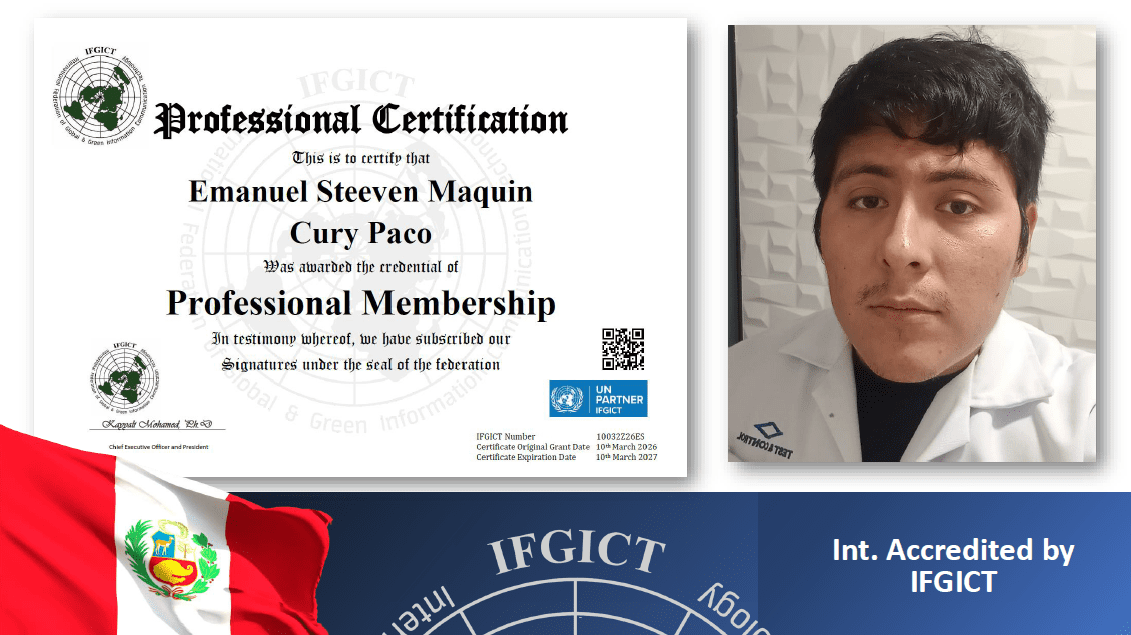
The rapid evolution of Industry 4.0 has created a profound demand for a new breed of engineering professional, one who can bridge the gap between traditional mechanical systems and the sophisticated world of data science. Emmanuel Steeven Maquin Cury Paco, an emerging leader in the field of mechatronics, has recently achieved a significant milestone in his professional journey by being awarded the prestigious Professional Membership by the International Federation of Global and Green ICT (IFGICT). This recognition serves as a testament to his high-performance trajectory and his specialized focus on the convergence of industrial automation, machine learning, and the Industrial Internet of Things (IIoT).
As the global industrial landscape shifts toward smarter, more autonomous operations, the role of international standards becomes vital. The IFGICT is a world-renowned organization that advocates for the integration of information and communication technology with environmental sustainability. By granting Emmanuel Steeven Maquin Cury Paco this professional membership, the federation acknowledges his commitment to these global standards. This credential distinguishes him as a specialist capable of navigating the technical complexities of modern industry while upholding the principles of Green ICT, ensuring that the technological advancements of tomorrow are both efficient and ecologically responsible.
A Dual Academic Foundation at Peru’s Elite Institutions
The foundation of Emmanuel’s expertise is built upon an exceptional academic background involving two of the most prestigious educational institutions in South America. He began his technical journey at the National University of Engineering (UNI) in Peru, an institution widely regarded as the historical cradle of Peruvian engineering. His time spent studying Electrical and Electronic Engineering at UNI provided him with a rigorous understanding of power systems, circuitry, and the fundamental principles that govern modern technology. This initial phase of his education was instrumental in developing a deep technical intuition and an analytical mindset.
Seeking to expand his horizons and integrate his electronic knowledge with mechanical systems, Emmanuel is currently pursuing a degree in Mechatronics Engineering at the Pontificia Universidad Católica del Perú (PUCP). Often ranked as the top university in the country, PUCP offers a multidisciplinary environment that encourages innovation and complex problem-solving. This dual background from both UNI and PUCP has allowed him to develop a hybrid perspective that is rare among engineering students. He understands the “muscle” of industrial machinery through electrical engineering and the “brain” through mechatronics and data science, making him a versatile asset in any high-level industrial project.
Mastering the Science of Predictive Maintenance
At the heart of Emmanuel’s specialization is the concept of predictive maintenance, a strategy that is revolutionizing how industries manage their critical assets. In traditional industrial settings, maintenance was often reactive, meaning repairs were only made after a machine failed, or preventive, which involved replacing parts based on a set schedule regardless of their actual condition. Emmanuel’s approach uses Machine Learning and Industrial IoT to move beyond these outdated models. By analyzing real-time data from sensors embedded in machinery, he can identify patterns that indicate a potential failure before it occurs.
This ability to predict the future of a machine’s health is not just a technical feat; it is a significant economic advantage for global industries. Predictive maintenance reduces unplanned downtime, extends the lifespan of expensive equipment, and optimizes the use of spare parts. For Emmanuel, this involves the careful application of data science to mechanical systems. He leverages algorithms to filter through the “noise” of industrial data to find the subtle signals of wear and tear, thermal stress, or vibration anomalies. This focus on reliability ensures that critical infrastructure, whether in mining, manufacturing, or energy production, remains operational and safe.
The Convergence of Machine Learning and Industrial IoT
The modern factory floor is no longer just a collection of gears and motors; it is a dense network of data-generating nodes. Emmanuel Steeven Maquin Cury Paco specializes in the Industrial Internet of Things (IIoT), which provides the connectivity necessary for a truly smart factory. By implementing IIoT architectures, he allows machines to “communicate” their status to central processing units. This connectivity is the backbone of the data-driven decision-making processes that define high-performance engineering.
However, data alone is not enough to optimize an industrial plant. This is where Emmanuel’s expertise in Machine Learning becomes critical. Machine learning acts as the intelligence that interprets the massive influx of information coming from IIoT devices. By training models on historical performance data, he can create systems that learn and adapt to specific operational environments. This convergence of automation and data science allows for a level of precision that was previously impossible. It enables the optimization of energy consumption, the improvement of product quality, and the reduction of waste, all while maintaining the highest standards of industrial safety.
Integrating Green ICT and Global Standards
The inclusion of Emmanuel Steeven Maquin Cury Paco into the IFGICT as a professional member highlights a crucial aspect of his work: the commitment to sustainable technology. The International Federation of Global and Green ICT emphasizes that the technology of the future must be “green.” This means that ICT solutions should not only solve technical problems but also minimize their environmental impact. Emmanuel’s work in optimizing industrial reliability directly supports this mission. By making machines more efficient and preventing catastrophic failures, he helps industries reduce their energy waste and prevent environmental accidents.
Professional membership in the IFGICT also signifies an alignment with global ICT standards. In an increasingly connected world, engineers must ensure that their systems are compatible with international protocols for data security, interoperability, and ethical technology usage. Emmanuel’s recognition by such a global body indicates that his technical methodologies meet these rigorous standards. For partners and organizations working with him, this credential provides an extra layer of confidence that his solutions are built on a foundation of international best practices and a forward-thinking perspective on technological ethics.
Optimizing Reliability for Critical Industrial Assets
Emmanuel’s professional focus is ultimately about the reliability of critical assets. In sectors like mining, which is a pillar of the Peruvian economy, the failure of a single large-scale asset can result in millions of dollars in losses and potential safety risks for workers. By applying his knowledge of mechatronics and machine learning, Emmanuel works to ensure that these high-value assets perform at their peak. This involves a cycle of continuous monitoring, data analysis, and proactive intervention.
His high-performance approach is defined by a “zero-failure” mindset. While absolute perfection is difficult to achieve in the physical world, the goal of a mechatronics specialist is to bring the probability of failure as close to zero as possible. Through the implementation of smart sensors and predictive algorithms, Emmanuel creates a “digital twin” of physical machinery, allowing engineers to simulate different scenarios and understand how a machine will react under various stresses. This strategic use of technology ensures that industrial operations are resilient, scalable, and ready to meet the demands of a competitive global market.
The Future of Mechatronics and Emmanuel’s Vision
As Emmanuel Steeven Maquin Cury Paco continues his academic and professional journey at PUCP and within the IFGICT, his vision remains clear: to lead the digital transformation of the industrial sector in Peru and beyond. He represents a new generation of Peruvian engineers who are not only technically proficient but also globally connected and environmentally conscious. His transition from the electrical foundations of UNI to the mechatronic innovations of PUCP has prepared him to tackle the most complex challenges of the modern era.
The combination of a Professional Membership from the IFGICT and a deep specialization in Predictive Maintenance and Machine Learning positions Emmanuel as a definitive authority in the future of industrial engineering. His career serves as a blueprint for how young professionals can leverage multidisciplinary education and international credentials to make a tangible impact on the world. By focusing on the reliability of technology and the sustainability of the environment, he is helping to build a future where industry and nature can coexist through the power of intelligent engineering.