
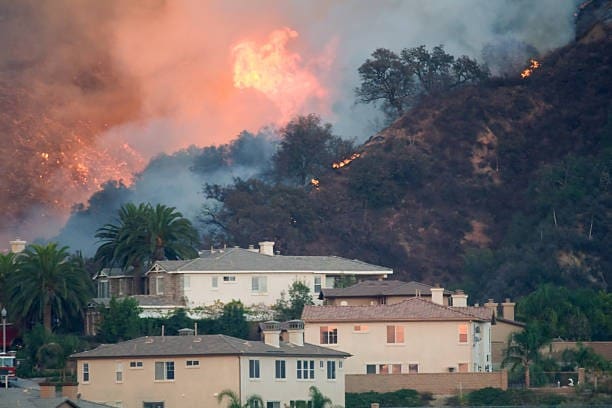
The January 2025 wildfire season in California marked a turning point in the state’s housing market. Aside from the losses, the January 2025 wildfires made the underlying weaknesses in the California housing market visible, including supply constraints and the challenges posed by the need for new locations and funding models. The long-term effects of the January 2025 wildfires will become evident.
Faster Re-pricing of Risk: Insurance and Financing
One of the quickest impacts on the market has been a significant re-pricing of wildfire risk through property insurance. Insurers began raising premiums, non-renewing policies in ZIP codes with significant risk, or exiting a market entirely, leaving homeowners with few alternatives except to sign up for expensive alternatives or FAIR plan coverage. This will certainly affect mortgage lending and home budgets, causing lenders to tighten credit or buyers to seek homes based on the availability and prices of insuring them.
Lower Inventory Levels, Localized Pricing Force
Physical destruction of housing stock in fire-damaged counties has reduced inventory, even as demand remains high. This has led to a short-term price jump as housing supply has decreased while demand remains high. This is coupled with a long-term polarization effect: high-risk areas are likely to see lower prices as buyers stay away, while lower-risk areas are likely to see rising prices. The overall effect is a polarization effect where prices are geographically divided in metropolitan areas.
Rebuilding, Costs, and Supply Chain Constraints
Reconstruction of damaged housing following large wildfires is a capital-intensive, lengthy process. Higher construction material costs, a labor shortage, and more stringent construction standards to make new housing more resilient will drive the average reconstruction cost per unit higher. Furthermore, this means that the complete reconstruction of destroyed housing units may take time, thereby increasing pressure on rents and prices in the affected region. On the contrary, some homeowners, particularly low-income ones, may not be able to afford resilient reconstruction or choose not to rebuild.
Market Conduct: Buyers, Investors, and Disclosure Rubenstein Continues
There is shifting buyer behavior regarding online inquiries and interactions with data on climate risk, as online searches and interactions with data on climate risk increased dramatically after the 2025 fires, and tour buyers now regularly ask for information on fire risk, defensible space, and insurance terms. Institutional investors are repricing portfolios to reflect high-risk corridors and the rising costs of mitigation and retrofitting. As such, property foundation factors are no longer made solely reliant upon traditional property factors such as amenities and access to transport and enterprise.
Policy and Planning Responses
Even at smaller scales of loss, adverse consequences of catastrophes on insurers and their behavior have motivated governments at various levels to explore various options, including enhanced land-use management in wildland-urban interfaces, supportive measures for making buildings disaster-resilient and retrofitting, risk pools or reinsurance mechanisms at various levels, and supportive or targeted measures for poor homeowners who are more vulnerable. In the absence of corrective action, adaptive correctives in the market, including insurer withdrawal and unaffordable premiums, may contribute to rebound effects.
Application in Households and Investment Contexts
For homeowners, it is essential to prioritize coverage analysis, enhance the property with defensible space and fire-resilient design and construction whenever possible, and document all work for potential resale or insurance claims; how the 2025 California Wildfires reshaped the real estate market highlights that these steps are critical for maintaining property value and insurability. For potential home buyers, integrating climate and wildfire risk into due diligence is now vital—reviewing prior claims, assessing neighborhood exposure, and confirming the feasibility of obtaining insurance are necessary to make informed purchasing decisions in a market increasingly influenced by wildfire events.
Conclusion: Adaptation is the New Baseline
The 2025 wildfires have galvanized the realization that climate risks have now become fundamental to property valuation and housing policy in California. The market is responding in various ways to these risks at the moment. To adapt successfully will now require that the response must come in the form of public policy that orients all incentives, private capital that assigns a price tag to risks openly, and private sector decisions that are informed on the issue of risk. The challenge for all participants in the housing sector is clear