
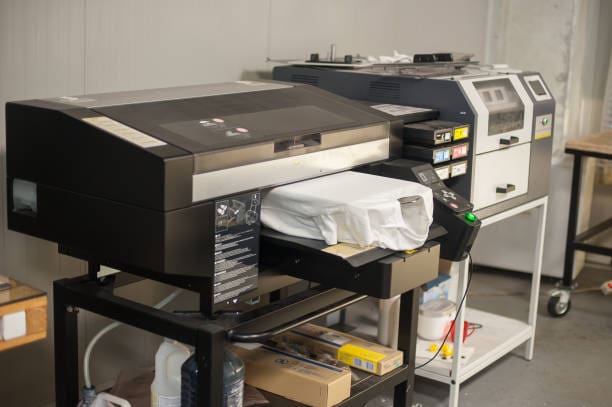
The custom merchandise market has never been more accessible — or more competitive. Dropshipping stores, print-on-demand platforms, and local custom shops are all competing for the same pool of buyers who want personalized apparel, branded gifts, and unique designs on everything from hoodies to tote bags. What separates the businesses that scale from the ones that plateau is usually not marketing. It is production capability. And right now, the technology giving smaller operators the biggest edge is the DTF printer.
If you are exploring DTF printing for the first time, or reconsidering whether to upgrade from an older system, this guide covers the real-world picture — what the technology does, where it genuinely outperforms alternatives, and what to look for before spending your money.
The Short Version of How DTF Works
Direct-to-Film printing transfers designs from a special PET film onto fabric using heat. The workflow has four stages: printing the design onto film using pigment inks with a white underbase, coating the wet print with hot-melt adhesive powder, curing the powder through a heat tunnel, and pressing the finished transfer onto the garment with a heat press for 10 to 15 seconds. The transfer bonds to the fabric, the film peels away, and you have a print that is vibrant, soft to the touch, and durable through 50 or more wash cycles.
What makes this workflow commercially powerful is what it eliminates. No screens. No pre-treatment chemicals. No minimum order sizes. No fabric type restrictions. You can run one piece or five hundred in the same session, mix designs freely on a single film sheet, and switch between cotton, polyester, nylon, and blends without changing any settings. That flexibility is what has driven DTF adoption so rapidly across the custom apparel industry.
The Gang Sheet Advantage Most People Underestimate
One of the most significant operational benefits of DTF that rarely gets discussed in introductory content is the gang sheet workflow. A gang sheet is a single film print that contains multiple different designs — different customer orders, different sizes, different graphics — laid out together and printed in one pass.
In practice this means a print shop receiving 40 different custom orders in a day does not run 40 separate print jobs. It nests all 40 designs onto as few sheets as possible, prints them together, cuts them apart, and presses each one individually. The printer time is the same whether you run one design or forty on a sheet. This collapses per-unit production time dramatically on mixed-order days and makes short-run custom work genuinely profitable rather than just technically possible.
Gang sheets also enable a wholesale transfer business model that many DTF operators build alongside their retail apparel work. Pre-printed transfers — bestselling graphics, seasonal designs, sports team artwork — can be produced in batches during slow periods and sold to other decorators who own heat presses but not printers. This model generates revenue from the machine even when there are no active customer orders.
Where DTF Beats Every Alternative
Screen printing is cheaper per unit at very high identical volumes — above 500 to 1,000 pieces per run — but requires screens, setup labor, and color-count limitations that make small runs expensive and multi-color work complex. Below that volume threshold DTF is consistently faster and cheaper with zero setup cost.
DTG printing delivers excellent results on ring-spun 100% cotton but requires chemical pre-treatment on every garment, costs $2.50 to $4.00 per shirt in consumables, and performs poorly on synthetic fabrics and dark polyester blends. DTF costs $0.40 to $0.80 per transfer and works on every fabric type with no pre-treatment. For shops serving wholesale clients across mixed fabric categories the economics are not close.
Sublimation produces beautiful all-over prints on white polyester but is completely ineffective on cotton and dark base colors. It serves a specific niche. DTF fills every gap sublimation leaves and does not require the all-white-polyester restriction that limits sublimation’s commercial range.
Critical Specs to Evaluate Before You Buy
The DTF printer market has a genuine quality problem. A large share of machines available through online marketplaces are unbranded units from generic factories, sold by resellers with no engineering capability or service infrastructure. When the machine has a problem — and every production machine eventually does — you are on your own.
Printhead quality is the first thing to evaluate. Production-grade machines use Epson i1600 or i3200 printheads engineered for continuous operation, high pass speeds, and variable droplet deposition that produces smooth gradients and fine detail. Lower-grade heads clog faster, produce inconsistent output, and cost more to maintain over time than the savings at point of purchase.
Automatic white ink circulation is non-negotiable for any shop running the machine more than a few days per week. White DTF ink contains titanium dioxide pigment that settles out of suspension rapidly. Without a continuous circulation pump keeping ink moving through the lines, clogs develop during every period of idle time. A machine without this feature is a maintenance liability from day one.
The heat tunnel’s temperature consistency directly determines transfer quality. Uneven heat across the tunnel width produces uneven powder curing, which means inconsistent adhesion and variable wash durability. Look for specifications confirming uniform temperature distribution across the full working width.
Finally, evaluate the manufacturer’s actual service capability. Can they provide remote technical support in your time zone? Do they stock spare parts? Do they have installation teams or certified technicians in your region? These questions matter far more after the sale than before it.MTuTech manufactures a full range of industrial-grade DTF printers backed by 16 years of digital printing experience and an active customer base across 90+ countries. From entry-level single-head systems to high-throughput multi-head production configurations, each machine ships factory-direct with transparent pricing, consumable starter kits, and technical support staffed by the engineers who built them. For entrepreneurs serious about custom apparel production in 2026, it is a practical and well-supported starting point.