
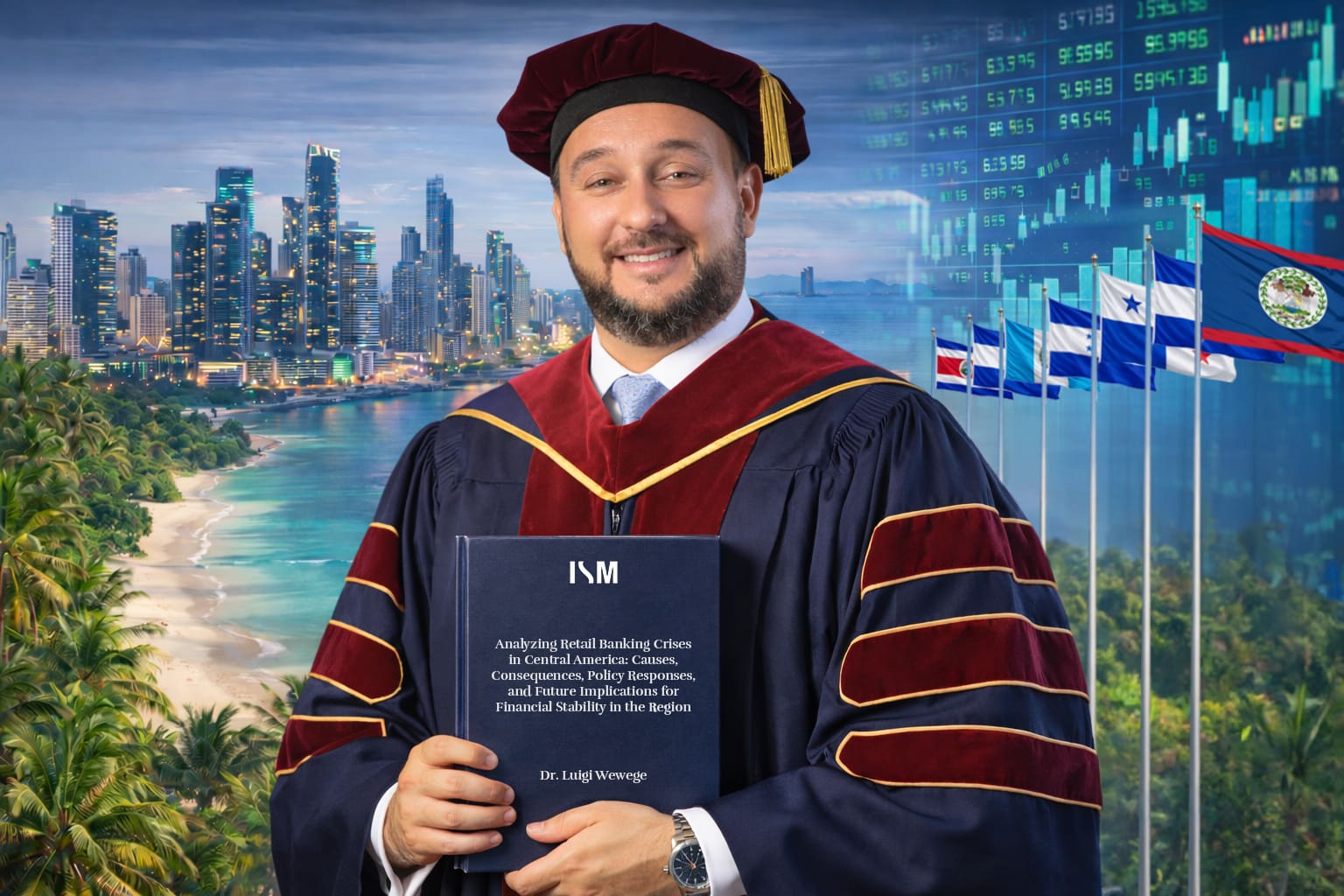
Dr. Luigi Wewege, President of Caye International Bank, has been formally awarded his Doctor of Philosophy (PhD), completing a rigorous multi-year academic journey focused on advancing financial stability across Central America. The doctorate represents not only a personal academic milestone, but also a significant contribution to the region’s ongoing efforts to strengthen retail banking systems and enhance economic resilience.
Dr. Wewege completed his doctoral research through the International School of Management in Paris. His dissertation, Analyzing Retail Banking Crises in Central America: Causes, Consequences, Policy Responses, and Future Implications for Financial Stability in the Region, delivers a comprehensive, data-driven examination of why retail banking crises occur, how they spread, and what policymakers and financial institutions can do to mitigate future systemic risk.
At a time when Central America continues to navigate structural vulnerabilities, including concentrated banking sectors, limited financial inclusion, exposure to external economic shocks, and correspondent banking pressures, the research provides timely and actionable insights. Dr. Wewege combined econometric modeling, comparative historical case studies, and in-depth interviews with senior regulators, policymakers, and financial executives across multiple jurisdictions. The result is a study that bridges academic rigor with practical application.
“This doctorate was never intended to be purely theoretical,” Dr. Luigi Wewege explained. “The goal was to produce research that can directly inform policy decisions and strengthen the long-term resilience of financial systems throughout the region.”
Identifying Structural Drivers of Crisis
The research highlights recurring structural weaknesses that have contributed to retail banking instability in Central America. These include governance shortcomings, supervisory gaps, excessive credit concentration, weak risk management frameworks, and delayed crisis-response mechanisms. Importantly, the study emphasizes that retail banking disruptions disproportionately affect depositors, small businesses, and emerging middle-income households, segments of society that depend most heavily on stable banking infrastructure.
By systematically comparing crisis and non-crisis periods across several countries, the dissertation moves beyond isolated national case studies. Instead, it establishes a regional analytical framework that distinguishes country-specific policy failures from broader systemic vulnerabilities. This comparative lens offers policymakers a clearer understanding of how localized weaknesses can evolve into regional financial stress.
Policy-Focused Solutions for Resilience
A defining feature of Dr. Luigi Wewege’s doctoral work is its applied orientation. The study proposes practical reforms aimed at strengthening prudential supervision, enhancing early-warning systems, improving depositor protection frameworks, and promoting coordinated crisis-management protocols. It also underscores the importance of institutional independence, regulatory transparency, and public confidence in maintaining financial stability.
For smaller and developing economies, where confidence shocks can rapidly translate into liquidity stress, proactive governance and regionally coordinated oversight are particularly critical. The research argues that early intervention mechanisms and improved regulatory capacity can significantly reduce both the frequency and severity of future banking disruptions.
From Dissertation to Global Textbook
Further reinforcing the academic significance of this work, the doctoral thesis has been accepted for publication as a full academic textbook by De Gruyter Brill, one of the world’s leading scholarly publishers. Scheduled for release in 2026, the textbook will expand upon the dissertation’s findings and make them accessible to policymakers, regulators, academics, and financial practitioners worldwide, with particular relevance for emerging and frontier markets.
Dr. Luigi Wewege intends to continue engaging with regulators and financial institutions across Central America and the Caribbean, translating research insights into actionable frameworks.
“A stable retail banking system is not optional,” he noted. “It is foundational to economic development, investment confidence, and social mobility. If this research helps even one country reduce its vulnerability to crisis, then it will have achieved its purpose.”
By transforming his doctoral research into a globally distributed academic resource, Dr. Wewege aims to ensure that the lessons drawn from Central America’s banking experience contribute meaningfully to both regional reform efforts and the broader international dialogue on financial stability and crisis prevention.
