
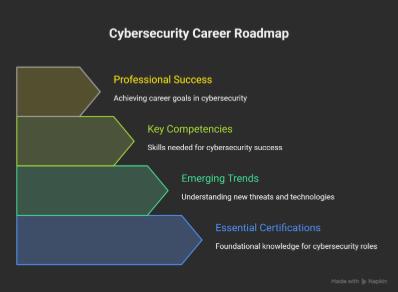
Navigating the Future: Your Ultimate Cybersecurity Certification Roadmap 2025
The cybersecurity world is evolving at lightning speed. As digital infrastructures expand, so do the risks—and with them, the demand for skilled defenders. 2025 stands as a pivotal year where cyber threats are becoming more advanced, and the need for specialized professionals has never been higher. The Cybersecurity Certification Roadmap 2025 serves as your comprehensive guide to navigating this dynamic industry and strategically building your expertise, one certification at a time.
This roadmap isn’t just a list of credentials; it’s a structured learning path designed to prepare professionals for the rapidly changing landscape of information security. Whether you’re a student stepping into IT, a system administrator transitioning to security, or a seasoned professional aiming for leadership, understanding which certifications to pursue and in what order can make all the difference in shaping your career.
Understanding the Importance of a Certification Roadmap
Cybersecurity certifications validate both your knowledge and practical skills in protecting systems from evolving digital threats. But with hundreds of certifications available, professionals often struggle to determine which ones truly matter. The roadmap simplifies this journey by aligning certifications with specific career stages: beginner, intermediate, and advanced, ensuring you acquire the right skills at the right time.
A well-structured Cybersecurity Certification Roadmap 2025 also helps bridge the gap between academic knowledge and hands-on technical expertise. It allows you to progress from foundational principles to specialized roles in ethical hacking, network defense, or cloud security without confusion or wasted effort.
Step One: Laying the Foundation
Every cybersecurity career begins with understanding the fundamentals. Foundational certifications introduce essential concepts like risk management, threat detection, and security frameworks.
The CompTIA Security+ (SY0-701) remains one of the most recommended starting points in 2025. It provides a comprehensive overview of network security, encryption, and compliance standards. Similarly, ISC2 Certified in Cybersecurity (CC) is perfect for beginners aiming to establish credibility without prior experience.
These entry-level certifications not only validate technical skills but also demonstrate commitment, something employers greatly value. They act as the first stepping stones toward more advanced certifications and open opportunities in roles such as junior security analysts or SOC technicians.
Step Two: Advancing to Technical Mastery
Once you’ve mastered the basics, it’s time to develop deeper, hands-on skills. The intermediate stage focuses on identifying, mitigating, and responding to complex security incidents.
The Certified Ethical Hacker (CEH) certification teaches penetration testing, vulnerability scanning, and system exploitation—all critical skills in today’s threat landscape. Meanwhile, CompTIA Cybersecurity Analyst (CySA+) emphasizes proactive threat hunting and behavioral analytics to detect attacks before they cause damage.
For those focusing on enterprise systems, the Cisco CCNP Security (350-701 SCOR) certification in 2025 stands out. It covers advanced network security technologies, from firewalls to VPNs, helping professionals manage large-scale infrastructure securely.
By this stage, professionals are equipped for specialized roles like cybersecurity engineers, penetration testers, or threat intelligence analysts.
Step Three: Reaching the Expert and Leadership Level
At the top of the Cybersecurity Certification Roadmap 2025 lie certifications that define industry leaders. These are designed for professionals who manage security programs, lead teams, or design enterprise-wide security architectures.
The CISSP (Certified Information Systems Security Professional) certification remains the gold standard for senior security professionals. It covers eight domains, including governance, risk management, and network security. Similarly, CISM (Certified Information Security Manager) focuses on aligning security programs with business objectives—a vital skill for managers and executives.
For hands-on experts, OSCP (Offensive Security Certified Professional) continues to hold prestige due to its practical, real-world hacking challenges. These certifications separate those who understand theory from those who can apply it under pressure.
Professionals at this level often move into roles such as Chief Information Security Officer (CISO), Security Architect, or Incident Response Director.
Step Four: Embracing Cloud and AI Security
In 2025, cybersecurity doesn’t end with traditional systems. The future is cloud-driven, and certifications are adapting to match this evolution. As organizations shift workloads to multi-cloud environments, specialized credentials have become essential.
Certifications like AWS Certified Security – Specialty, Microsoft Certified: Cybersecurity Architect Expert, and Google Professional Cloud Security Engineer are among the most sought-after in the industry. These programs validate expertise in managing complex hybrid environments, securing APIs, and enforcing compliance standards.
Artificial intelligence is also reshaping cybersecurity. AI-driven automation tools detect threats faster than ever, and professionals equipped with AI-integrated security knowledge are becoming invaluable. Combining traditional and emerging skills is now the key to career longevity.
Mapping a Sustainable Cybersecurity Career
What makes the Cybersecurity Certification Roadmap 2025 effective is its adaptability. You don’t need to follow every certification—it’s about choosing the right ones for your career aspirations.
For example, if you want to specialize in governance and compliance, certifications like CISM or CRISC are ideal. For hands-on roles, CEH and OSCP are better fits. Those leaning toward cloud or automation can focus on vendor certifications from AWS, Google, or Microsoft.
Remember, cybersecurity is not static. Continuous learning is critical. Many professionals revisit certifications every few years to stay updated with new tools, policies, and attack methods.
How Cert Empire Supports Your Certification Journey
A roadmap is only useful if you have the right resources to travel it. That’s where Cert Empire plays a crucial role. As one of the most reliable platforms for exam preparation materials, practice tests, and updated dumps, Cert Empire helps candidates pass certifications with confidence. Its resources are aligned with the latest exam patterns and real-world scenarios, ensuring that professionals don’t just memorize answers—but truly master the content.
The Future Outlook
Cybersecurity roles are expected to continue dominating the IT job market through 2025 and beyond. With the rise of ransomware, cloud breaches, and AI-powered attacks, certified professionals will be the first line of defense for organizations worldwide. The industry’s growth is unstoppable, and those who plan their path wisely using the Cybersecurity Certification Roadmap 2025 will enjoy both stability and financial success.
By strategically selecting certifications, committing to ongoing learning, and utilizing platforms like Cert Empire for preparation, aspiring cybersecurity experts can establish a strong, future-proof career in this ever-evolving digital landscape.