
You’ve worked hard to build your website, create amazing content, and drive traffic. Now comes the million-dollar question: how do you actually turn those visitors into revenue?
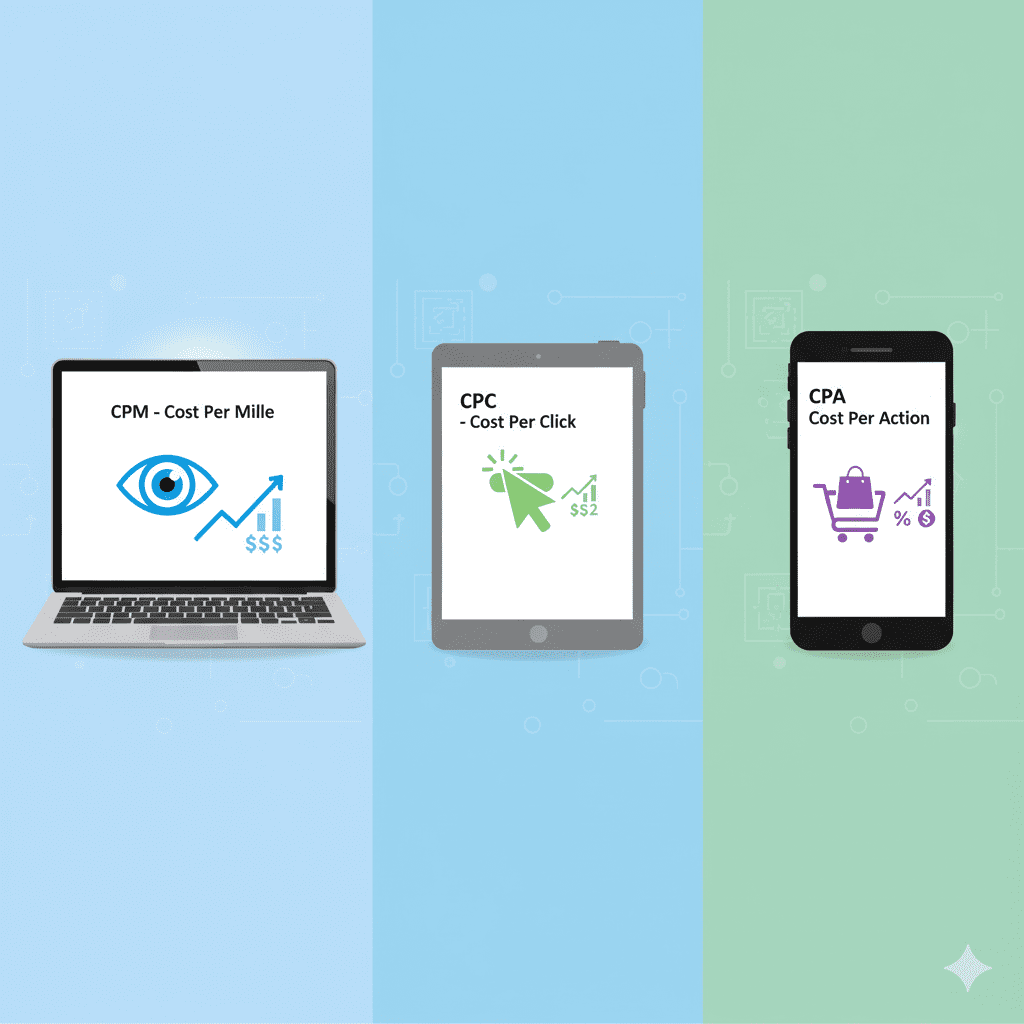
If you’re staring at terms like CPM, CPC, and CPA wondering which magical acronym will fill your bank account faster, you’re not alone. The digital advertising world can feel like alphabet soup, but here’s the truth: there’s no universal “best” ad model. The highest-paying option depends entirely on your traffic, niche, and audience behavior.
In this guide, I’ll break down exactly how each advertising model works, who makes the most money with each one, and—most importantly—how to choose the right strategy for your specific situation. Let’s turn that traffic into actual income.
Understanding the Three Major Ad Models
Before we dive into the comparison, let’s get crystal clear on what we’re actually comparing. Think of these as three different ways restaurants charge customers: a buffet (pay for access), à la carte (pay per item), or results-only (pay only if you’re satisfied).
What is CPM (Cost Per Mille)?
CPM stands for “cost per mille”—that fancy Latin word “mille” just means thousand. With CPM advertising, you earn money every time your ads are displayed 1,000 times, whether anyone clicks them or not.
Think of CPM like billboard advertising. Companies pay for eyeballs, not engagement. Your job as a publisher is simple: get people to see the ads. A click is just a bonus, not a requirement.
Typical CPM rates range wildly from $1 to $20+ depending on your niche. Finance and insurance websites might see $15-50 CPMs, while entertainment blogs often struggle at $2-5 CPMs. Google AdSense, Media.net, and premium networks like Mediavine all offer CPM-based monetization.
The beauty of CPM? It’s predictable. If you consistently get 100,000 pageviews monthly at a $5 CPM, you can count on roughly $500. No surprises, no waiting for clicks.
What is CPC (Cost Per Click)?
CPC—or pay-per-click advertising—only pays you when someone actually clicks your ads. No click, no cash. It’s performance-based from the publisher’s perspective.
This model rewards engaging content and strategic ad placement. If your audience finds ads relevant and clicks them at a healthy rate, CPC can dramatically outperform CPM. Click-through rates typically range from 0.5% to 5% depending on ad relevance and placement.
Average CPC rates vary from $0.10 to $5 or more. Competitive niches like legal services, insurance, and B2B software see higher CPCs because advertisers pay premium rates to reach buyers. Google Ads dominates this space, though platforms like Bing Ads and native ad networks also use CPC pricing.
The catch? Income unpredictability. Your earnings fluctuate based on how many visitors decide to click, which can vary day-to-day based on content, ad relevance, and even the weather.
What is CPA (Cost Per Action)?
CPA—sometimes called cost per acquisition—is the heavy hitter of digital advertising. You only earn when visitors complete specific actions: making a purchase, signing up for a trial, filling out a form, or downloading an app.
This is affiliate marketing territory. Amazon Associates, ShareASale, ClickBank, and hundreds of affiliate networks operate on CPA models. Commission rates range from 3-5% for physical products up to $50-200+ for software subscriptions, financial services, or insurance leads.
The math is brutal but potentially lucrative. If only 1% of your visitors convert at $50 per conversion, you need 100 visitors to make $50. But with 100,000 monthly visitors, that’s $50,000. The gap between CPM’s $500 and CPA’s potential $50,000 for the same traffic is exactly why publishers obsess over conversion optimization.
The Real Answer: Which Model Pays More?
Here’s what you actually want to know: which one makes you the most money? The honest answer is frustratingly simple: it depends. But don’t worry—I’ll help you figure out your specific answer.
It Depends on Your Traffic Volume
Low traffic (under 10,000 monthly visitors): CPC or CPA typically wins. You don’t have enough volume to generate meaningful CPM revenue. A website with 5,000 monthly pageviews at a $5 CPM earns just $25/month. But with a 2% CTR and $1 CPC, those same 5,000 visitors generate 100 clicks and $100. Or one well-placed affiliate sale could bring in $50-100 alone.
Medium traffic (10,000-100,000 monthly visitors): This is hybrid territory. You have enough volume for CPM to contribute meaningfully, but CPC and CPA still outperform. Most successful publishers at this level use display ads (CPM/CPC) for passive baseline income while strategically placing affiliate links in high-converting content.
High traffic (100,000+ monthly visitors): CPM becomes highly competitive here. Premium ad networks like Mediavine (requires 50,000 sessions) and AdThrive (requires 100,000 pageviews) offer optimized CPM rates of $15-25+. At this scale, even a $10 CPM generates $10,000+ monthly from 1 million pageviews.
Visual Suggestion: A three-tier infographic showing different traffic levels with recommended ad models and realistic monthly earning potentials for each scenario.
It Depends on Your Niche
Not all traffic is created equal. A visitor interested in “funny cat videos” is worth pennies to advertisers. Someone searching “best business insurance for small companies” is worth dollars.
Premium CPM niches include finance ($15-50), insurance ($10-30), legal ($10-25), B2B software ($8-20), and healthcare ($8-18). These industries have high customer lifetime values, so advertisers pay premium rates for exposure.
High CPC niches overlap significantly: legal services often see $10+ CPCs, insurance averages $5-15, and finance-related clicks can cost advertisers $3-8 each.
Top CPA niches include credit cards ($100-200 per approval), insurance leads ($10-50 per quote), software subscriptions ($50-200 per signup), web hosting ($50-100 per sale), and online education ($30-150 per enrollment).
Meanwhile, entertainment, general lifestyle, and hobby sites typically see $2-5 CPMs, $0.25-0.75 CPCs, and limited high-value CPA offers.
It Depends on Audience Quality
A million visitors from click-bait headlines won’t earn what 10,000 highly engaged, purchase-ready visitors generate. Audience quality trumps quantity every time.
For CPM success, you need engaged visitors who actually view ads (not immediately bouncing). Geographic location matters enormously—US and UK traffic generates 5-10x higher CPMs than traffic from developing nations.
For CPC success, you need audiences with intent. Someone searching “how to fix a leaky faucet” might click an ad for plumbing services. Someone passively scrolling Instagram probably won’t.
For CPA success, you absolutely need an audience ready to take action. Review and comparison content converts because readers are in buying mode. General informational content rarely converts affiliate offers effectively.
Real-World Revenue Comparison
Let’s run the numbers on a realistic scenario to see how these models stack up.
Scenario: You have a finance blog with 100,000 monthly pageviews, averaging 1.5 pages per session (about 67,000 sessions). Your audience is 70% US-based, primarily desktop users researching credit cards and investing.
CPM Calculation
- 100,000 pageviews × $12 CPM (finance niche) = $1,200/month
- Predictable, passive income
- No additional effort beyond traffic generation
CPC Calculation
- 100,000 pageviews × 2% CTR = 2,000 clicks
- 2,000 clicks × $2.50 average CPC = $5,000/month
- Requires relevant ad placement and content-ad alignment
- Income varies with click rates
CPA Calculation
- 67,000 sessions × 0.75% conversion rate = 502 conversions
- 502 conversions × $150 average commission (credit card offers) = $75,300/month
- Requires conversion-optimized content and trust-building
- Highly variable but potentially explosive
This example illustrates why so many publishers pursue hybrid strategies. Use CPM/CPC for reliable baseline income while optimizing high-value content for CPA conversions.
How to Choose the Right Model for Your Website
Stop guessing and start strategizing. Here’s your decision framework:
Step 1: Assess Your Current Situation
Answer these questions honestly:
- Monthly pageviews: Under 10K, 10-100K, or 100K+?
- Audience geography: Primarily US/UK/Canada or global?
- Content type: Informational, reviews/comparisons, or entertainment?
- Niche: High-value (finance, B2B) or general interest?
- Audience intent: Browsing or buying mode?
Step 2: Match Models to Your Strengths
Choose CPM if:
- You have high traffic volume (100K+ pageviews monthly)
- You’re in a premium niche with strong CPM rates
- You want predictable, passive income
- You already have display ad approval (AdSense, Mediavine, etc.)
Choose CPC if:
- You have moderate traffic (10K-100K monthly)
- Your content naturally attracts engaged readers
- You can place ads strategically near relevant content
- You want a balance between effort and reward
Choose CPA if:
- You create product-focused or review content
- Your audience has clear purchase intent
- You’re willing to actively manage affiliate relationships
- You prioritize maximum revenue per visitor
Visual Suggestion: A simple decision tree flowchart with “Start Here” leading through traffic volume, niche, and content type questions to arrive at a recommended primary model.
Step 3: Implement a Hybrid Strategy
The smartest publishers don’t choose—they combine. Here’s the optimal approach:
The 70-20-10 Rule:
- 70% of revenue from your primary strength (usually CPA for targeted sites, CPM for high-traffic sites)
- 20% from your secondary model
- 10% experimental (testing new networks, formats, or strategies)
For example, a tech review site might generate 70% revenue from affiliate commissions (CPA), 20% from display ads (CPM/CPC), and 10% from sponsored content and other opportunities.
Common Mistakes That Cost You Money
Avoid these profit-killers:
CPM Mistakes:
- Overcrowding pages with too many ad units (kills user experience and SEO)
- Placing all ads below the fold where viewability is poor
- Ignoring mobile optimization (50%+ of traffic is mobile)
- Accepting any ad network without comparing CPM rates
CPC Mistakes:
- Using irrelevant ad targeting that doesn’t match your content
- Placing ads where users never look (banner blindness is real)
- Never A/B testing ad positions and formats
- Sacrificing user experience for slightly more ad placements
CPA Mistakes:
- Promoting products you don’t genuinely recommend (kills trust)
- Not pre-qualifying traffic with targeted content
- Weak or missing calls-to-action
- Failing to disclose affiliate relationships (FTC requirement and trust issue)
The Future of Digital Advertising
As we move through 2025, several trends are reshaping how publishers monetize:
AI-driven optimization is making CPM more competitive. Networks like Ezoic use machine learning to test thousands of ad combinations, often increasing CPM rates by 30-50% over manual optimization.
First-party data is becoming crucial as third-party cookies disappear. Publishers who build email lists and understand their audiences will command premium ad rates across all models.
Video advertising continues growing, with CPV (cost per view) models offering $20-40 CPMs for video content—significantly higher than display ads.
The winners will be publishers who adapt quickly, test relentlessly, and focus on genuine audience value rather than chasing quick monetization tricks.
Conclusion: Your Action Plan
So which ad model pays more? For most publishers, the answer is: all of them, strategically combined.
Start where you are:
- Under 10K monthly visitors? Focus on CPA affiliate marketing while building traffic
- 10K-100K monthly visitors? Apply for Google AdSense (CPM/CPC hybrid) and add strategic affiliate links
- 100K+ monthly visitors? Pursue premium ad networks while maintaining top-performing affiliate partnerships
The key isn’t choosing one model—it’s understanding which performs best for your specific traffic, niche, and content type, then optimizing relentlessly.
Test for 90 days, analyze your data, and adjust. Your first monetization strategy won’t be your last. The publishers making serious money aren’t lucky—they’re strategic, patient, and willing to evolve.
Now stop reading and start implementing. Your traffic is worth money—you just need to unlock it with the right strategy.
Frequently Asked Questions
1. Which ad model is best for beginners with low traffic?
CPA (affiliate marketing) is typically best for beginners with under 10,000 monthly visitors because it has no minimum traffic requirements and offers the highest per-conversion payouts. Most CPM networks require at least 10,000-50,000 monthly pageviews for approval, making them inaccessible to new sites. CPC (through Google AdSense) can work with lower traffic, but you’ll earn very little—perhaps $10-50 monthly—with minimal pageviews. Focus on creating product-focused content with strategic affiliate links while you build your audience.
2. How much traffic do I need to make $1,000 per month?
To earn $1,000 monthly, you typically need:
- CPM: 100,000-200,000 monthly pageviews (at $5-10 CPM average)
- CPC: 50,000-100,000 monthly pageviews (assuming 2% CTR and $1 CPC)
- CPA: 25,000-50,000 monthly visitors (with 1-2% conversion rate and $40-80 average commission)
These numbers vary dramatically by niche. A finance site might hit $1,000 with 40,000 pageviews, while a general entertainment blog might need 300,000+ pageviews. High-value niches and well-targeted traffic dramatically reduce the traffic requirement.
3. Can I use CPM, CPC, and CPA together on the same website?
Absolutely, and you should! Using multiple monetization models is called a hybrid strategy, and it’s how successful publishers maximize revenue. Google AdSense automatically serves both CPM and CPC ads based on what pays more per impression. You can (and should) also add affiliate links naturally within your content. Just follow these rules: don’t overcrowd pages with too many ads, always disclose affiliate relationships, and never sacrifice user experience for ads. Most ad networks allow you to use other monetization methods alongside their ads—just check their terms of service.
4. Why are my CPM rates so low, and how can I increase them?
Low CPMs (under $3) usually result from:
- Traffic from low-value geographic regions (CPMs vary 10x between countries)
- Low-value content niches (entertainment vs. finance)
- Poor ad viewability (ads users never actually see)
- Mobile-heavy traffic (mobile CPMs are typically 40-60% lower than desktop)
To increase your CPM:
- Target high-value keywords in premium niches (finance, insurance, legal, B2B)
- Improve content quality to attract US/UK/Canada traffic
- Optimize ad placement for viewability (above the fold, within content)
- Apply to premium networks like Mediavine or AdThrive when you qualify
- Implement header bidding to increase advertiser competition
5. Is affiliate marketing (CPA) really more profitable than ads?
For targeted, conversion-focused content, yes—CPA dramatically outperforms display ads. A single affiliate sale can earn what 10,000-50,000 ad impressions generate. However, CPA requires more work: finding relevant products, creating conversion-optimized content, building trust with your audience, and actively managing affiliate relationships. Display ads (CPM/CPC) are truly passive—once set up, they generate income from any content and any visitor. The best approach for most publishers is using display ads for baseline passive income while strategically optimizing high-traffic content for affiliate conversions. Test both for 3-6 months to see what works for your specific audience and content.
