

Computer-Aided Engineering Market Scope and Overview
The global Computer-Aided Engineering Market has become a vital component in the digital transformation of industries. CAE solutions offer advanced simulation and analysis tools that assist engineers in designing, analyzing, and optimizing products. These tools integrate different computer-based simulations, including structural analysis, fluid dynamics, and optimization techniques, enabling firms to develop efficient, cost-effective, and reliable products. As industries become more focused on improving product quality, reducing development time, and minimizing costs, the demand for CAE is increasing significantly. With the integration of cloud computing and enhanced software capabilities, the CAE market is poised for steady growth, further driven by innovations across industries like automotive, electronics, defense, and healthcare.
The Computer-Aided Engineering (CAE) market focuses on the use of software to simulate performance and optimize product designs in engineering processes. CAE tools assist engineers in modeling, analyzing, and improving the durability, fluid dynamics, and thermal properties of products, reducing the need for physical prototypes. Industries such as automotive, aerospace, and industrial manufacturing rely heavily on CAE solutions for designing complex systems and enhancing product development. With the increasing adoption of automation and advanced manufacturing techniques, the CAE market is poised for growth as it helps businesses streamline innovation and cut down production costs.
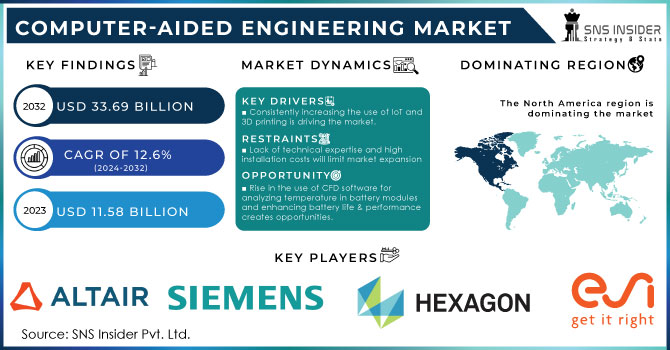
Competitive Analysis
The Computer-Aided Engineering market is highly competitive, with key players continually innovating to maintain their market positions. Leading companies such as Altair Engineering, Siemens AG, ESI Group, Hexagon AB, and ANSYS, Inc. are prominent in this space, providing comprehensive CAE solutions across various industries. These companies focus on expanding their product offerings, improving software functionalities, and enhancing customer experience. Autodesk, Inc., another major player, emphasizes design simulation, especially in industrial and manufacturing sectors.
Several companies are also increasingly investing in cloud-based CAE platforms, aiming to reduce hardware costs and offer scalable solutions. For instance, SimScale and Bentley Systems, Inc. are driving the market with their cloud-centric platforms that provide engineers the flexibility to perform simulations anywhere. Dassault Systemes and Mentor Graphics Corporation leverage their partnerships and acquisitions to strengthen their technological edge, integrating more sophisticated functionalities into their product suites. In a bid to differentiate, companies are also incorporating AI and machine learning to enhance simulation accuracy and reduce human intervention in complex analysis tasks.
Computer-Aided Engineering Market Segmentation
The CAE market can be segmented based on deployment model, type, and end-user industries. Each segment represents a specific need within the market, showcasing the diverse applications of CAE across sectors.
By Deployment Model
- On-Premise: Traditional on-premise CAE solutions offer companies full control over their simulation infrastructure. Industries with stringent security requirements, such as defense and aerospace, prefer on-premise systems due to data sensitivity. On-premise solutions are particularly relevant to enterprises that need highly customized and complex simulations, often requiring substantial hardware investments for high-performance computing.
- Cloud: The rise of cloud computing has transformed the CAE landscape, providing an alternative to resource-intensive on-premise systems. Cloud-based CAE offers several benefits, including scalability, flexibility, and reduced IT infrastructure costs. It allows businesses to pay only for what they use, making advanced simulation tools accessible to small and medium enterprises (SMEs). Cloud CAE also facilitates remote access, enhancing collaboration among geographically dispersed teams, which is especially beneficial in industries like automotive and electronics, where global collaboration is critical.
By Type
- Computational Fluid Dynamics (CFD): CFD is one of the most popular CAE tools, widely used in industries such as automotive, aerospace, and industrial equipment. It helps simulate and analyze fluid flow, thermal heat transfer, and aerodynamic behaviors, providing engineers with detailed insights into product performance in various conditions. CFD tools are crucial in the development of energy-efficient vehicles and optimizing performance in industrial systems.
- Multibody Dynamics (MBD): MBD simulations focus on the dynamic behavior of interconnected rigid or flexible bodies. Industries such as automotive, robotics, and machinery manufacturing use MBD to model the movements and interactions of mechanical systems. This technology allows engineers to predict and optimize the movement of components in complex machinery, improving system efficiency and reducing wear and tear.
- Finite Element Analysis (FEA): FEA is used to assess the structural integrity of components and systems under various loads and conditions. It is heavily utilized in industries like construction, automotive, and electronics to analyze stresses, strains, and deformations in products. FEA allows designers to identify weaknesses and potential failure points in structures before physical testing, thus saving time and costs.
- Optimization: CAE optimization tools help improve the design of products by automatically suggesting the best configurations based on performance requirements. They are increasingly used in sectors like aerospace, automotive, and defense to reduce weight, improve strength, and enhance performance. These tools help engineers meet the growing demand for lighter, more efficient, and environmentally friendly products.
- Simulation: Simulation covers a broad range of applications, allowing engineers to virtually test the performance of products in various real-world scenarios. It is used across industries to reduce the need for physical prototypes, accelerate time-to-market, and improve product quality. Simulations are indispensable for complex systems, such as automotive safety features and aerospace structures.
By End Users
- Automotive: The automotive industry is one of the largest adopters of CAE solutions, using simulation tools for crash analysis, aerodynamics, thermal management, and structural design. With growing demand for electric vehicles (EVs) and autonomous driving technologies, automotive companies are increasingly investing in advanced CAE tools to stay competitive.
- Electronics: Electronics manufacturers leverage CAE for thermal management, signal integrity, and structural simulations, ensuring that their products meet safety and performance standards. As electronics become smaller and more powerful, CAE tools help manufacturers design robust and reliable products that can withstand mechanical and environmental stresses.
- Defense: The defense sector uses CAE for modeling and simulating complex systems, such as military vehicles, aircraft, and weapons systems. High levels of precision and security are paramount in defense applications, making CAE essential for performance optimization, durability, and operational readiness.
- Healthcare: In healthcare, CAE tools are used for designing medical devices, prosthetics, and implants. Simulation technologies help optimize the performance and safety of these devices, enabling better outcomes for patients. With the increasing complexity of medical technologies, CAE is becoming critical in ensuring regulatory compliance and product reliability.
- Industrial Equipment: Manufacturers of industrial machinery use CAE tools for product design, mechanical analysis, and performance optimization. These tools help improve efficiency, durability, and safety in machinery, which is vital in heavy industries like mining, construction, and manufacturing.
- Others: Other industries using CAE include aerospace, energy, and consumer goods. Aerospace companies rely on CAE for simulating flight dynamics and structural analysis of aircraft. The energy sector uses CAE for designing equipment like turbines and pipelines, while consumer goods manufacturers leverage CAE for product design and innovation.
Key Growth Drivers of the Computer-Aided Engineering Market
Several factors are driving the growth of the CAE market. First, the increasing complexity of products across industries necessitates the use of advanced simulation and analysis tools. Companies are under pressure to develop high-performing, cost-effective, and energy-efficient products, and CAE helps them achieve these goals.
The growing adoption of cloud-based solutions is another major growth driver. Cloud platforms allow firms to access CAE tools without the need for expensive hardware, lowering barriers to entry for small and medium-sized enterprises. The integration of artificial intelligence (AI) and machine learning (ML) into CAE tools is further enhancing simulation accuracy and reducing analysis times, making these tools more efficient and attractive to businesses.
Furthermore, regulatory pressures in industries like automotive, aerospace, and healthcare are pushing companies to adopt CAE solutions to ensure compliance with safety and environmental standards. The rise of electric vehicles (EVs) and autonomous driving technologies in the automotive sector is also fueling demand for advanced CAE solutions to test and optimize these new innovations.
Strengths of the Computer-Aided Engineering Market
One of the key strengths of the CAE market is its ability to significantly reduce product development time and costs. By allowing virtual testing of prototypes, CAE eliminates the need for expensive physical testing, which accelerates time-to-market and enhances innovation.
CAE tools also enable greater design flexibility, allowing engineers to iterate designs quickly and test multiple scenarios to find the best solution. This capability is essential in industries where product performance and reliability are critical, such as automotive, aerospace, and defense.
The growing integration of CAE with cloud computing has further strengthened the market by making advanced tools accessible to a wider range of industries, including SMEs. Cloud-based CAE platforms allow businesses to scale their usage according to their needs, providing cost-effective solutions for complex simulations.
Key Objectives of the Market Research Report
The primary objective of the CAE market research report is to provide stakeholders with comprehensive insights into the market’s current status, trends, and future prospects. The report aims to identify key growth opportunities, analyze competitive dynamics, and provide an in-depth understanding of market segmentation.
Other objectives include offering detailed information on the latest technological advancements in CAE, understanding the impact of regulatory changes, and assessing the market’s growth potential across various regions and industries. The report also provides actionable insights for businesses to make informed decisions about product development, investments, and market strategies.
Conclusion
The Computer-Aided Engineering market is rapidly evolving, driven by technological advancements, increasing product complexity, and the demand for more efficient and cost-effective solutions across industries. With major players like Altair Engineering, Siemens AG, and Autodesk leading the market, competition is fierce, and innovation is paramount.
Market segmentation reveals the diverse applications of CAE across industries, including automotive, electronics, defense, and healthcare. The growing adoption of cloud-based platforms and the integration of AI into CAE tools are expected to shape the market’s future, providing more accessible and efficient solutions for businesses of all sizes.
In conclusion, the CAE market presents significant growth opportunities, with key drivers such as technological advancements, regulatory pressures, and the rise of electric vehicles contributing to its expansion. As businesses increasingly prioritize simulation and analysis in product development, the demand for CAE solutions will continue to rise, making it a critical tool in modern engineering.
Table of Contents
- Introduction
- Industry Flowchart
- Research Methodology
- Market Dynamics
- Impact Analysis
- Impact of Ukraine-Russia war
- Impact of Economic Slowdown on Major Economies
- Value Chain Analysis
- Porter’s 5 Forces Model
- PEST Analysis
- Computer-Aided Engineering Market Segmentation, by Deployment Model
- Computer-Aided Engineering Market Segmentation, by Type
- Computer-Aided Engineering Market Segmentation, by End User
- Regional Analysis
- Company Profile
- Competitive Landscape
- USE Cases and Best Practices
- Conclusion
Contact Us:
Akash Anand – Head of Business Development & Strategy
info@snsinsider.com
Phone: +1-415-230-0044 (US) | +91-7798602273 (IND)
About Us
SNS Insider is one of the leading market research and consulting agencies that dominates the market research industry globally. Our company’s aim is to give clients the knowledge they require in order to function in changing circumstances. In order to give you current, accurate market data, consumer insights, and opinions so that you can make decisions with confidence, we employ a variety of techniques, including surveys, video talks, and focus groups around the world.
Read Our Other Reports:
Project Portfolio Management Market Share
Artificial Intelligence in Accounting Market Research
Synthetic Data Generation Market Overview
Trade Management Software Market Statistics