

There is a particular moment on any construction site worth paying attention to. It is not the ground-breaking ceremony or the roof installation. It is the day the structural steel arrives. Watching a crew bolt and weld a building skeleton together in a matter of days, watching something that was a flat concrete pad become a three-dimensional structure that will stand for fifty years, tells you more about why steel has taken over commercial and industrial construction than any product brochure ever could. The speed is real. The precision is real. And the durability that follows is equally real for anyone who has ever tracked the maintenance costs of a steel building versus a timber or masonry equivalent over two decades of operation.
Steel building applications now cover an enormous range of project types, from small commercial showrooms to massive logistics complexes spanning hundreds of thousands of square feet. If you are evaluating structural options for a business facility and want a clear picture of what the steel route actually involves across different project categories, a good first step is to see common uses for steel structures and understand how each application takes advantage of steel’s specific strengths. The variety is genuinely broader than most buyers expect when they first start researching.
This article walks through the major commercial and industrial applications where steel has become the default or preferred structural choice, explains the reasoning behind those preferences, and gives businesses considering a steel project a realistic sense of what the decision involves.
Why Steel Became the Backbone of Modern Commercial Construction
It helps to understand that steel did not displace traditional building materials simply because it became cheaper or because the industry decided to standardize on it. It displaced them because it solved problems that other materials handled poorly. The two most persistent problems in commercial and industrial construction are the need for large, unobstructed interior spaces and the need to complete buildings on schedules that business commitments demand.
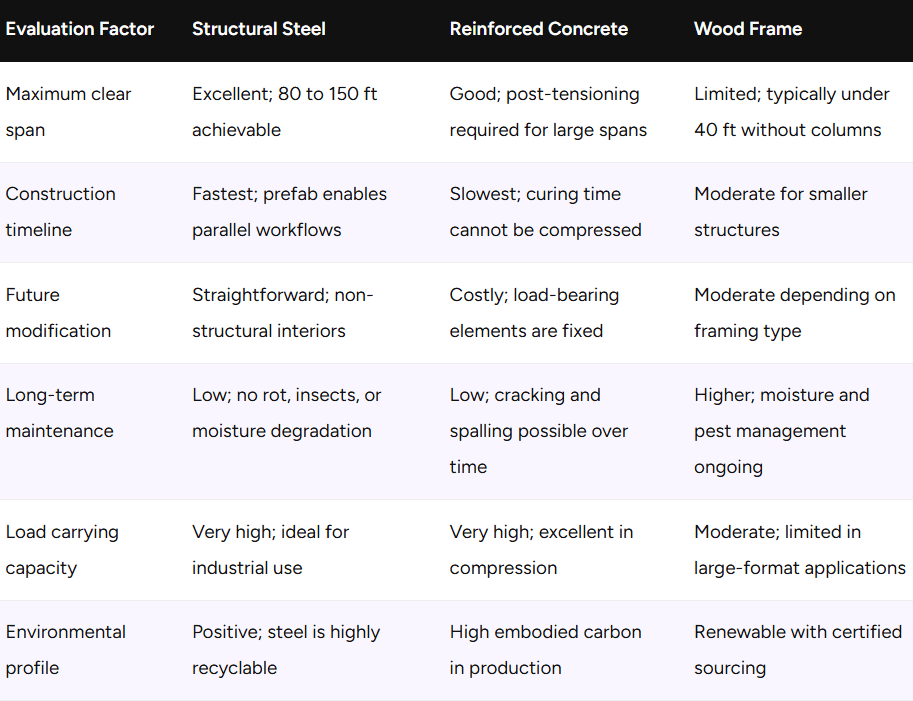
Concrete and masonry structures are strong in compression but they need substantial wall thickness and interior columns to manage loads across large spans. A wood-framed building encounters practical limits on span width that make it unsuitable for anything requiring open floor areas measured in thousands of square feet. Steel carries loads in both tension and compression, which means structural members can be sized to achieve long spans while staying comparatively slender. A steel portal frame that carries a 60-foot clear span without any interior columns takes up far less floor space than the concrete or masonry equivalent and delivers it faster.
The construction speed argument is equally genuine and equally important to the businesses commissioning these buildings. When a company signs a lease, commits to an opening date, or schedules the arrival of manufacturing equipment, the building needs to be ready. Prefabricated steel building uses have expanded dramatically because the factory manufacturing model compresses on-site construction time in a way that site-built alternatives fundamentally cannot match. The structural package arrives engineered, labeled, and ready to assemble. Foundation work and steel erection can be scheduled to overlap rather than sequence, trimming weeks from the overall project timeline.
Industrial Steel Building Solutions: Where Performance Is Non-Negotiable
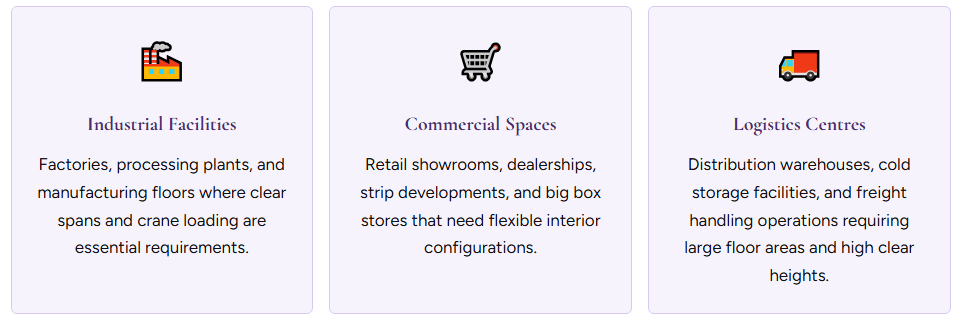
Industrial facilities place demands on buildings that most other construction categories never encounter. Heavy machinery generates vibration and point loads that require structural systems designed specifically to handle them. Overhead cranes running on rail systems embedded in the building frame apply dynamic loads that shift constantly during operation. Chemical processing environments expose structural materials to moisture, heat, and corrosive agents that degrade many conventional building materials over time.
Industrial steel building solutions have been developed specifically around these demands. A manufacturing plant or processing facility built on a steel frame can accommodate overhead crane systems without requiring a separate structural element to carry the crane rails. The columns and rafters that form the building frame can be designed as the crane runway support simultaneously, which eliminates redundant structure and reduces total cost while delivering the operational capability the facility requires.
Factories and Production Facilities
A production facility has requirements that differ meaningfully from a storage building even when both are described as industrial structures. Production floors need overhead clearance for equipment, utilities, and ventilation systems. They need floor loading capacity beyond what most standard buildings provide. They need the ability to accommodate future equipment additions or process changes without major structural modification. Steel framing addresses all three requirements in a single structural system, which is why virtually every greenfield manufacturing facility built in Canada over the past two decades has used steel as its primary structural approach.
Warehouses and Logistics Infrastructure
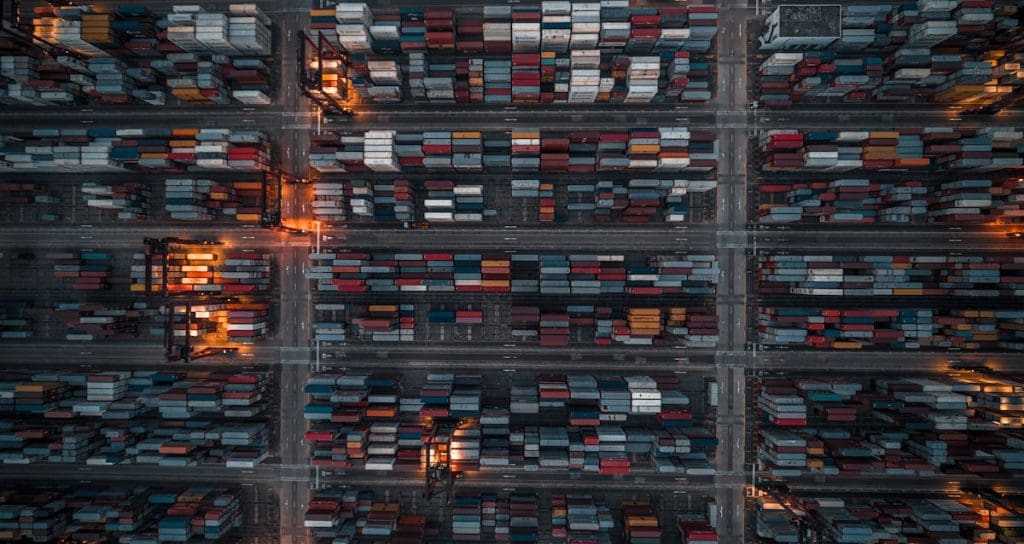
The logistics sector’s relationship with steel construction has intensified alongside the growth of e-commerce. Fulfillment and distribution facilities need floor areas measured in tens or hundreds of thousands of square feet; they need clear heights that accommodate modern automated racking systems; and they need to be built fast enough to serve markets that are scaling in real time. A conventional building approach simply cannot deliver on all three simultaneously. Steel construction routinely does.
Cold storage and refrigerated distribution facilities represent a particularly demanding subset of warehouse construction where steel excels. The thermal cycling that refrigerated buildings experience as doors open and close, as temperatures fluctuate between interior and exterior, and as the refrigeration system responds to load changes creates stresses that degrade less capable structural systems. Steel carries these stresses with far less long-term performance impact than concrete or wood alternatives.

Commercial Steel Structures: Flexibility That Pays Off Over Time
Commercial real estate operates differently from industrial real estate in one important respect: the occupants change more frequently and their requirements vary more widely between successive tenants. A retail location that houses a furniture store today might house a gym, a medical clinic, or a food service operation within a decade. Each of those uses has different internal partitioning requirements, different mechanical and electrical needs, and different demands on the building envelope.
Commercial steel structures handle this kind of lifecycle variability better than masonry or heavily compartmentalized concrete structures because the load path in a steel building runs through the frame rather than through interior walls. Interior walls in a steel-framed commercial building are almost always non-structural, which means they can be added, removed, or repositioned with minimal structural implication. That flexibility is not a small advantage in a commercial real estate market where building adaptability directly influences long-term asset value and tenant attraction.
Automotive Dealerships and Service Centres
Automotive facilities represent one of the clearest commercial arguments for steel construction. A vehicle showroom needs column-free floor space so customers can circulate around inventory without obstruction. A service department needs overhead clearance for vehicle lifts and the ability to route exhaust ventilation through the ceiling structure without creating obstructions. The same building often needs to accommodate office space, parts storage, a customer waiting area, and a wash bay, each with different functional requirements but all within a single structure. Steel framing integrates all of these requirements in a way that would require significantly more architectural compromise in alternative structural systems.
Offices and Corporate Facilities
The relationship between office construction and steel is sometimes overlooked because office buildings do not always announce their structural system the way industrial facilities do. But the steel frame is there, doing the same job it does in a warehouse: carrying loads across long spans, allowing interior configurations to evolve without touching the structure, and providing a building envelope that performs predictably across decades of occupancy.
Multi-storey commercial office developments increasingly use steel framing for upper floors even when the ground floor uses concrete for specific program reasons. The combination of concrete-formed ground floor plates and steel-framed upper floors is now common in mid-rise commercial construction because it delivers the fire and impact resistance characteristics the ground floor requires while achieving the speed, flexibility, and weight advantages that steel offers on upper floors.
One of the most consistent observations from facility managers who have operated steel buildings for ten or more years is that the maintenance cost differential becomes more apparent over time rather than less. The absence of rot, pest damage, and moisture-related structural degradation is not a dramatic event; it is simply a cost that never appears on the maintenance budget. Over a twenty-year ownership period, that absence compounds into a significant financial advantage.
Prefabricated Steel Building Uses: The Efficiency Argument in Full
The prefabricated model deserves particular attention because it changes not just how a building is constructed but how the entire project is managed. When a business commissions a prefabricated steel building, the engineering happens in a factory environment where precision is controlled and quality is verifiable before a single piece of steel leaves the facility. Every structural member is fabricated to exact dimensions. Every connection point is pre-drilled and labeled. The structural package that arrives on site has been designed to assemble as a system rather than as a collection of individual pieces that require field interpretation.
What happens at the factory
Structural members are cut, drilled, and fabricated to precise engineering specifications. Coatings are applied in controlled conditions. Each piece is labeled and packaged for sequential assembly on site. Quality control checks happen before shipping, not after erection.
What happens on site
Foundation and site preparation proceeds independently while the structural package is fabricated. When the steel arrives, erection begins immediately without waiting for on-site cutting or fabrication. The entire structural frame can often be erected in days rather than weeks.
For businesses that need to manage a construction project alongside their primary operations, this factory engineering model reduces the coordination burden significantly. The structural package arrives with the engineering already done, the compliance calculations already completed, and the material already prepared. The business owner does not need to manage a series of subcontractor decisions on-site; they manage a delivery and assembly sequence that has been engineered in advance.
Prefabricated steel building uses have expanded well beyond warehouses and farms into municipal facilities, aviation hangars, recreational centres, and institutional buildings because the efficiency and predictability argument applies regardless of building type. Any building project that benefits from schedule certainty and engineered quality control benefits from the prefabricated steel approach.
Steel vs Traditional Materials: An Honest Side-by-Side Comparison
Evaluating structural options honestly means acknowledging that every material has genuine strengths and real limitations. Steel wins more commercial and industrial comparisons than it loses, but the reasons are specific to how those projects are used rather than inherent across all construction types.
What Businesses Should Know Before Committing to a Steel Structure
Steel building construction ideas are most useful when they are grounded in the specific operational requirements of the business rather than general descriptions of what steel can theoretically achieve. The decisions made at the design stage have a larger impact on total project cost and long-term building performance than almost any subsequent choice, so approaching those decisions with clarity pays dividends throughout the project and beyond. To discover steel building project ideas suited to specific commercial and industrial applications; engaging with an experienced supplier who has worked across multiple sectors provides context that is genuinely difficult to obtain from general research alone.
- Establish your clear span and clear height requirements before approaching any supplier or designer. These two numbers drive structural cost more than any other variable. Knowing them precisely allows you to receive accurate proposals rather than estimates that will shift as the project develops.
- Decide early whether future expansion is likely and communicate that intention at the design stage. Incorporating expansion provisions into the original structural engineering costs a fraction of what it costs to retrofit them into a building that was not designed to accommodate growth.
- Understand the local building code requirements for your site before finalizing any structural specifications. Snow load, wind load, seismic requirements, and occupancy-specific fire ratings vary significantly across Canadian municipalities and regions. A structural package designed to the correct local standards moves through permit review predictably; one that requires redesign during review adds time and cost that no schedule accommodates easily.
- Budget for site preparation as a primary line item rather than an afterthought. Grading, drainage, utility connections, and foundation work frequently represent 25 to 40 percent of total project cost. Discovering this after committing to a building package creates the kind of budget pressure that forces compromises nobody planned for.
- Request and compare at least three complete proposals from reputable suppliers. The completeness and quality of those proposals tells you as much about the supplier’s experience as the numbers do. A supplier who asks detailed questions about your operational requirements before quoting is demonstrating the kind of engagement that produces buildings that actually serve your business well.
- Ask specifically about insulation specifications for any building where temperature control matters. Steel conducts heat efficiently; a building that is not properly insulated will have energy costs that erode the economics of steel’s lower maintenance profile. Getting insulation right at the design stage is significantly cheaper than retrofitting it after occupancy.
The Case for Steel Comes Down to Real-World Performance
Commercial steel structures and industrial steel building solutions have earned their dominant position in the construction market the slow way: by performing well over time, across demanding environments, for owners who track what their buildings actually cost to operate. The initial case for steel is clear spans, fast construction, and engineering precision. The long-term case is the maintenance cost that never appears, the reconfiguration that happens without structural surgery, and the building that is still performing at year thirty the same way it did at year three.
The breadth of steel building applications today reflects decades of owners and developers learning from experience. Warehouses, factories, offices, showrooms, sports facilities, agricultural buildings, and municipal infrastructure all share space in the portfolio of projects where steel has proven itself the preferred structural answer, not because it won a marketing competition, but because it consistently solved the problems those projects presented.
For any business evaluating its options for a new commercial or industrial facility, the steel case deserves a genuine and detailed look. The structural performance is proven. The prefabricated delivery model is mature. The long-term economics are well documented. And the range of completed projects across every sector means that whatever you are building, someone has built something comparable in steel and can tell you exactly how it performed.