

Email verification is often seen as a simple technical step: run a list through a tool, remove invalid addresses, and start sending. While verification is essential, many email marketers unknowingly make mistakes in how they approach it.
These mistakes rarely cause immediate failures, but over time, they quietly damage sender reputation, inbox placement, and overall campaign performance.
The most common email verification mistakes include:
- Treating verification as a one-time task
- Relying only on syntax checks
- Uploading unverified lists directly into sending platforms
- Mishandling catch-all and role-based addresses
- Verifying emails only after campaigns are sent
- Assuming verified emails are always safe
- Applying the same verification rules to every campaign
- Confusing verification with list hygiene
- Over-verifying active subscribers
- Ignoring long-inactive or reused lists
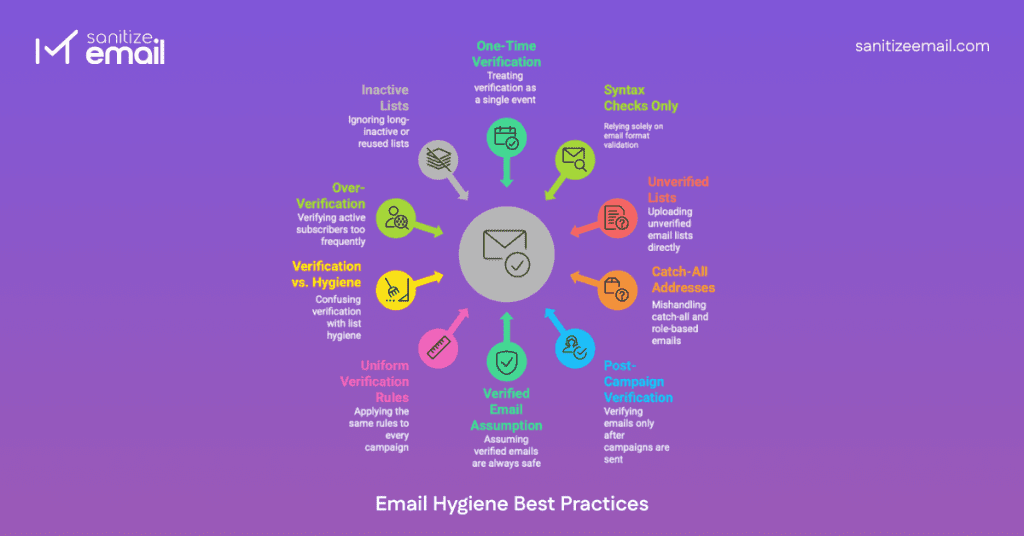
Below, we break down each of these mistakes in detail and explain why they hurt deliverability more than most teams realize.
Treating Email Verification as a One-Time Task
One of the most common mistakes is assuming that email verification is something you do once and never revisit.
Email lists naturally decay. People change jobs, abandon inboxes, switch domains, or deactivate accounts. Even a list that was fully verified a few months ago can slowly become risky over time. When marketers continue sending to aging lists without re-verification, bounce rates increase gradually, often without raising immediate alarms.
Verification should be treated as a recurring process, especially for:
- Lists collected over long periods
- Lists reused across multiple campaigns
- Lists imported from older databases
Since email lists decay continuously, relying on a single verification pass often leads to avoidable bounce and deliverability issues over time. Tools like SanitizeEmail are designed to support ongoing list validation by helping businesses regularly check and maintain email quality, rather than treating verification as a one-time cleanup task.
Relying Only on Syntax Checks
Many platforms perform basic syntax validation, checking whether an email address follows the correct format. While this removes clearly broken entries, it does not confirm whether an inbox actually exists.
Syntax checks alone cannot detect:
- Non-existent mailboxes
- Disabled inboxes
- Catch-all domains
- Temporary or risky addresses
This is where the difference between basic and high-quality verification tools becomes clear. The best email verification tools go beyond format checks and combine multiple layers of validation, including domain verification, mailbox-level signals, and risk detection. These deeper checks are what help marketers reduce silent bounces and long-term deliverability issues.
A detailed comparison of platforms that perform full-spectrum verification, rather than surface-level checks, is covered in this guide on Best Email Verification Tools in 2026, which explains how leading tools differ in accuracy and validation depth.
Relying only on syntax validation creates a false sense of safety. True email verification requires tools that verify inbox behavior, not just email structure.
Uploading Unverified Lists Directly into Sending Platforms
Many deliverability issues start before a campaign is even sent, especially when email lists are introduced directly into hosted email systems without proper preparation. Hosted email environments are designed for delivery, not deep list validation, which is why understanding how these systems work is critical. This overview of hosted email systems and email authentication explains how infrastructure and setup decisions can impact email performance early on.
This can result in:
- Reduced inbox placement
- Account warnings or restrictions
- Long-term reputation damage
Verification should always happen before emails are introduced into any sending environment.
Ignoring Catch-All and Role-Based Email Addresses
Catch-all domains accept emails sent to any address, regardless of whether the mailbox exists. Role-based emails such as info@, sales@, or support@ can also behave unpredictably.
Many marketers treat these addresses as fully valid because they technically accept mail. However, sending at scale to these addresses can:
- Lower engagement rates
- Increase spam filtering risk
- Reduce sender reputation over time
Catch-all and role-based emails are not always bad, but they should be handled cautiously, often separated from core campaign lists or tested gradually.
Verifying Emails Only After Campaigns Are Sent
Email providers have become increasingly cautious due to the growing abuse of email as an attack vector. Verification mistakes don’t just affect deliverability; they can also increase security-related filtering. As email continues to be exploited for phishing and spoofing, inbox providers apply stricter trust signals. This article on why email has become a major attack surface provides useful context on why verification and sender trust matter more than ever.
Verifying lists before sending helps avoid problems rather than attempting to fix them after the fact.
Assuming “Verified” Means “Safe Forever”
Verification confirms that an email address exists and can receive messages. It does not confirm that the recipient is active, interested, or engaged.
Sending repeatedly to verified but unresponsive contacts can still harm deliverability. Low engagement is a strong negative signal for inbox providers, even if the email address itself is valid.
This is why verification must be combined with engagement monitoring and list hygiene practices. Validity alone is not enough to ensure healthy campaigns.
Using the Same Verification Rules for Every Campaign
Enterprise inbox providers evaluate multiple trust signals beyond email validity, including sender behavior, infrastructure, and historical reputation. Security-focused filtering systems are increasingly involved in delivery decisions, especially for high-volume or B2B campaigns. This breakdown of enterprise email security considerations highlights why modern email filtering goes far beyond simple spam rules.
Verification rules should be aligned with:
- Campaign type
- Sending volume
- Domain age
- Audience familiarity
A flexible approach reduces deliverability issues without over-restricting legitimate sends.
Confusing Email Verification with List Hygiene
Email verification and email hygiene are related but not the same.
Verification focuses on whether an email address exists and can receive mail. Hygiene focuses on how recipients interact with emails over time, including engagement, inactivity, and responsiveness.
Many marketers assume that running verification alone is enough to maintain list health. In reality, even fully verified lists require regular hygiene checks to remove inactive or disengaged recipients.
Treating these two processes as interchangeable leads to long-term performance decline.
Over-Verifying Active Subscribers
While verification is important, applying it too aggressively can also create problems.
Re-verifying highly engaged subscribers too frequently can result in false negatives, especially with providers that use strict filtering or temporary inbox behaviors. Removing active users based on overly cautious verification can hurt engagement and revenue.
Verification should be balanced with engagement data. Active subscribers should be treated differently from newly collected or dormant addresses.
Ignoring Old or Reused Email Lists
Old lists are often reused for new campaigns without reconsideration. Even if a list performed well in the past, its quality may have degraded significantly over time.
Domains may no longer exist, employees may have left companies, and inboxes may have been deactivated. Sending to these lists without re-verification introduces unnecessary risk.
Any list that has not been used for an extended period should be treated as new and verified again before sending.
Final Thoughts
Email verification is a critical part of protecting deliverability, but it is often oversimplified. Most verification mistakes do not cause immediate failures. Instead, they quietly accumulate, making deliverability issues harder to diagnose and fix later.
By treating verification as a continuous, preventative process and avoiding these common mistakes, email marketers can improve inbox placement, protect sender reputation, and build more sustainable email programs.
Strong deliverability is rarely the result of one tool or one action. It is built through consistent, thoughtful practices across every stage of the email marketing workflow.
