
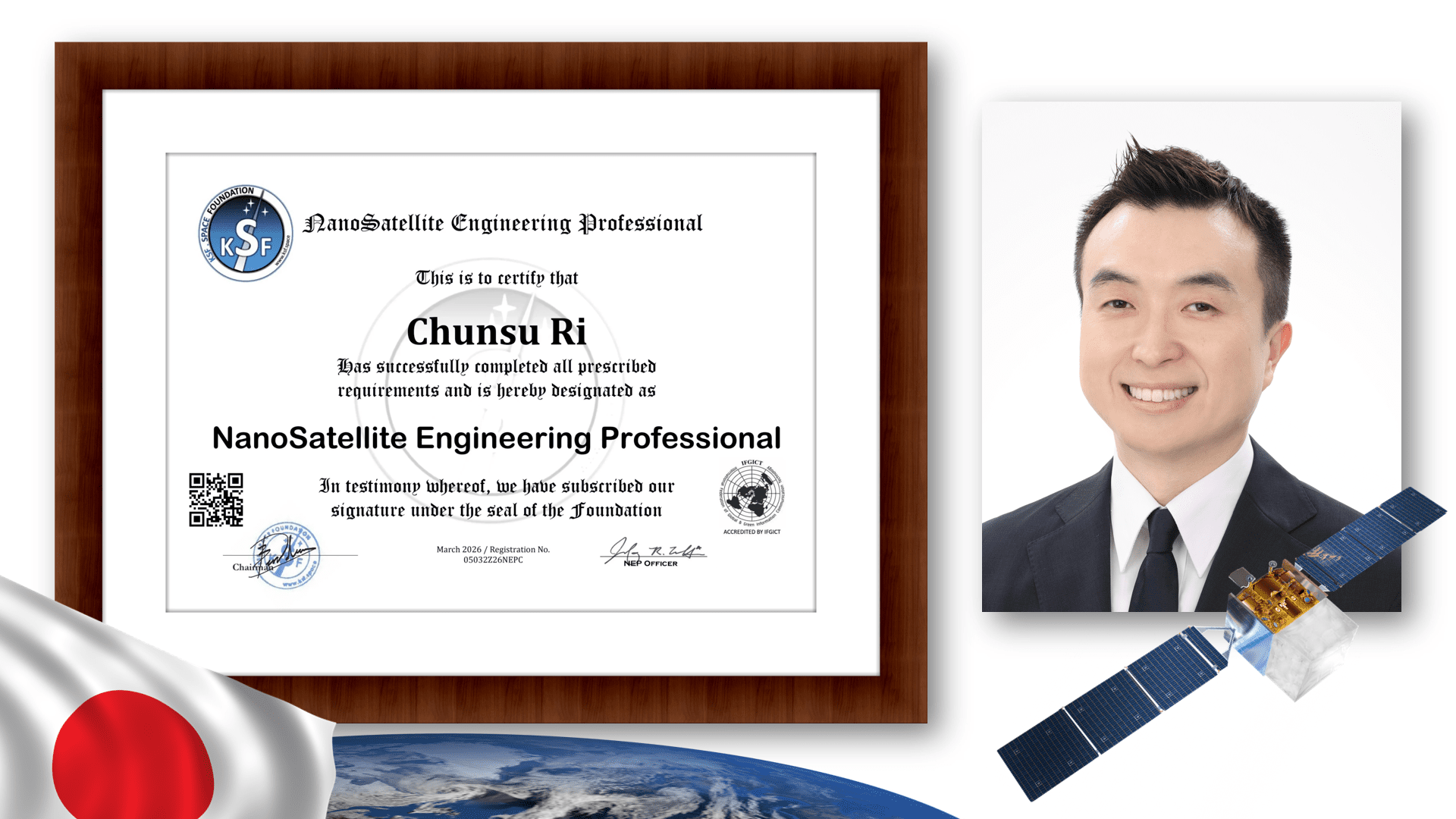
The landscape of the Japanese aerospace and IT sectors has reached a significant milestone with the professional certification of Chunsu Ri. As the Chief Executive Officer of Aisumairu LLC, a Tokyo-based firm recognized for its excellence in system development and IT support, Ri has officially become the first individual in Japan to earn the Nanosatellite Engineering Professional (NEP) degree. This prestigious qualification is awarded by the KSF Space Foundation, a global leader in providing cost-effective access to low Earth orbit for research and academic purposes. Ri’s achievement signals a new era for Japanese tech leaders who are looking beyond traditional software boundaries to embrace the burgeoning commercial space industry.
The Nanosatellite Engineering Professional degree is designed to validate a high level of technical proficiency in the design, development, and operational management of small-scale orbital assets. For Chunsu Ri, this certification is not merely a personal accolade but a strategic bridge between his established expertise in information technology and the specialized requirements of modern space systems. By mastering the KSF Space Foundation’s rigorous standards, he has positioned himself as a vital link in Japan’s effort to democratize space technology and integrate it with terrestrial business solutions.
The Foundation of Aisumairu LLC and a Vision for Innovation
Before his foray into space engineering, Chunsu Ri built a robust reputation as a versatile leader in the Tokyo tech scene. A graduate of Korea University in Tokyo, Ri’s career spanned multiple industries, providing him with a nuanced understanding of how technology serves human needs across different sectors. This diverse experience culminated in the founding of Aisumairu LLC. The company operates with a core mission to enrich lives through a blend of high-level technology and human creativity. By delivering custom IT solutions and streamlined system development, Aisumairu has helped numerous businesses optimize their internal operations.
Under Ri’s leadership, Aisumairu has prioritized the human element of technology. The company’s philosophy suggests that IT should not just be a tool for efficiency, but a means to enhance the quality of life for its users. This worldview naturally transitioned into Ri’s interest in space. He recognizes that satellite technology, particularly in the form of cost-effective nanosatellites, holds the potential to solve complex global challenges ranging from environmental monitoring to providing internet access in remote regions. His pursuit of the KSF Space Foundation certification was driven by a desire to apply Aisumairu’s creative system development approach to the stars.
Bridging the Gap Between IT Support and Orbital Systems
The integration of IT support services with satellite engineering is a growing trend known as the “NewSpace” movement. Traditional space missions often relied on massive, government-funded hardware, but the modern industry is shifting toward software-defined satellites. This is where Ri’s background becomes a significant asset. A nanosatellite is essentially a sophisticated flying computer, and the challenges of managing its data, ensuring its cybersecurity, and maintaining its software architecture are identical to the challenges Aisumairu solves for its clients on the ground.
By earning the NEP degree, Ri has mastered the specific hardware constraints that differentiate space systems from Earth-bound servers. The KSF Space Foundation’s curriculum covers essential topics such as orbital mechanics, link budget analysis, and thermal management. This allows Ri to oversee the entire lifecycle of a satellite mission, ensuring that the software developed by his team at Aisumairu can withstand the harsh vacuum and radiation of space. His expertise now covers the full spectrum of the data journey, from the sensors on an orbiting satellite to the dashboard of a Tokyo business owner.
A Commitment to the Peaceful Use of Space Technology
One of the primary tenets of Chunsu Ri’s professional philosophy is the peaceful and ethical use of space technology. As the first NEP Certified professional in Japan, he is a vocal advocate for the commercial space industry’s growth in a way that benefits all of humanity. He believes that the orbital environment should be a collaborative space for scientific discovery and commercial innovation rather than an arena for conflict. His alignment with the KSF Space Foundation further emphasizes this point, as the foundation is known for supporting non-profit research and educational missions that aim to solve terrestrial problems using space-based data.
Ri’s vision for the commercial space industry in Japan is one of inclusivity. He hopes to see more small-to-medium enterprises (SMEs) entering the field, breaking the monopoly of large aerospace conglomerates. By reducing the technical and financial barriers to entry, Ri aims to foster a competitive environment where creativity and efficiency are the primary drivers of success. His role as a certified professional allows him to consult with other Japanese firms, helping them navigate the complexities of satellite engineering while adhering to international standards of safety and sustainability.
Empowering the Next Generation Through Programming and Space Education
Outside of his duties as CEO, Chunsu Ri is deeply invested in the future of Japan’s youth. He has long been a dedicated volunteer, promoting programming education for children. He views coding as a fundamental literacy of the 21st century, essential for any child who wishes to navigate the future workforce. With his recent KSF Space Foundation certification, Ri is now looking to expand his educational outreach to include space science. He believes that by teaching children about nanosatellites, he can ignite a passion for STEM that goes beyond traditional classroom boundaries.
Ri’s goal is to make space education accessible and exciting for young learners. He envisions programs where students can learn how to write code for simple satellite tasks, perhaps even participating in “citizen science” missions. By demystifying the technology behind the NEP degree, he hopes to inspire a new generation of Japanese engineers who see space not as a distant dream, but as a practical workplace. His work with children reflects his broader mission of using technology to enrich lives, ensuring that the benefits of the space age are shared by those who will inherit the Earth.
Setting a National Precedent in Japan
The achievement of becoming Japan’s first KSF Space Certified Nanosatellite Engineering Professional carries significant weight in a country known for its precision engineering and technological foresight. Ri has set a high bar for his peers, demonstrating that the transition from a traditional IT career to a specialized space role is not only possible but necessary in a changing global economy. His success is likely to encourage other tech leaders in Tokyo and beyond to seek out similar cross-disciplinary certifications, strengthening Japan’s position in the global aerospace market.
As Aisumairu LLC continues to grow, the influence of Ri’s new expertise will undoubtedly be reflected in the company’s future projects. Whether through the development of specialized software for ground stations or the design of custom satellite subsystems, Ri is now uniquely equipped to lead. His story is one of continuous learning and a refusal to be defined by industry silos. By combining his past experiences in diverse sectors with his new status as a space professional, Chunsu Ri is charting a course that is both innovative and deeply rooted in the service of people.
Future Perspectives for the Commercial Space Sector
Looking ahead, Chunsu Ri intends to be a central figure in the dialogue regarding Japan’s commercial space regulations and infrastructure development. The KSF Space Foundation provides a network of international professionals, and as the inaugural Japanese representative of this certified group, Ri serves as an ambassador for Japanese innovation on the world stage. He is particularly interested in how nanosatellites can contribute to the “Green ICT” movement, using orbital data to track carbon emissions and promote environmental sustainability.
The journey of Chunsu Ri from a system development specialist to a certified space engineer is a narrative of ambition tempered by a sense of social duty. Through Aisumairu LLC, his volunteer work with children, and his pioneering role in nanosatellite engineering, he is building a legacy that spans from the streets of Tokyo to the reaches of low Earth orbit. His work stands as a testament to the idea that technology, when guided by creativity and a mission to improve lives, knows no limits.
Would you like me to create a summary of the KSF Space Foundation’s certification requirements or a brief profile of Aisumairu LLC’s primary services?