
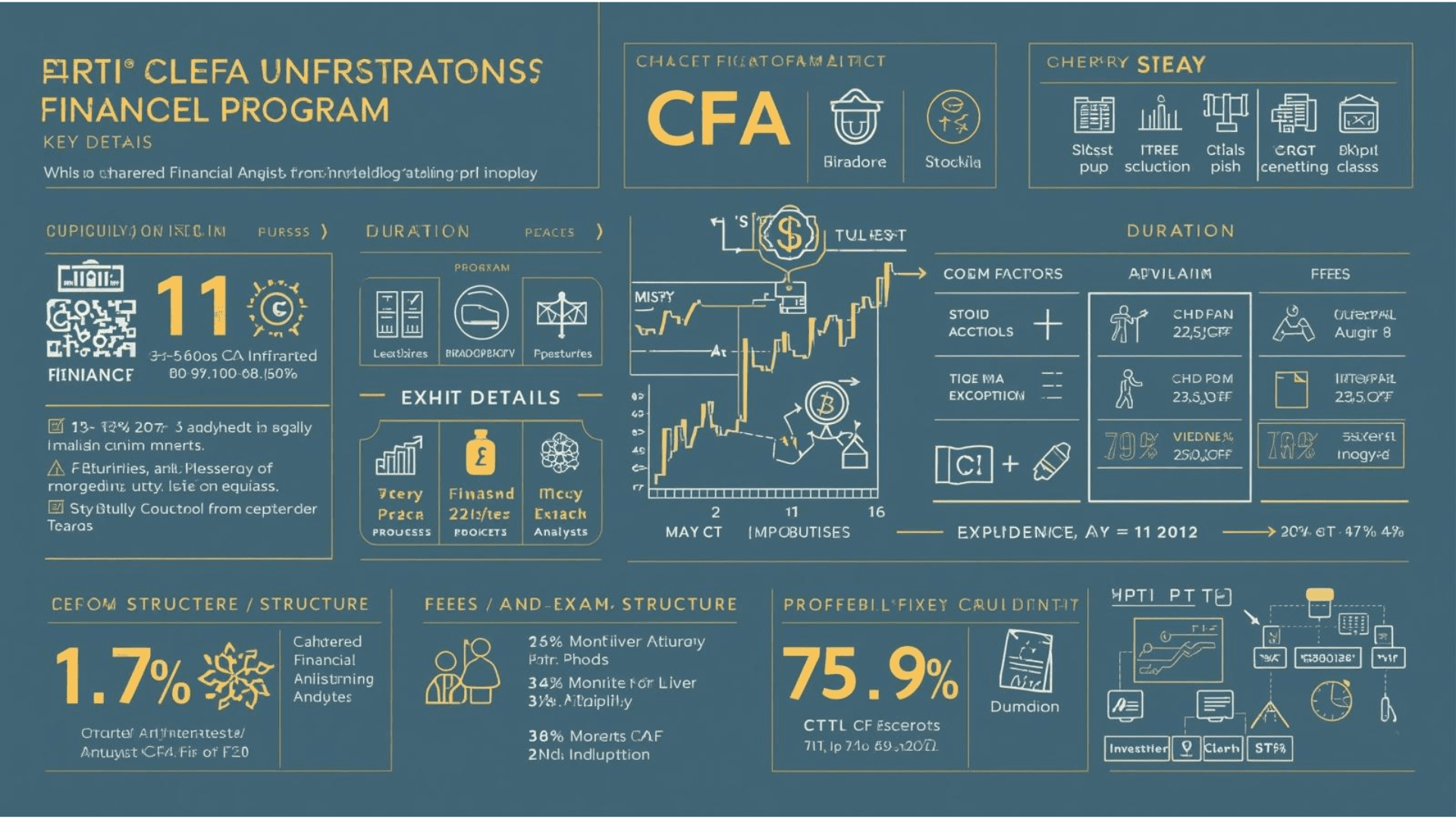
The Chartered Financial Analyst (CFA) program is one of the most prestigious and globally respected qualifications in the finance and investment industry. Designed to develop deep expertise in investment management, financial analysis, ethics, and portfolio management, the CFA designation is highly valued by employers worldwide. Understanding the CFA Course Details is essential for students and working professionals planning to build a long-term career in finance.
In this blog, we clearly and practically explain the eligibility criteria, duration, fees, and exam structure of the CFA program.
What Is the CFA Program?
The CFA program is administered by the CFA Institute (USA) and consists of three exam levels: Level I, Level II, and Level III. Each level tests progressively advanced knowledge in finance, investments, and ethical practices. The program is renowned for its rigorous curriculum and high professional standards, establishing it as a benchmark qualification in the global financial sector.
To complete the program and earn the CFA charter, candidates must pass all three levels, gain relevant work experience, and adhere to the CFA Institute’s code of ethics.
CFA Eligibility Criteria
One of the key aspects of the CFA Course Details is its flexible eligibility criteria, which allow candidates from diverse academic backgrounds to apply. Students can register for the CFA program if they meet any one of the following conditions:
Candidates must hold a bachelor’s degree or be in the final year of their undergraduate program. Alternatively, individuals with a combination of professional work experience and education totalling at least four years are also eligible. There is no specific requirement for a finance background, making the CFA program accessible to students from commerce, science, engineering, and even arts streams.
Additionally, candidates must have a valid international passport and meet the professional conduct requirements set by the CFA Institute.
CFA Course Duration
The CFA program does not have a fixed duration, as it depends on how quickly a candidate clears all three exam levels. On average, most candidates take between 2.5 and 4 years to complete the program.
Each exam level requires a significant amount of preparation, typically around 300 hours of study per level. Many candidates choose to prepare alongside their jobs or studies, making structured guidance from institutes like Synthesis Learning extremely valuable for maintaining consistency and exam readiness.
CFA Course Fees
Understanding the fee structure is an important part of the CFA Course Details. The overall cost of the CFA program depends on the time of registration and exam scheduling.
Candidates are required to pay a one-time enrollment fee when registering for the Level I exam. In addition, each exam level has a separate registration fee, which may vary based on early, standard, or late registration windows. On average, the total cost of completing all three levels can range from a moderate to a higher investment compared to other professional courses.
However, considering the global recognition, career growth, and earning potential associated with the CFA designation, the return on investment is often considered highly favourable. Some candidates may also qualify for scholarships offered by the CFA Institute, which can significantly reduce the financial burden.
CFA Exam Structure
The CFA exams are known for their rigorous and analytical format. Each level of the CFA exam tests different skill sets and knowledge areas.
- Level I focuses on foundational knowledge, including ethics, quantitative methods, financial reporting, economics, and basic investment tools. It emphasises understanding concepts rather than application.
- Level II shifts towards application and analysis, testing candidates on valuation, asset pricing, and complex financial instruments. This level is considered more challenging due to its case-based question format.
- Level III concentrates on portfolio management and wealth planning. It evaluates a candidate’s ability to apply concepts in real-world investment scenarios and includes both item-set questions and structured response (essay-type) questions.
Due to the increasing complexity of each level, many aspirants rely on expert coaching and mentorship from institutes like Synthesis Learning to strengthen their conceptual clarity and exam approach.
Why Choose Professional Guidance for CFA Preparation?
The CFA syllabus is vast and concept-driven, requiring disciplined study and strategic exam preparation. Professional training institutes such as Synthesis Learning provide structured study plans, expert faculty, regular assessments, and exam-oriented guidance that help candidates stay focused and confident throughout their CFA journey.
With the right mentorship and a clear understanding of CFA Course Details, candidates can significantly improve their chances of clearing the exams on the first attempt.
Conclusion
The CFA program is a challenging yet highly rewarding qualification for anyone aiming to build a global career in finance and investment management. By understanding the complete CFA Course Details, including eligibility, duration, fees, and exam structure, aspirants can make informed decisions and plan their preparation effectively.
With consistent effort, strategic planning, and expert support from trusted institutes like Synthesis Learning, achieving the CFA charter becomes a realistic and achievable goal.