

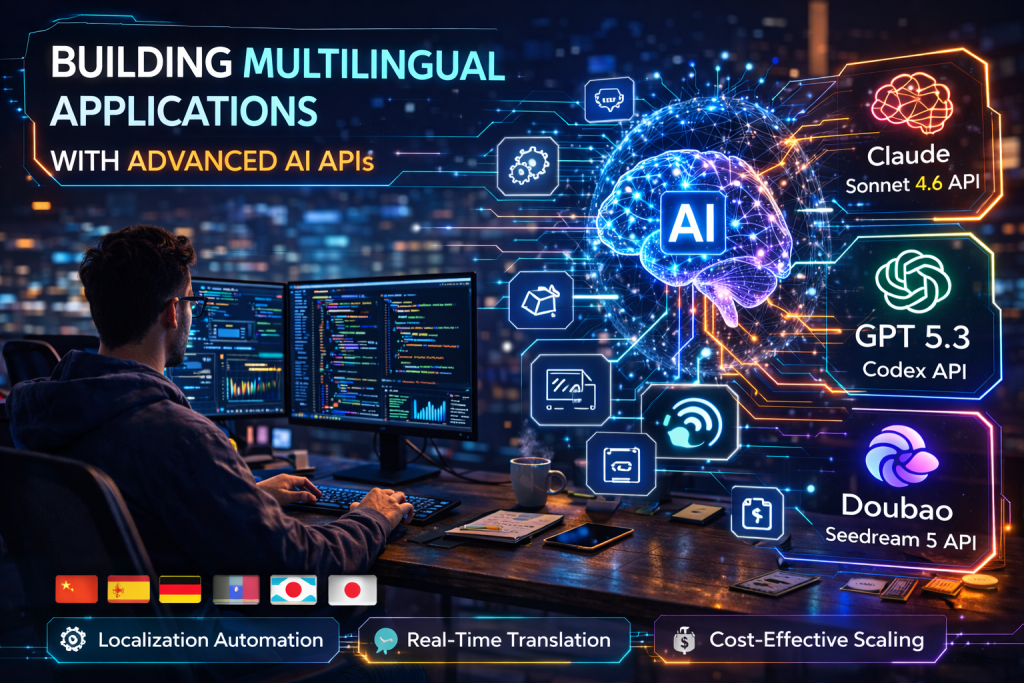
In 2026, global digital growth is happening across Asia, Latin America, the Middle East, and Africa. Businesses expanding internationally must communicate fluently with users in multiple languages—not just through translation, but through culturally aware, contextually accurate content.
This is where advanced AI APIs have become essential. Multilingual AI is no longer limited to basic translation engines. Today’s AI models understand nuance, tone, structure, and context across languages.
For developers building international platforms, selecting the right AI API can determine whether expansion feels seamless—or fragmented.
This guide explores how to build multilingual applications using advanced AI APIs and how cost-effective infrastructure through CometAPI makes global scaling achievable.
1. The Global Need for Multilingual AI
Modern applications serve users from diverse linguistic backgrounds.
Consider:
- Global eCommerce platforms
- SaaS tools with international clients
- Mobile apps scaling into emerging markets
- Enterprise platforms operating across regions
Users expect localized experiences. That includes:
- Accurate translations
- Cultural tone adaptation
- Context-aware responses
- Multilingual customer support
Manual localization processes are slow and expensive. Traditional translation services cannot keep pace with dynamic content updates.
AI-powered multilingual systems solve this problem by:
- Automating real-time translation
- Generating localized marketing content
- Adapting documentation across languages
- Supporting global customer service automation
To achieve this reliably, developers need advanced AI APIs with strong multilingual reasoning capabilities.
2. Challenges in Localization
Localization is more complex than direct translation.
Contextual Nuance
Words often change meaning depending on context. Literal translations can create confusion or unintended tone shifts.
Cultural Sensitivity
Marketing copy that works in one region may feel awkward or inappropriate in another.
Technical Documentation Accuracy
Developer documentation must maintain precise terminology across languages.
Consistency Across Platforms
Web apps, mobile apps, support channels, and marketing materials must align linguistically.
Scalability
As user bases grow, localization workflows must scale without dramatically increasing costs.
Basic translation APIs struggle with these requirements. Advanced AI models provide deeper reasoning and context awareness.
3. Doubao Seedream 5 Strengths
The Doubao Seedream 5 API stands out as a powerful solution for multilingual application development.
It offers:
- Strong cross-language reasoning
- Balanced performance and speed
- Multimodal flexibility
- Efficient inference suitable for real-time systems
For global platforms, Doubao Seedream 5 supports:
- Live chat translation
- Multilingual marketing generation
- Localized content rewriting
- Cross-regional product descriptions
Its ability to maintain context while switching languages makes it ideal for international SaaS and consumer applications.
Additionally, its efficient performance profile helps maintain responsiveness across high-traffic environments.
4. Claude Sonnet for Structured Content
The Claude Sonnet 4.6 API excels in structured reasoning and long-context analysis.
For multilingual systems, this is particularly valuable when handling:
- Legal documents
- Compliance policies
- Technical manuals
- Enterprise knowledge bases
Claude Sonnet 4.6 ensures:
- Logical consistency across translations
- Structured formatting retention
- High coherence in long documents
When international enterprises need precise cross-language document transformation, deep contextual reasoning becomes essential.
Rather than simply translating, Claude helps preserve structural integrity and intent.
5. GPT 5.3 Codex for Localization Automation
The GPT 5.3 Codex API plays a different but equally important role in multilingual systems.
Beyond content generation, it supports localization automation at the infrastructure level.
Key capabilities include:
- Generating localization scripts
- Automating translation workflows
- Managing multilingual JSON structures
- Updating UI language packs programmatically
For example, developers can:
- Automatically extract and translate UI strings
- Generate structured localization files
- Maintain consistent formatting across app versions
This automation significantly reduces manual overhead.
For engineering teams building scalable multilingual products, GPT 5.3 Codex enhances workflow efficiency.
6. Cost Comparison via CometAPI
Global applications generate high API usage.
Each translated message, localized product description, or multilingual support interaction consumes tokens.
Without careful cost planning, international expansion can become expensive.
CometAPI provides access to Doubao Seedream 5, Claude Sonnet 4.6, and GPT 5.3 Codex at highly competitive rates.
CometAPI offers these AI APIs at very affordable pricing, making them highly cost-effective for startups and enterprises.
This affordability allows:
- Startups to expand globally earlier
- Enterprises to automate multilingual systems at scale
- Platforms to maintain healthy margins during international growth
Cost-effective infrastructure ensures that multilingual AI remains an enabler—not a financial burden.
7. Scaling International Platforms
When scaling multilingual systems, infrastructure matters as much as language capability.
Load Management
High-traffic international platforms must handle simultaneous multilingual requests without latency spikes.
Regional Optimization
Deploy AI workloads closer to target markets when possible.
Hybrid Model Strategy
Use:
- Doubao Seedream for live translation and content generation
- Claude Sonnet for structured documents
- GPT 5.3 Codex for localization automation scripts
Combining models strategically optimizes both performance and cost.
Monitoring & Analytics
Track:
- Token usage per region
- Translation accuracy metrics
- Cost per user segment
Scalable AI infrastructure supports continuous international expansion.
8. Best Practices
To build effective multilingual applications:
1. Prioritize Context Over Literal Translation
Use AI prompts that emphasize tone, intent, and cultural alignment.
2. Maintain Terminology Libraries
Create consistent multilingual glossaries for technical and brand-specific terms.
3. Automate Where Possible
Use AI-driven scripts to manage UI language files and content updates.
4. Monitor Output Quality
Implement human review processes for high-risk content such as legal or compliance documents.
5. Optimize Token Usage
Design prompts efficiently to reduce unnecessary token consumption.
Smart optimization keeps multilingual systems both accurate and affordable.
9. Final Thoughts
The future of digital platforms is multilingual.
Users expect seamless experiences in their native languages, and companies that fail to localize effectively risk losing global opportunities.
Advanced AI APIs now enable real-time, context-aware multilingual systems at scale.
- Doubao Seedream 5 powers dynamic cross-language content.
- Claude Sonnet 4.6 ensures structured and logical consistency.
- GPT 5.3 Codex automates localization workflows at the engineering level.
By leveraging cost-effective access through CometAPI, organizations can expand internationally without overwhelming infrastructure expenses.
In 2026, multilingual AI is no longer optional.
It is the foundation of global digital growth.