
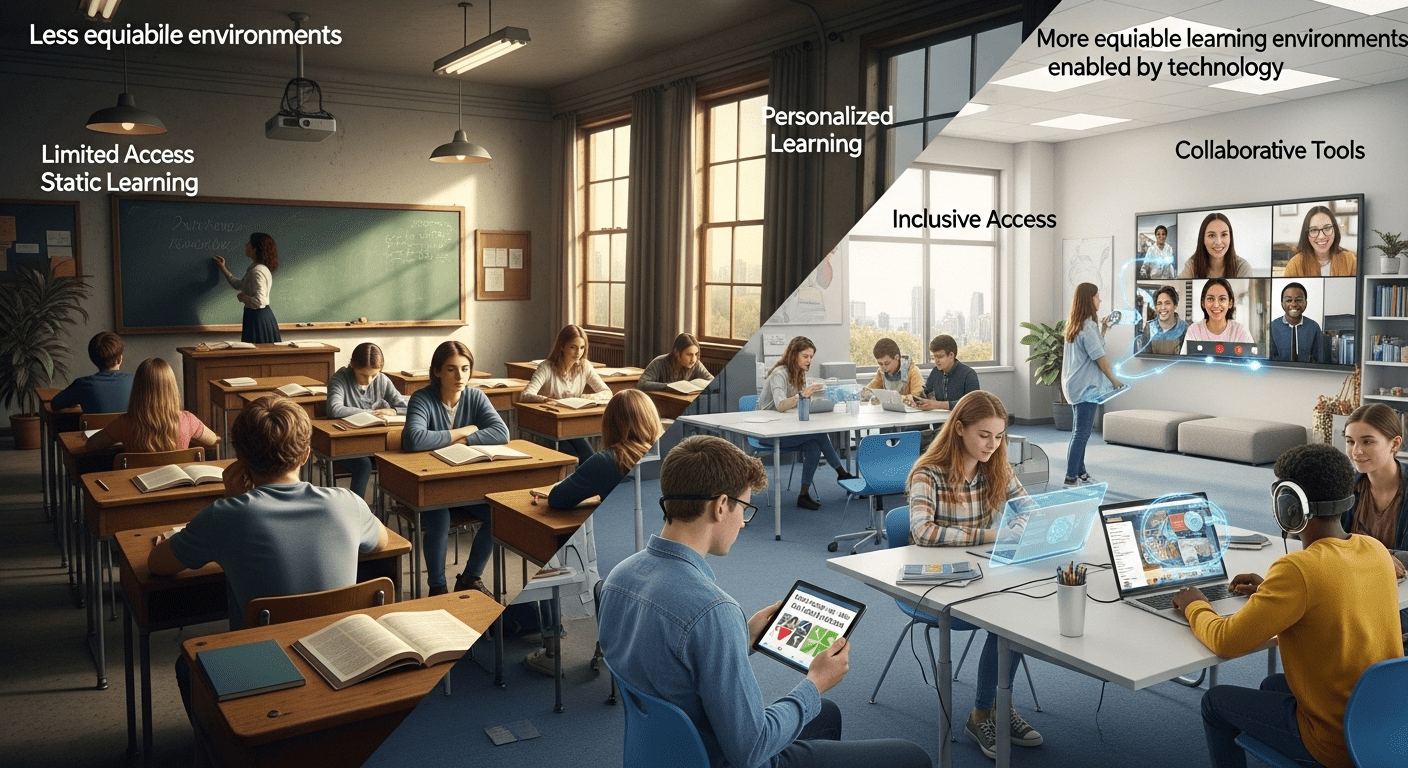
The Promise and Peril of Educational Technology
The rapid integration of tech into educational settings has created unprecedented opportunities to transform learning experiences. Digital tools offer the potential to personalize instruction, provide immediate feedback, and connect students to vast repositories of knowledge regardless of their physical location. These innovations have fundamentally altered what’s possible within and beyond traditional classroom walls, enabling new pedagogical approaches that would have been unimaginable just decades ago.
Yet alongside these promising developments lies a complex reality: the same technological advances that hold such transformative potential can simultaneously widen existing educational disparities when implementation fails to account for existing socioeconomic inequalities. The uneven distribution of technological resources across communities creates a multi-layered digital divide that threatens to leave vulnerable student populations further behind.
Understanding the Dimensions of the Digital Divide
The digital divide in education manifests across multiple dimensions, creating complex barriers to equitable technology integration. The most obvious dimension involves basic access to devices and connectivity—a gap that remains stubbornly persistent despite decades of awareness. In economically disadvantaged communities, many students lack reliable home internet connections or personal computing devices, limiting their ability to fully participate in technology-enhanced learning experiences. Even as smartphone penetration has increased, these devices often prove inadequate for completing substantive educational tasks.
Beyond physical access, the usage divide presents another significant barrier. Many students who have basic technology access lack the digital literacy skills necessary to effectively leverage these tools for learning. Without proper guidance and instruction in information evaluation, digital citizenship, and productive technology use, students may engage with digital tools in ways that fail to support their educational development or even prove counterproductive.
The third dimension involves the participation gap, where cultural, linguistic, and design factors may exclude certain student populations from meaningful engagement with educational technologies. When educational platforms and content fail to represent diverse perspectives or accommodate different learning needs, they effectively marginalize students from non-dominant groups.
These three dimensions of the digital divide—access, usage, and participation—interact in complex ways that can compound educational inequities if not deliberately addressed through thoughtful implementation strategies.
The Role of Teachers in Technology Integration
Skilled and well-supported teachers remain the single most important factor in effective educational technology implementation. While digital tools offer powerful capabilities, their impact depends entirely on the pedagogical context in which they’re deployed. When teachers receive comprehensive professional development that addresses both technical and pedagogical aspects of technology integration, they can transform digital tools into powerful vehicles for student learning and engagement. However, many educators find themselves expected to implement new technologies with minimal training or support, creating frustration rather than empowerment.
Effective professional development for technology integration must go beyond basic tool functionality to address deeper questions of instructional design, assessment, and differentiation. Teachers need opportunities to explore how specific technologies can support their subject-specific learning goals and address the diverse needs of their student populations. Collaborative learning communities where educators can share strategies, troubleshoot challenges, and reflect on implementation successes and failures prove particularly valuable in building collective capacity for meaningful technology integration.
Schools must also recognize that teachers’ technology needs vary widely based on their prior experience, subject areas, and student populations. Differentiated professional development approaches that meet educators where they are and provide ongoing support throughout implementation yield far better results than one-size-fits-all technology trainings.
Innovative Models for Equitable Technology Integration
Despite the challenges, numerous schools and districts have developed promising approaches to more equitable educational technology implementation. Community-based connectivity initiatives have emerged in many regions, with schools partnering with local businesses, libraries, and municipal governments to extend internet access beyond school walls. Mobile hotspot lending programs, community WiFi networks, and subsidized home internet programs have all shown success in expanding connectivity for underserved populations.
Device equity programs have evolved beyond traditional computer lab models to ensure students have consistent access to appropriate technology. One-to-one device initiatives, when thoughtfully implemented with proper training and support structures, can significantly reduce access disparities. Some schools have adopted hybrid approaches that combine school-owned devices with BYOD (Bring Your Own Device) policies, providing school devices to students who lack personal technology while allowing others to use familiar tools.
Culturally responsive technology integration represents another promising approach. By selecting digital content and tools that reflect diverse cultural perspectives and learning preferences, schools can address the participation gap that often excludes non-dominant student groups. This approach requires careful evaluation of educational technology resources to ensure they support rather than undermine equity goals.
Data-Informed Approaches to Digital Equity
Effective digital equity initiatives increasingly rely on sophisticated data collection and analysis to identify specific barriers and measure implementation outcomes. Schools at the forefront of this work have moved beyond simple metrics like device ratios to develop more nuanced understandings of how technology actually functions within their educational ecosystems.
Usage analytics from learning management systems, educational software, and device monitoring tools can reveal patterns of technology engagement across different student populations. These data often uncover hidden inequities in how various student groups interact with available technology, even when physical access appears equivalent. For example, analysis might reveal that English language learners engage less frequently with certain digital resources or that students from lower-income neighborhoods primarily use devices for passive consumption rather than creative production.
By disaggregating technology usage and outcome data across demographic factors, schools can identify specific intervention points and develop targeted supports for student populations experiencing barriers to effective technology use. This data-informed approach allows for more precise allocation of limited resources and enables continuous improvement of digital equity initiatives.
Beyond Devices: Building Digital Literacy and Citizenship
Meaningful technology equity extends far beyond providing devices and connectivity to encompass the development of critical digital literacy skills. Students require explicit instruction in information evaluation, online safety, digital citizenship, and productive technology use—competencies that don’t develop automatically through mere exposure to digital tools. Schools committed to digital equity recognize that these skills are just as important as traditional academic content and allocate instructional time accordingly.
Comprehensive digital literacy curricula address not only functional skills like keyboarding and software use but also higher-order capabilities like critical evaluation of online information, ethical technology use, and strategic learning with digital tools. These programs recognize that digital literacy isn’t a single skill but rather a complex set of competencies that develop progressively throughout a student’s educational journey.
Particularly important is developing students’ capacity to critically evaluate online information—a skill that has taken on new urgency in our current information environment. When students learn to assess credibility, identify potential bias, and cross-check information across sources, they become empowered digital citizens rather than passive consumers vulnerable to misinformation.
Policy Implications and Systemic Approaches
While individual schools and teachers can make significant progress toward digital equity, sustainable solutions ultimately require policy interventions at district, state, and federal levels. Funding formulas that account for technology needs, broadband infrastructure investments in underserved communities, and teacher preparation standards that emphasize technology integration all play crucial roles in creating systemic conditions for equitable digital education.
E-rate programs that subsidize school connectivity have made substantial progress in ensuring that schools themselves have adequate internet access, but policies must evolve to address the “homework gap” that affects students outside school hours. Some states and municipalities have begun treating internet connectivity as an essential utility for education, creating programs to ensure universal home access for students.
Teacher preparation and certification requirements also warrant examination, as many teacher education programs still treat technology integration as an optional specialization rather than a core professional competency. By updating these standards to reflect the centrality of digital tools in contemporary education, policymakers can ensure that new teachers enter the profession ready to leverage technology effectively for all students.
Conclusion: Toward a More Equitable Digital Future
The integration of technology into education holds tremendous potential to either exacerbate or alleviate existing inequities, depending entirely on implementation approaches. By acknowledging the multi-dimensional nature of the digital divide, prioritizing teacher development, implementing innovative access models, utilizing data strategically, developing comprehensive digital literacy programs, and advocating for supportive policies, schools can harness technology as a powerful force for educational equity.
The goal isn’t merely to ensure that all students have equivalent access to devices and connectivity—though that remains an essential foundation—but rather to create educational environments where all students develop the digital competencies needed for full participation in an increasingly technology-mediated society. When we approach educational technology with equity at the center rather than as an afterthought, we can transform digital tools from potential barriers into powerful vehicles for educational opportunity and empowerment.