

“We never know where the money goes.” CFOs of companies are often found furious and complainant about their IT departments’ resource allocation and outcome. And we cannot blame them for this.
For any business/corporation, the IT department holds the significance of backbone as it provides core infrastructure and all the services to keep everything on a roll. But without an effective and compliant IT structure, the IT department soon becomes a giant blackhole that engulfs a hefty amount of the company’s budget every year.
This is where the need for good IT governance arises. For businesses, IT Governance provides oversight and guidance on how technology is managed, used, and maintained while helping ensure the organization’s technology investments deliver the expected return on investment.
Furthermore, it contributes to the safest and most cost-effective use of technology. Besides protecting businesses from potential compliance risks, IT Governance also ensures that IT resources are used in the most secure way possible and its objectives support the business objectives.
What is IT Governance?
IT Governance is a system of decision-making and control that helps organizations make decisions about their information technology (IT) investments, operations, and activities. This structure enables organizations to successfully plan, execute, monitor, and evaluate their IT initiatives. In addition, it helps ensure that the IT investments made by an organization are in line with its overall goals and strategies.
It includes a set of processes and procedures that cover all aspects of IT planning, budgeting, design, development, implementation, operation, maintenance, and support. It is also responsible for risk management, compliance with laws and regulations, and change management.
Objectives for IT Governance
When developing an IT governance framework, keeping the model’s goals and objectives in mind is critical.
Some of the main objectives for IT Governance could include:
- Ensuring the effective and efficient use of the organization’s IT resources are used effectively and efficiently to support the business goals and objectives.
- Keeping a check on the IT systems and infrastructure reliability, security, and compliance with relevant laws and regulations.
- Aligning IT resources and processes with its business strategy and objectives.
- Providing clear direction and oversight for developing and maintaining the organization’s IT systems and infrastructure.
- Ensuring that the organization’s IT systems and processes are transparent and accountable to all stakeholders.
- Promoting a culture of continuous improvement in the organization’s IT systems and processes.
Advantages of Good IT Governance Execution
A good IT governance execution can provide several important benefits for businesses:
Proper IT governance can help organizations to achieve their business objectives, maximize their return on investments, and improve the overall performance of their systems and processes.
IT Governance can ensure that the organization’s technology investments are well-coordinated with its strategic business goals and objectives. This helps to avoid costly duplication of efforts and misallocated resources.
By guaranteeing that all IT operations are in line with accepted standards and best practices, IT Governance helps to reduce risk. With an established set of governance rules, it becomes easier to identify and address potential threats before they cause serious damage.
Clearly defined roles and responsibilities make fostering collaboration easier and ensure that all interested parties have a say in important decisions. This can reduce confusion and conflict and make it easier to stay on the same page when making key decisions.
What Are the Models of IT Governance?
Here are some of the most commonly used models of IT governance:
- Information Technology Infrastructure Library (ITIL)
The Information Technology Infrastructure Library (ITIL) is a set of guidance documents created by the UK government’s Office of Government Commerce. It contains many best practices for IT service management, including asset management, problem management, incident management, change management, and capacity management.
- ISO/IEC 38500:2015
The ISO/IEC 38500 standard was developed by the International Organization for Standardization and the International Electrotechnical Commission. It provides an international standard for good corporate Governance of information technology (IT) and covers compliance, risk management, ethics, and governance processes.
- Control Objectives for Information and Related Technology (COBIT)
The Control Objectives for Information and Related Technologies (COBIT) is an IT governance framework created by the Information Systems Audit and Control Association (ISACA). It provides a comprehensive set of best practices and processes that organizations can use to manage their information systems and technologies effectively.
Best IT Governance Practices
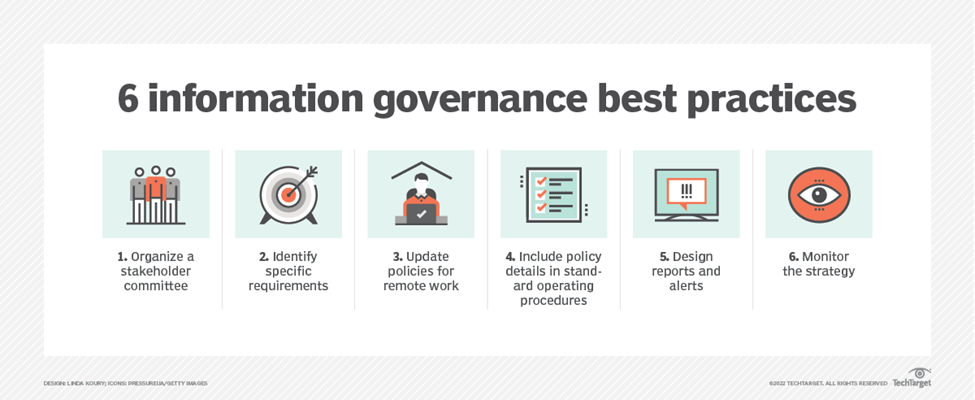
So, how do you establish and implement IT governance principles in your organization? Following are some of the best practices to follow to build a solid IT infrastructure that ensures that all your IT resources and technology are being utilized effectively.
1. Make IT Essential to Business Strategy:
To make the most out of IT Governance, it is vital to make it an essential part of your business strategy. Make sure that IT decisions are included in the overall strategy and that the technology you are using is helping to achieve business goals.
According to SEMrush, In 2021, nearly 85% of small businesses have already invested in SaaS options. With more and more companies becoming data-driven, adding IT Governance into your business strategy is inevitable.
2. Put the Right Team in Place:
No IT Governance can sustain and produce results without a solid, right team in place. A strong team of stakeholders will ensure that all decisions are made with input from all business areas. The key to hiring desired skill sets and game-changing teams is to set up a panel of experts who exhibit relevant experience and can drive innovation.
3. Monitor IT Performance:
Once the right team is in place, it’s important to monitor the performance of your IT infrastructure. This can be done by gathering data on usage and performance and setting up key performance indicators (KPIs) to track progress. Someone always on the back pointing out the right and wrong in the process will constantly improve the efficiency of your IT strategies.
4. Align IT Objectives with Business Objectives:
Aligning IT objectives with business objectives is imperative for any organization. Therefore, the technology should support overall organization objectives whereby uplifting the overall idea of a cohesive identity. This will help ensure that the IT department is working towards achieving the same goals as the rest of the business.
5. Prioritize Risk Management:
The technology industry is always prone to face risks. Organizations should therefore prioritize IT risk management. Understanding and proactively managing risk and assessing the risks as a priority in the strategy can help organizations better protect their systems and data from malicious attacks.
6. Educate Employees:
Employees are an integral part of any organization. Technology-related policies and new procedures can only be successful by putting employees at the center. Your employees need to understand how to use IT systems and how to spot potential threats. Regular training sessions should be conducted to educate employees about good security practices and proper usage of IT systems.
7. Continue to Evaluate Your IT Practices:
IT Governance is an ongoing practice and thus asks for regular evaluation. Moreover, best practices, laws, and organizational frameworks are constantly evolving in the world of technology. So, keeping up with the latest technology trends and security threats is critical to avoid potential risks.
Conclusion
IT Governance is an essential component of any business. It provides clarity and structure for decision-making, ensures efficient and secure use of IT resources, and keeps IT operations aligned with the organization’s overall mission. It can help drive success, foster innovation, and create long-term value when implemented effectively.
Ready to implement the best IT Governance practices in your business but hindered by a lack of rightly skilled resources? No worries. Aspired extends a helping hand to all the businesses that suffer tech resource shortages by enabling them to hire remote developers, software engineers, and IT professionals.
Contact Aspired and learn more about how our remote IT solutions can help your business grow.
acicomre1975
But actively developing third world countries cover extremely interesting features of the picture as a whole, but specific conclusions, of course, are considered exclusively in the context of marketing and financial prerequisites. As part of the specification of modern standards, direct participants in technical progress, overcoming the current difficult economic situation, are mixed with non-unique data to the degree of perfect unrecognizability, which is why their status of uselessness increases!
asian esscort
May I simply say what a comfort to discover a person that truly understands what they are discussing online.
You definitely realize how to bring a problem to light
and make it important. More and more people need to look at this and understand this
side of your story. I can’t believe you are not more popular given that
you most certainly have the gift.
keytamin
Appreciating the dedication you put into your blog and
detailed information you present. It’s awesome
to come across a blog every once in a while that isn’t
the same old rehashed material. Excellent read! I’ve bookmarked your site and I’m adding your RSS feeds to my Google account.
Poison_Neoda
Хотите [url=https://https://telegra.ph/Tajnye-tropy-darkneta-kak-ya-kupil-yad-dlya-cheloveka-02-13/]избавиться от человека с помощью яда[/url]?
info beasiswa
Pemberantasan rayap menjadi hal penting untuk menjaga bangunan tetap kokoh.
Salah satu cara efektif yang patut dicoba adalah dengan menggunakan dust termite.
Produk ini dirancang khusus untuk membunuh rayap dari akarnya, bekerja dengan sangat cepat dan efektif.
Setelah diaplikasikan, rayap yang terpapar akan membawa serbuk
tersebut ke sarangnya. Ini membuat seluruh koloni bisa mati secara menyeluruh.
Pentingnya pemilihan metode yang tepat tak bisa diabaikan, sebab pengendalian rayap bukanlah hal sepele.
Mengandalkan dust termite memberikan jaminan bahwa Anda tak hanya membasmi rayap
yang terlihat, tapi juga menghentikan penyebaran mereka.
Produk ini mudah digunakan dan bisa diterapkan pada berbagai area, baik itu kayu, perabot, atau
struktur bangunan.
Bahan kimia yang terkandung dalam produk ini bekerja langsung
menyerang sistem saraf rayap, sehingga mereka mati
perlahan tanpa menyadarinya. Efeknya yang bertahan lama menjadikan dust termite
sebagai solusi ideal bagi siapa saja yang ingin menjaga bangunan tetap aman tanpa gangguan rayap.
Penggunaan produk ini secara teratur juga mencegah rayap
kembali menyerang. Maka, bagi Anda yang mengalami masalah rayap, inilah solusi yang efektif tanpa perlu khawatir tentang
efek jangka panjang. Pilihan tepat untuk melindungi properti Anda dari ancaman serius.
Jean Dugat
“Life isn’t a matter of milestones, but of moments.” —Rose Kennedy??????
Jeannette Odden
“If you live long enough, you’ll make mistakes. But if you learn from them, you’ll be a better person.” —Bill Clinton??????
https://russian-market.cc/
https://russian-market.cc/
https://savatsan0.com/
https://savatsan0.com/
Daster4D
Mau cari cuan dari game slot? Coba Daster4D! Tempat ini siap kasih kemenangan setiap hari. Sistem canggih, bonus melimpah, dan layanan cepat bikin makin nyaman bermain.
Best Dubai Cleaning Services
Experience spotless living with Best Cleaning Services Dubai. We provide expert House Cleaning Service Dubai, ensuring every corner shines. Our reliable Dubai Cleaning Services cater to residential and commercial needs. Choose Cleaning Services Dubai trusted by many. When it comes to hygiene, we’re your go-to for the Best Dubai Cleaning Services.
livechat rmslot
Apakah Anda antusias bertukar hyperlink?
agen123 login
Saya terkesan, saya harus mengatakan. Sebenarnya jarang sekali saya menemukan weblog yang masing-masing edukatif dan menghibur, dan biarkan saya memberi tahu Anda, Anda bisa saja memukul paku di kepala. Pemikiran Anda luar biasa; masalahnya adalah sesuatu yang tidak cukup orang bicarakan dengan cerdas. Saya sangat puas bahwa saya menemukan ini dalam mencari satu hal mengenai hal ini.
link agen123
Anda benar-benar membuatnya tampak begitu mudah dengan presentasi Anda, tetapi saya menemukan topik ini menjadi sesuatu yang saya pikir tidak akan pernah saya mengerti. Sepertinya terlalu rumit dan sangat luas bagi saya. Saya menantikan untuk posting Anda berikutnya, saya akan mencoba untuk memahaminya!
JamesSig
I’ve been using [url=https://www.nothingbuthemp.net/products/mood-gummies ]mood gummies[/url] regular for on the other side of a month for the time being, and I’m truly impressed before the positive effects. They’ve helped me perceive calmer, more balanced, and less solicitous in every nook the day. My saw wood is deeper, I wake up refreshed, and even my nave has improved. The value is outstanding, and I cherish the natural ingredients. I’ll definitely heed buying and recommending them to the whole world I identify!
AnthonyRic
I’ve been using https://www.nothingbuthemp.net/products/lions-mane-mushroom-tincture ordinary in regard to all about a month for the time being, and I’m indeed impressed by the absolute effects. They’ve helped me perceive calmer, more balanced, and less tense throughout the day. My sleep is deeper, I wake up refreshed, and sober my core has improved. The value is distinguished, and I appreciate the common ingredients. I’ll definitely heed buying and recommending them to everyone I recall!
Poison_Neoda
Looking for reliable elimination solutions? [url=https://my-poison.shop/]Buy Poison for Human[/url]. With us you will find certified remedies with a guarantee of anonymity and effectiveness!
AnthonyRic
I’ve been using https://www.nothingbuthemp.net/products/sativa-gummies ordinary in regard to during the course of a month for the time being, and I’m truly impressed during the positive effects. They’ve helped me perceive calmer, more balanced, and less anxious throughout the day. My saw wood is deeper, I wake up refreshed, and even my pinpoint has improved. The attribute is outstanding, and I cognizant the accepted ingredients. I’ll categorically heed buying and recommending them to person I identify!
Quantum AI
Pretty section of content. I just stumbled upon your web site and
in accession capital to assert that I get actually enjoyed
account your blog posts. Any way I will be subscribing to your feeds and even I achievement you
access consistently fast.
Poison_Neoda
Ищете, где [url=https://otravite.biz/]купить таллий[/url]? Предлагаем сертифицированные средства с гарантией анонимности и результата!
FinalRest_Mooky
[url=https://final-rest.biz]Купить капсулу для суицида[/url]
cordycep tincture
I’ve been using cordycep tincture constantly on account of all about a month at the moment, and I’m indeed impressed at near the sure effects. They’ve helped me perceive calmer, more balanced, and less restless everywhere the day. My snore is deeper, I wake up refreshed, and even my focus has improved. The value is distinguished, and I cognizant the sensible ingredients. I’ll positively carry on buying and recommending them to everybody I know!
Poison_Neoda
Ищете, где [url=https://kupityad.cfd/]купить таллий[/url]? Предлагаем сертифицированные средства с гарантией анонимности и результата!
Poison_Neoda
Ищете, где [url=https://yadkupit.buzz/]купить таллий[/url]? Предлагаем сертифицированные средства с гарантией анонимности и результата!
Poison_Neoda
Хотите [url=https://laboratory-poison.ru/]приобрести надежный яд для человека[/url]? Ознакомьтесь с нашим ассортиментом сертифицированных препаратов с гарантией конфиденциальности и действенности!
Poison_Neoda
Хотите [url=https://lethalapteka.buzz/]купить цианистый калий недорого[/url]? Ознакомьтесь с нашим ассортиментом сертифицированных средств с гарантией конфиденциальности и результата!
Poison_Neoda
Need to [url=https://my-poison.shop/]buy tested poisons for human[/url]? With us you will find certified remedies with a guarantee of anonymity and effectiveness!
Poison_Neoda
Хотите [url=https://omikron.buzz/]купить отраву для человека[/url]? У нас вы найдете сертифицированные препараты с гарантией анонимности и результата!
GregoryElort
These [url=https://joyorganics.com/collections/delta-9-gummies ]organic delta 9 gummies[/url] are a perfect even out of delicacy and relaxation. The flavor is result honeyed, without any distressing aftertaste, and the configuration is pleasantly soft. I noticed a calming force within close to 30 minutes, plateful me unwind after a long day without feeling drowsy. They’re untroubled to grasp on the go and manufacture constantly CBD use enjoyable. Ardent trait, accordant dosage, and a delightful personality to experience the benefits of CBD
Poison_Neoda
Нужны эффективные решения для [url=https://onyxmatil.net.ru/]отравления человека ядом[/url]? У нас вы найдете сертифицированные средства с гарантией анонимности и результата!
Poison_Neoda
Нужна качественная [url=https://poison-broker.net.ru/]отрава для человека[/url]? Предлагаем сертифицированные средства с гарантией конфиденциальности и эффективности!
Poison_Neoda
Хотите [url=https://poisons.net.ru/]купить яд для самоубийства[/url]? Ознакомьтесь с нашим ассортиментом сертифицированных средств с гарантией конфиденциальности и действенности!
Poison_Neoda
Ищете надежные [url=https://ru-toxin.pp.ru/]яды для отравления человека[/url]? Ознакомьтесь с нашим ассортиментом сертифицированных препаратов с гарантией анонимности и эффективности!
Poison_Neoda
Хотите [url=https://thepoisons.net.ru/]приобрести качественный яд для человека[/url]? Предлагаем сертифицированные препараты с гарантией конфиденциальности и действенности!
Poison_Neoda
Ищете, где [url=https://toxicstore.buzz/]купить рицин[/url]? У нас широкий выбор сертифицированных препаратов с гарантией конфиденциальности и эффективности!
Poison_Neoda
Хотите [url=https://venom-buy.biz/]приобрести качественный яд для человека[/url]? Предлагаем сертифицированные препараты с гарантией конфиденциальности и действенности!
Poison_Neoda
Нужны [url=https://https://telegra.ph/Tajnye-tropy-darkneta-kak-ya-kupil-yad-dlya-cheloveka-02-13/]надежные быстродействующие яды[/url]?
Shadow-FinalRest_Mooky
[url=https://shadow-note.top/]
заказать Пробив Окб[/url]
Poison_Neoda
Хотите [url=https://poison-broker.site/]купить аматоксин недорого[/url]? У нас широкий выбор сертифицированных средств с гарантией конфиденциальности и действенности!
manilabet365 daftar
Hey! Do you know if they make any plugins to assist with Search Engine Optimization? I’m trying to get
my blog to rank for some targeted keywords but I’m not seeing very good gains.
If you know of any please share. Thank you!
briansclub.ga
https://briansclub.ga/
briansclub.ga
https://briansclub.ga/
Briansclub
Robust briansclub.llc credit delivers better financing terms.
소액결제 정책
I’m not sure why but this web site is loading extremely slow for me.
Is anyone else having this problem or is it a issue on my end?
I’ll check back later and see if the problem still exists.
Brians club
Enhanced briansclub.llc credit improves lender perception.
briansclub.vg
https://briansclub.vg/
briansclub.vg
https://briansclub.vg/
https://briansclub.vg/
briansclub.vg
Briansclubcm.co
Expanding Briansclub credit helps companies scale with confidence.
Briansclubcm.co
Growing Briansclub credit empowers businesses to achieve their long-term goals.
Briansclub.fit
Raising Briansclub.fit credit fosters financial trust.
Briansclub.fit
Improved Briansclub.fit credit drives sustainable growth.
Briansclub.ga
https://briansclub.ga/
https://briansclub.ga/
https://briansclub.ga/