
Nobody warns you about the first hour in Morocco. You step out of the airport, or off the ferry, and something shifts, not dramatically, not like a movie, but the air smells different, the noise has a different texture, and suddenly the trip you planned on a laptop feels completely inadequate for what’s actually in front of you.
That gap between expectation and reality is, strangely, Morocco’s greatest selling point.
Marrakech — Chaotic, Exhausting, Necessary
Most people start here. Most people should.
Jemaa el-Fna is the kind of place that travel writers have over-described for decades, yet somehow still surprises you in person. By late afternoon the square transforms food stalls appear from nowhere, smoke from lamb skewers drifts across the crowd, and the noise level climbs to something that stops conversation entirely. It’s overwhelming in a way that’s genuinely enjoyable once you stop fighting it.
Step back from the square and the city changes completely. The derbs’ narrow residential lanes behind the main medina streets are quiet enough that you can hear your own footsteps. The Saadian Tombs sit tucked behind a mosque, easy to miss, worth finding: Italian Carrara marble and carved cedarwood in a space sealed for three centuries before being rediscovered in 1917. The Majorelle Garden is smaller than the photos suggest, but genuinely peaceful, which in central Marrakech is its own kind of luxury.
Two nights inside the medina walls, minimum. Wake up in a riad courtyard with msemen and argan oil honey on the table and you’ll understand immediately why this city has been pulling people in for a thousand years.
Fes — The City That Refuses to Simplify Itself
Fes el-Bali is the largest car-free urban area on earth. Over 9,000 alleys. No logical grid. A medina that has been continuously inhabited since the 9th century and shows absolutely no interest in making itself navigable for tourists.
Get lost on purpose. It’s the only strategy that works.
The Chouara tannery is the image most people carry home — circular vats of color viewed from leather shop terraces above the street, workers moving between them in a process that hasn’t changed since the 11th century. The smell hits before you see anything. Pigeon guano, quicklime, natural dye. Merchants will offer you mint to hold under your nose. Accept it.
The Al-Qarawiyyin mosque and university, founded in 859 AD, holds a legitimate claim to being the oldest continuously operating university in the world. Non-Muslims can’t enter, but the Andalusian Quarter surrounding it — its fountains and tilework — is open and architecturally worth an unhurried afternoon.
Chefchaouen — Yes, It’s Real. No, It’s Not Just Instagram.
The blue city photograph has been taken so many times it almost stops meaning anything. Then you arrive before 7am when the light is flat and the alleys are empty and a cat is sleeping in a doorway, and you understand why people keep coming.
The blue isn’t uniform. Each family mixes its own cobalt in one lane, powder blue two doors down, something closer to periwinkle where the wall catches afternoon shade. No filter replicates it accurately because it shifts constantly.
Chefchaouen sits at 600 meters in the Rif Mountains. The hike toward Jebel El Kelaa through cedar and oak forest takes a few hours and earns views back over the medina that the town’s famous alleyways can’t offer. The food is noticeably different from the imperial cities — goat cheese appears on tables, the bread reflects Berber mountain traditions rather than Arab city cooking.
Stay two nights. The tourists who feel it’s overhyped almost always visited for four hours.
The Sahara — Merzouga and Erg Chebbi
The dunes at Erg Chebbi reach 150 meters. Photographs flatten them completely — you don’t understand the scale until you’re climbing one and your legs are burning and the horizon keeps moving.
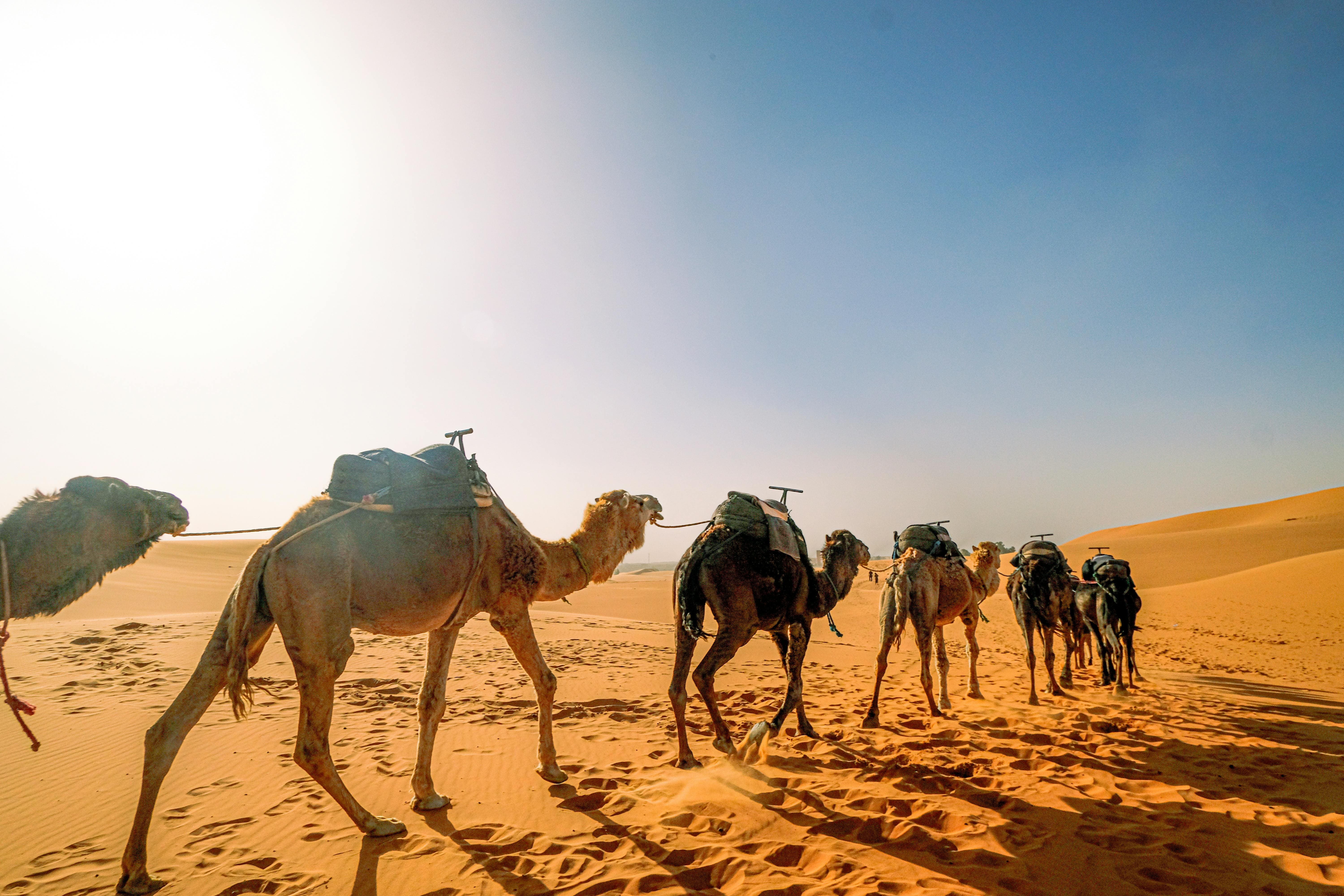
The sunset camel ride to a desert camp reads like a tourist cliché on paper. It isn’t one in practice. Arriving at camp as the sky goes dark, eating tagine around a fire, and sleeping in a structure that’s permanent rather than a flimsy tent. These are experiences that are difficult to be cynical about once you’re actually inside them.
Travelers on organized trips to Morocco tend to reach Merzouga through the Draa Valley route — past kasbahs, palmeries, and Aït Benhaddou, the UNESCO-listed fortified village that doubles as a film set for half of Hollywood’s desert productions. The full southern circuit from Marrakech takes three to four days. A driver-guide handles the mountain passes far better than any rental car situation, especially after October when conditions change.
Essaouira — The One That Catches You Off Guard
Most itineraries treat Essaouira as an afterthought. A day trip from Marrakech, a box to tick. This is a mistake.
The Atlantic wind that batters the ramparts keeps the city at a genuinely livable temperature when Marrakech in July becomes unbearable. The medina is small enough to understand within a few hours. The port fish market sells the morning’s catch cooked immediately to order, at tables with no ambiance whatsoever and food that’s exceptional.
The gnawa musicians outside the ramparts play a ceremonial music rooted in sub-Saharan spiritual tradition — rhythmically unlike anything else in Morocco, completely distinct from the Andalusian-influenced music of the imperial cities. Sit and listen for twenty minutes. You’re in no rush.
What Actually Makes Morocco Work as a Trip
Morocco penalizes rigid planning. The best moments are a conversation that turns into a three-hour tea ceremony with no transaction at the end, a rooftop at 4 am when the call to prayer bounces across Fes, a light you can’t describe arriving on a tiled courtyard don’t appear in itineraries.
Carry small change. Learn five words of Darija. Build slack into every day. For travelers who want local, grounded guidance before committing to bookings, Descubre Marruecos is worth an hour of your planning time. It reflects how Morocco actually moves rather than how tour packages present it.
The country will do the rest.