
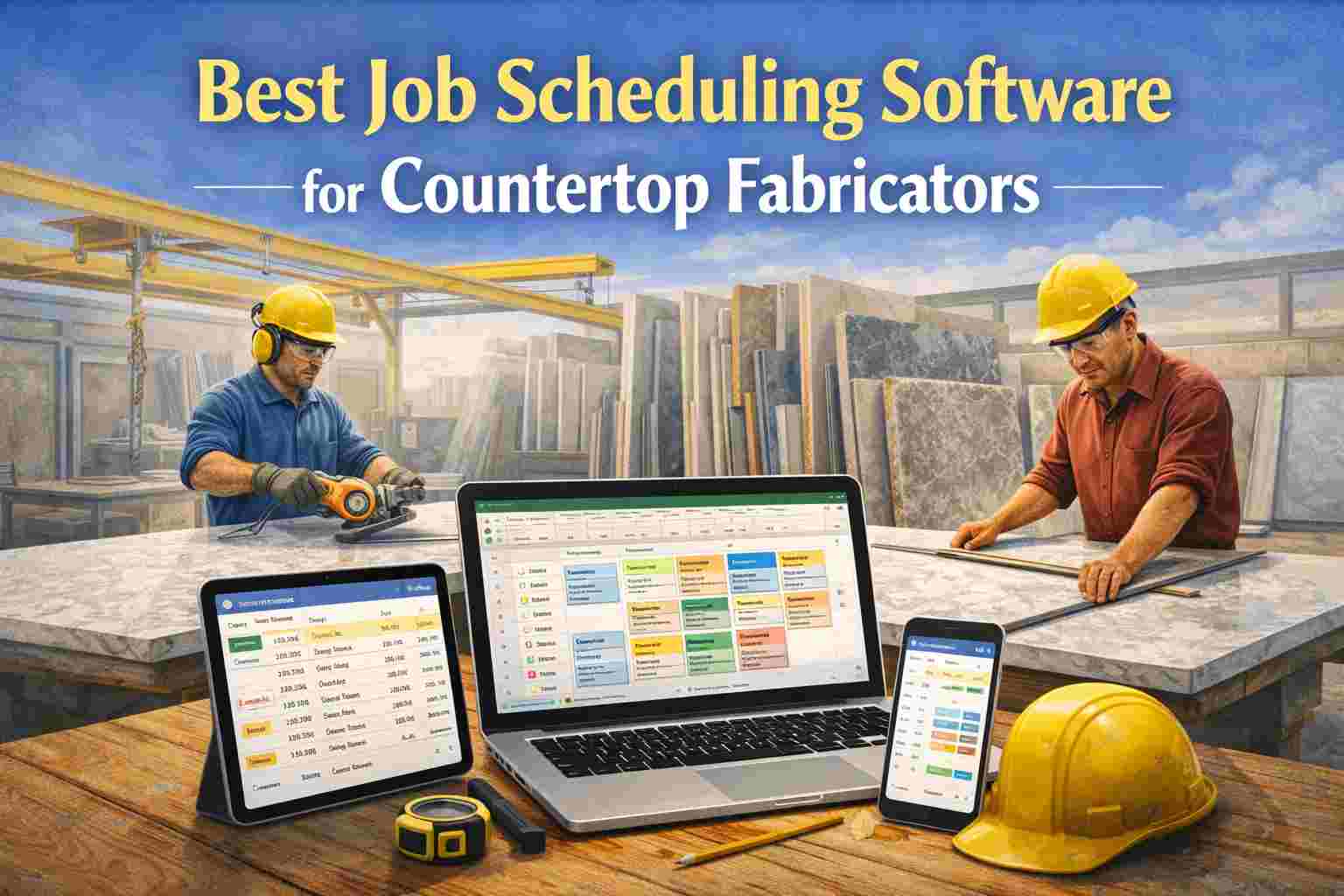
Running a countertop fabrication shop is not just about cutting stone well. It is about moving every job from template to fabrication to install without confusion, delay, or wasted labor. That is where job scheduling software starts to matter. When a shop is still relying on whiteboards, spreadsheets, and text messages, the schedule often lives in too many places at once. One missed update can throw off templating, saw time, install crews, customer communication, and cash flow.
For countertop fabricators, the best job scheduling software is not simply a calendar. It should work like an operating system for the shop. It should show what is ready, what is waiting, what is behind, and what needs attention right now. That kind of visibility becomes more important as the business grows and the number of moving parts increases. Research in manufacturing continues to show that production downtime and disruptions force schedules to be rebuilt, while digital operations tools can materially improve labor productivity, on-time delivery, and overall equipment effectiveness when they are implemented well.
Why scheduling is such a big issue in countertop fabrication
Countertop fabrication is a workflow business. A single job can involve sales approval, field measurements, slab selection, file preparation, fabrication, edge work, sink cutouts, quality checks, delivery coordination, and installation. When those steps are not connected, jobs slip. One crew may be waiting on a template file while another is ready to fabricate. A slab may be reserved but not visible to the person building the schedule. An install date may be promised before the fabrication side is actually ready.
This is why scheduling software for fabricators needs to go beyond simple appointment booking. It has to reflect the real sequence of shop operations. In manufacturing more broadly, schedule instability is closely tied to breakdowns, interruptions, and the need to continuously rebuild production plans. That same pattern shows up in stone shops, even if the environment is smaller and more specialized. A countertop business may not call it shop floor optimization, but that is exactly what it is.
What the best scheduling software should actually do
The best job scheduling software for countertop fabricators should make the work visible in a way that feels practical, not theoretical. Shop owners and operations managers need to see where every job stands without clicking through five systems. A strong platform should connect the schedule to quoting, production status, slab or remnant information, customer approvals, and install readiness.
That matters because scheduling only works when the data behind it is current. If the schedule says a job is ready but the DXF is still being cleaned up, the software is not helping. If the install crew is booked but the slab has not been optimized or assigned properly, the business is still operating on guesswork. In real operations, better scheduling comes from better information flow. Studies on manufacturing lead time reduction repeatedly show that process visibility, waste reduction, and stronger coordination reduce delays and improve throughput.
Features that make the biggest difference in the shop
For countertop fabricators, the most useful scheduling features are the ones that reduce handoffs and help the team make quick decisions. A visual board is often better than a dense spreadsheet because it shows status immediately. If a job can move from template to approved to fabrication to install with a simple drag and drop workflow, the whole team stays aligned more easily.
Capacity awareness is also important. A good system should help managers avoid overloading a fabrication day while leaving install crews underbooked later in the week. It should also make it easy to spot bottlenecks. In many shops, the problem is not a lack of work. It is that too much of it piles up at one stage. When digital manufacturing leaders improve how work is monitored and prioritized, the gains can be significant. McKinsey has documented an 11 percent improvement in overall equipment effectiveness from digital monitoring and analytics, while the World Economic Forum has reported that its latest Lighthouse cohort saw major gains in labor productivity and on-time performance through digital solutions and better operational coordination.
Why generic scheduling tools often fall short
A general project management app may look fine on the surface, but countertop fabrication has its own logic. Jobs depend on slab dimensions, seam placement, machine readiness, customer signoff, and install windows. A generic app can track tasks, but it usually does not understand stone fabrication workflows. That creates more manual work because the team has to translate real shop conditions into a tool that was never built for them.
This is where specialized software stands apart. A fabricator does not need another disconnected calendar. They need something that reflects how a countertop job actually moves through the business. The closer the software matches the real workflow, the more likely the team will use it consistently. And consistent use is what makes scheduling better over time.
How SlabWise can help
SlabWise is worth considering because it is built specifically for countertop fabricators rather than for general contractors or office teams. On its site, SlabWise positions job scheduling as part of a broader countertop fabrication platform. It includes a Kanban-style workflow from template to install, along with quoting, customer portal tools, invoicing, slab inventory, DXF middleware, and nesting optimization. That matters because scheduling becomes far more useful when it is connected to the rest of the job rather than sitting in isolation.
In practical terms, that means a fabricator can manage scheduling in the same ecosystem where they are already handling other key parts of the operation. If your team is quoting jobs, validating files, optimizing slab usage, and coordinating installs in separate places, delays are almost guaranteed. SlabWise tries to pull those functions together. For shops that want fewer missed handoffs and better operational visibility, that integrated model can be a real advantage. The company also highlights that its platform supports drag and drop job scheduling while tying into production and customer-facing workflows, which is the kind of setup many growing fabricators need.
Choosing the right software for your shop
The best software is not always the one with the longest feature list. It is the one your team will actually use every day. For a small or mid-sized countertop fabricator, the right platform should make scheduling easier within the first week, not harder. It should help answer simple questions quickly. What is ready for fabrication. What is waiting on approval. What is scheduled for install. Where is the bottleneck. Which jobs are at risk.
That is the real value of scheduling software. It brings order to a workflow that can become chaotic very fast. In a business where delays affect crews, customers, slabs, and revenue all at once, that kind of clarity is not a luxury. It is operational protection.
Final thoughts
The best job scheduling software for countertop fabricators is software that understands fabrication, not just scheduling. It should fit the real path of a job from first approval to final install. It should reduce confusion, improve coordination, and help the team respond faster when something changes. Research across manufacturing keeps pointing in the same direction. Better visibility and stronger digital coordination lead to better performance. For countertop shops trying to scale without losing control, that lesson applies just as much on the shop floor as it does in larger factories.
If you want, I can also rewrite this into a more SEO-focused version with a stronger intro and more commercial keyword use.