

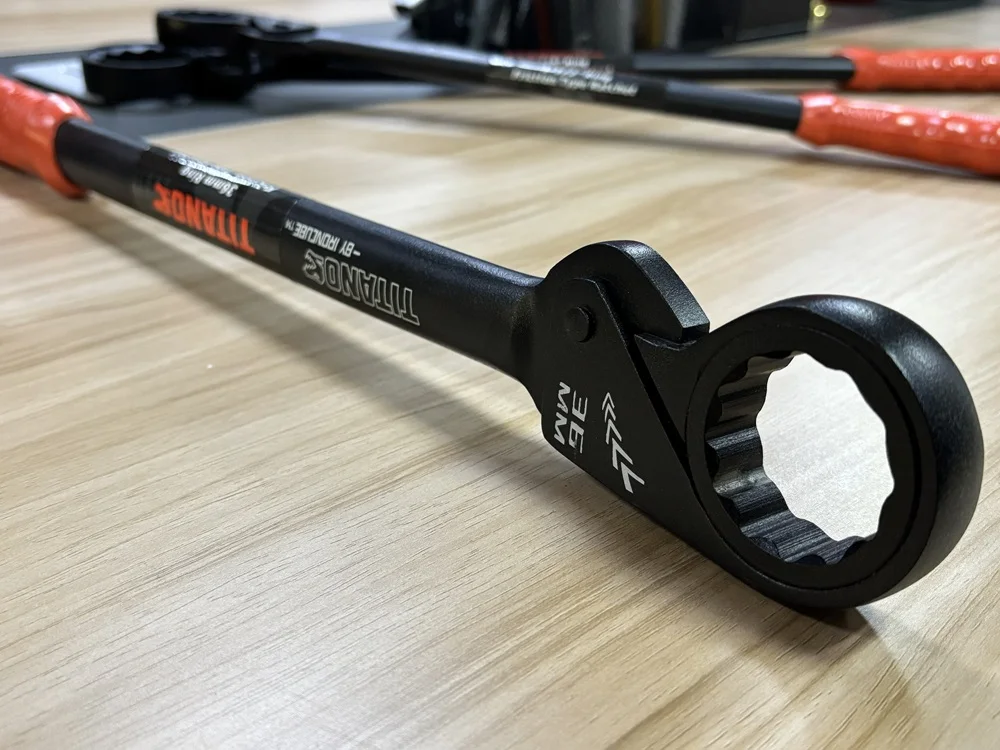
Diesel engines don’t ask nicely. Everything about them is bigger, heavier, and torqued tighter than their gasoline counterparts — from turbo clamp bolts to injector line fittings, from flywheel housing fasteners to exhaust manifold studs. If you’ve spent any time under the hood of a Cummins, Caterpillar, or Detroit Diesel, you already know that generic tool sets fall short almost immediately. What you need is a heavy duty ratcheting wrench that’s engineered specifically for the kind of abuse diesel work delivers, shift after punishing shift.
This guide was written for working diesel mechanics — the technicians in fleet shops, mining operations, marine yards, and agricultural dealerships who can’t afford tool failure halfway through a head gasket job. We’ll break down what separates a genuinely professional-grade heavy duty ratcheting wrench from the mass-market hardware-store variety, compare specific products head to head, and explain why the IRONCUBE extra-large heavy duty ratcheting wrench series has been gaining serious traction among diesel professionals over the past two years.
The global hand tool market continues to grow. Industry research projects the ratcheting wrench segment alone at over $2 billion by 2025, driven by increased demand in automotive repair, heavy equipment maintenance, and industrial construction. Within that market, heavy-duty and oversized wrenches represent one of the fastest-expanding niches — and diesel mechanics are a primary driver of that growth.
What Actually Makes a Ratcheting Wrench Heavy Duty?
Manufacturers love to slap the words “heavy duty” onto product labels, and most buyers have learned to take those claims with a grain of salt. So what does the term actually mean when applied to a ratcheting wrench? It comes down to four measurable factors: material grade, cross-sectional thickness, ratchet mechanism design, and jaw geometry.
Material grade is the foundation. Professional-quality heavy duty ratcheting wrench tools use chrome vanadium (Cr-V) steel, which delivers an excellent balance of hardness, toughness, and corrosion resistance. Budget tools often substitute plain carbon steel or unspecified alloy blends that bend under load and fatigue quickly. For diesel work — where torque demands regularly exceed what automotive fasteners require — Cr-V is the minimum acceptable standard.
Cross-sectional thickness determines how much load a wrench beam can absorb before it begins to flex. Thin-profile wrenches are great for tight automotive spaces, but diesel engines have larger clearances and much larger fasteners. A thicker beam translates to less deflection, which means more of your effort reaches the fastener instead of being wasted bowing the tool.
Ratchet mechanism design separates professional tools from throwaway ones. Tooth count is the most visible metric: a 72-tooth mechanism gives you a 5-degree arc swing, while a cheaper 36-tooth unit requires 10 degrees. In the confined spaces of a diesel engine bay, that difference is enormous. The internal pawl and gear should ride on hardened pins and be rated for thousands of cycles without service.
Jaw geometry is the often-overlooked factor that determines how well the wrench grips the fastener. Precision-machined jaws distribute load evenly across the flat surfaces of a hex nut or bolt head, reducing the risk of rounding. Loose-tolerance jaws concentrate stress on the corners, which damages both the fastener and the tool over time.
The ASME B107.100 standard establishes performance and safety requirements for flat wrenches including combination and ratcheting designs. Any wrench marketed as heavy duty should meet or exceed these published minimums — and the best tools significantly surpass them.
Why Diesel Mechanics Need a Heavy Duty Ratcheting Wrench More Than Anyone
Diesel engines are designed around durability, which means they use larger fasteners, higher torque specifications, and harder materials than gasoline powertrains. A Class 8 truck engine can weigh over 2,800 pounds. The head bolts on a Caterpillar C15 require torque values north of 300 foot-pounds. Exhaust manifold studs on a Cummins ISX sit in a heat-cycled, carbon-caked environment that makes removal an exercise in patience and brute force.
In these conditions, a standard ratcheting wrench — the kind you’d grab for passenger car brake work — simply won’t survive. The beam flexes. The ratchet mechanism skips under load. The jaws round off the fastener, turning a routine job into a multi-hour extraction nightmare. Diesel mechanics reach for a heavy duty ratcheting wrench because their livelihood depends on tools that perform under extreme stress without hesitation.
There’s a productivity argument too. Diesel fleet shops bill labor by the hour, and downtime costs money. A ratcheting wrench with a 72-tooth, 5-degree swing lets a technician work faster in tight clearances around turbochargers, fuel systems, and exhaust components. That speed advantage compounds across hundreds of jobs per year. When a shop invests in quality tools, the return shows up directly in efficiency and profitability.
The IRONCUBE XLHD Series: Built for the Diesel Shop
IRONCUBE Works has been quietly building a reputation among mechanics who work on heavy equipment and commercial diesel engines. Their XLHD (Extra Large Heavy Duty) ratcheting wrench series targets the exact pain points diesel technicians face: oversized fasteners that other brands ignore, beam thickness that resists flexing, and a ratcheting mechanism precise enough for confined engine bays.
The IRONCUBE large heavy duty ratcheting wrench lineup covers metric sizes from 24mm through 50mm, along with equivalent SAE sizes. That 50mm ceiling is significant — most competing brands stop at 32mm, leaving diesel mechanics to improvise with adjustable wrenches, pipe wrenches, or slugging wrenches for anything larger. Those workarounds are slower, less precise, and more likely to damage fasteners.
Every wrench in the XLHD series is forged from chrome vanadium steel, heat treated to 42–48 HRC on the Rockwell scale. The matte chrome finish resists corrosion and provides a non-slip surface even with oily hands — a constant reality in diesel shops. Size markings are laser engraved on both sides, so identification is fast whether you’re reaching into a toolbox or pulling a wrench off a wall rack.
Heavy Duty Ratcheting Wrench Comparison: IRONCUBE vs. the Competition
Choosing a heavy duty ratcheting wrench means evaluating trade-offs between price, quality, and size coverage. The table below compares the IRONCUBE XLHD against three well-known alternatives across the specifications that matter most to diesel mechanics.
| Specification | IRONCUBE XLHD | Snap-on OEXRM | GearWrench XL | Budget Import |
| Material | Cr-V Steel | Alloy Steel | Cr-V Steel | Carbon Steel |
| Tooth Count | 72-tooth | 72-tooth | 72-tooth | 36-tooth |
| Arc Swing | 5° | 5° | 5° | 10° |
| Largest Size | 50mm / 2″ | 24mm / 15/16″ | 32mm / 1-1/4″ | 32mm / 1-1/4″ |
| Beam Profile | Thick / Reinforced | Slim / Standard | Standard | Thin |
| Price Range (per wrench) | $$ | $$$$ | $$$ | $ |
| Best For | Diesel / Heavy Equip. | Automotive / Light Truck | General Professional | Occasional DIY |
The standout difference is size coverage. Snap-on’s ratcheting combination wrenches are exceptional tools, but their catalog maxes out around 24mm — perfectly adequate for automotive work, but nowhere close to what diesel engines demand. GearWrench extends to 32mm, which covers some medium-duty diesel applications. The IRONCUBE XLHD pushes all the way to 50mm, covering the entire range of fasteners you’ll encounter on heavy-duty diesel engines, transmissions, and drivetrain components.
Price is the other factor worth examining. Snap-on tools carry a premium that reflects their distribution network and warranty service rather than raw material differences. IRONCUBE’s direct-to-consumer model eliminates tool-truck overhead, passing those savings along to the buyer. For a diesel mechanic outfitting a full-size toolbox, the cumulative savings across a complete set of wrenches are substantial. You can browse the complete IRONCUBE wrench collection to compare sizes and pricing.
Top Diesel Applications Where a Heavy Duty Ratcheting Wrench Excels
Let’s get specific about where these tools earn their keep. Diesel mechanics don’t just need big wrenches — they need wrenches that perform in situations where access is limited, torque is high, and fasteners are often corroded or heat-seized.
Turbocharger Removal and Installation
Turbos on modern diesel engines sit deep in the engine bay, surrounded by exhaust piping, coolant lines, and sensor wiring. The V-band clamps and mounting bolts typically range from 13mm to 19mm, but the surrounding hardware — exhaust manifold studs, EGR connections, and oil supply fittings — can reach 30mm and beyond. A heavy duty ratcheting wrench with a 5-degree swing lets you work in these spaces without constantly lifting and repositioning the tool.
Injector and Fuel System Service
Diesel fuel injectors operate at pressures exceeding 30,000 PSI in modern common-rail systems. The fittings and hold-down bolts demand precise torque and careful handling — you absolutely cannot afford to round a fuel line nut at those pressures. The tight jaw tolerance on a quality ratcheting wrench protects fastener integrity where it matters most. IRONCUBE also makes a dedicated ratcheting brake line wrench that uses similar jaw geometry for soft-line fittings.
Flywheel Housing and Bell Housing Work
Splitting a diesel engine from its transmission means dealing with a ring of large-diameter bolts in a cramped space between the engine and the firewall. These fasteners are typically 15/16″ to 1-1/8″ (24mm to 30mm) and torqued to specifications that demand a stiff, reliable wrench. This is exactly the scenario where a thin-beam wrench fails and a heavy duty ratcheting wrench proves its worth.
Exhaust Aftertreatment Systems
DPF filters, SCR catalysts, and DOC units on modern diesel trucks use large V-band clamps and flanged connections that require oversized wrenches. Heat cycling and road salt create corrosion that makes removal challenging even with the right tools. A thick-beam ratcheting wrench in the 36mm to 46mm range gives you the leverage and precision needed to break these connections loose without damage.
How to Choose the Right Heavy Duty Ratcheting Wrench Sizes for Diesel Work
Building a diesel-specific wrench set doesn’t mean buying every size available. Smart mechanics focus on the sizes they’ll actually use, then fill gaps as needed. Based on the most common fastener sizes found on Cummins, Caterpillar, Detroit, Paccar, and International diesel engines, here’s a practical starting point.
Essential metric range: 24mm, 27mm, 30mm, 32mm, 36mm. These five sizes cover the vast majority of large fasteners on heavy-duty diesel engines, including head bolts, main bearing caps, and exhaust manifold studs.
Essential SAE range: 15/16″, 1″, 1-1/16″, 1-1/4″, 1-7/16″. Many North American diesel platforms still use SAE fasteners, especially on older engines and drivetrain components.
Extended range for heavy equipment: 38mm, 41mm, 46mm, 50mm. If your shop services Caterpillar earthmoving equipment, Komatsu excavators, or similar machines, you’ll encounter fasteners in this range on undercarriage components, hydraulic cylinders, and structural pins.
IRONCUBE’s guide on big ratchet wrenches for heavy equipment goes deeper into size selection for specific equipment brands. For shops buying in volume, their resource on finding quality wholesale jumbo wrench sets covers purchasing strategies and what to look for from a supplier.
What to Pair with Your Heavy Duty Ratcheting Wrench
A ratcheting wrench is one piece of a complete toolkit. Diesel mechanics get the most from their wrenches when they pair them with complementary tools that cover different aspects of the job.
A torque friction wrench is the natural companion for applications that require controlled rotational force, such as tightening large flange connections or setting exhaust clamp tension. Where a ratcheting wrench excels at speed and access, a friction wrench provides the holding power needed for final torque.
For size-specific needs, the 1-7/8 inch friction wrench and the 1-1/2 inch heavy duty ratcheting spanner fill gaps that standard sets miss. An extra-long ratcheting wrench set adds reach for deep-set fasteners behind engine accessories and frame rails.
Don’t overlook the basics, either. A dependable screwdriver set gets used on almost every diesel job for hose clamps, electrical connectors, and access panels. The best large ratchet wrench guide from IRONCUBE covers additional options across multiple brands for technicians who want to compare before buying.
Maintaining Your Heavy Duty Ratcheting Wrench for Long-Term Performance
Diesel shop environments are rough on tools. Coolant, diesel fuel, carbon soot, and metal shavings all conspire to shorten a wrench’s service life if you don’t maintain it properly. Here’s how to keep your heavy duty ratcheting wrench performing at its best.
Flush the ratchet mechanism monthly. Spray a penetrating solvent into the ratchet head to dissolve contaminants, then work the pawl back and forth to clear debris. Follow up with three to four drops of light machine oil. Avoid thick grease — it attracts grit and gums up the mechanism over time.
Wipe down after every use. Diesel fuel and coolant are mildly corrosive. A quick wipe with a shop rag after each use prevents surface degradation and keeps the chrome finish intact.
Inspect jaw wear quarterly. Check the box-end contact surfaces for rounding, mushrooming, or material buildup. If the jaw no longer seats flush against all six faces of a hex fastener, the wrench is overdue for replacement. Continuing to use a worn wrench risks damaging expensive diesel components.
Store properly. Foam-lined drawer inserts, wall-mounted organizers, or dedicated wrench rolls protect chrome finishes and jaw geometry far better than tossing tools into a shared drawer. Proper storage also speeds up tool selection during time-sensitive jobs.
Never exceed the wrench’s intended capacity. Cheater bars and hammer strikes amplify force beyond the design limit of the ratcheting mechanism. If a fastener won’t break free with reasonable hand effort on the wrench handle, step up to a breaker bar, impact wrench, or hydraulic torque tool.
Where to Buy the IRONCUBE XLHD Heavy Duty Ratcheting Wrench
IRONCUBE sells directly through their website at ironcubeworks.com, which gives buyers access to the full product catalog, bulk pricing, and technical specifications for every wrench in the lineup. For mechanics who prefer Amazon’s shipping speed and return policy, the IRONCUBE jumbo friction ratcheting wrench is available on Amazon as well.
Fleet managers and shop owners purchasing multiple sets should reach out through the IRONCUBE contact page to discuss volume pricing. Direct relationships with the manufacturer also mean faster access to new sizes as they’re released — and IRONCUBE has been adding to the XLHD line consistently based on customer feedback from the diesel and heavy equipment community.
Industry Trends Shaping the Heavy Duty Ratcheting Wrench Market
Several shifts in the diesel industry are pushing demand for specialized hand tools higher than ever. First, the aging commercial truck fleet in North America means more repair and maintenance work on vehicles designed with oversized, high-torque fasteners. The average age of Class 8 trucks on the road has been climbing steadily, and older engines require more service hours per year than newer models.
Second, emissions aftertreatment systems — DPF, SCR, EGR — add layers of hardware that didn’t exist on pre-2010 diesel engines. Each of those systems uses its own set of bolted connections that need periodic service. The IRONCUBE extra-large heavy duty ratcheting wrench series covers many of the specific sizes these aftertreatment components require.
Third, the growth of renewable energy — particularly wind turbine installation and maintenance — has created crossover demand for oversized ratcheting wrenches. Turbine tower bolts and foundation anchor bolts use fasteners in the 36mm to 65mm range, and many wind energy technicians come from diesel mechanic backgrounds. A heavy duty ratcheting wrench designed for diesel work adapts seamlessly to these newer applications.
Frequently Asked Questions
What is the best heavy duty ratcheting wrench for diesel mechanics?
The best heavy duty ratcheting wrench for diesel work combines chrome vanadium steel construction, a 72-tooth ratcheting mechanism for tight-access operation, and a size range that extends well beyond 32mm. The IRONCUBE XLHD series checks all of those boxes while offering a price point significantly below premium tool-truck brands, making it a top choice for diesel professionals who need performance without overpaying.
What size ratcheting wrenches do diesel mechanics need most?
Diesel mechanics most frequently reach for wrenches in the 24mm to 36mm metric range and the 15/16″ to 1-1/4″ SAE range. These sizes cover the majority of fasteners on heavy-duty diesel engines, transmissions, and drivetrain components. For heavy equipment work, extending your heavy duty ratcheting wrench collection to 46mm or 50mm ensures you’re prepared for undercarriage and hydraulic system fasteners as well.
Is chrome vanadium steel better than alloy steel for wrenches?
Chrome vanadium offers a superior balance of hardness, toughness, and corrosion resistance compared to generic alloy steel. This combination matters for any heavy duty ratcheting wrench that sees regular use under high torque loads. Cr-V wrenches resist bending and surface wear longer, which protects both the tool and the fasteners it engages. For professional diesel work, Cr-V is the minimum standard worth accepting.
How does tooth count affect ratcheting wrench performance?
Tooth count determines the minimum rotation angle needed to advance a fastener. A 72-tooth ratchet requires only 5 degrees of swing, compared to 10 degrees for a 36-tooth design. In the tight clearances typical of diesel engine bays, that reduced swing angle is the difference between working efficiently and needing to remove the wrench after every stroke. Always choose a heavy duty ratcheting wrench with at least 72 teeth for professional diesel applications.
Can I use a cheater bar on a ratcheting wrench?
No reputable manufacturer recommends extending a ratcheting wrench handle with a cheater bar. Doing so multiplies torque beyond the tool’s design limits, risking permanent damage to the ratchet mechanism or catastrophic beam failure. If a fastener won’t break free within the working capacity of your heavy duty ratcheting wrench, switch to a breaker bar, impact wrench, or hydraulic torque tool that’s rated for the required load.
Where can I buy IRONCUBE heavy duty ratcheting wrenches?
IRONCUBE sells directly through their website and through Amazon. The website provides the full product catalog with detailed specifications, and their contact page offers access to volume pricing for shops and fleet operations. Many diesel mechanics prefer purchasing their heavy duty ratcheting wrench tools directly from IRONCUBE for the broadest selection and fastest access to new releases.
Final Verdict
Diesel mechanics operate in a world where tools either perform or break — there’s no middle ground. A professional-grade heavy duty ratcheting wrench must deliver the material strength, ratchet precision, and size coverage to handle oversized fasteners in demanding conditions, day after day. The IRONCUBE XLHD series meets that standard with chrome vanadium construction, 72-tooth ratcheting, a reinforced beam profile, and a size range extending to 50mm that outreaches most competitors.
Whether you’re splitting a Cummins ISX for an in-frame rebuild, replacing a turbocharger on a Cat C13, or servicing aftertreatment systems on a fleet of Freightliners, the right wrench makes every job faster, safer, and more precise. Visit IRONCUBE Works to explore the full XLHD heavy duty ratcheting wrench lineup and equip your shop with tools that match the demands of your profession.