
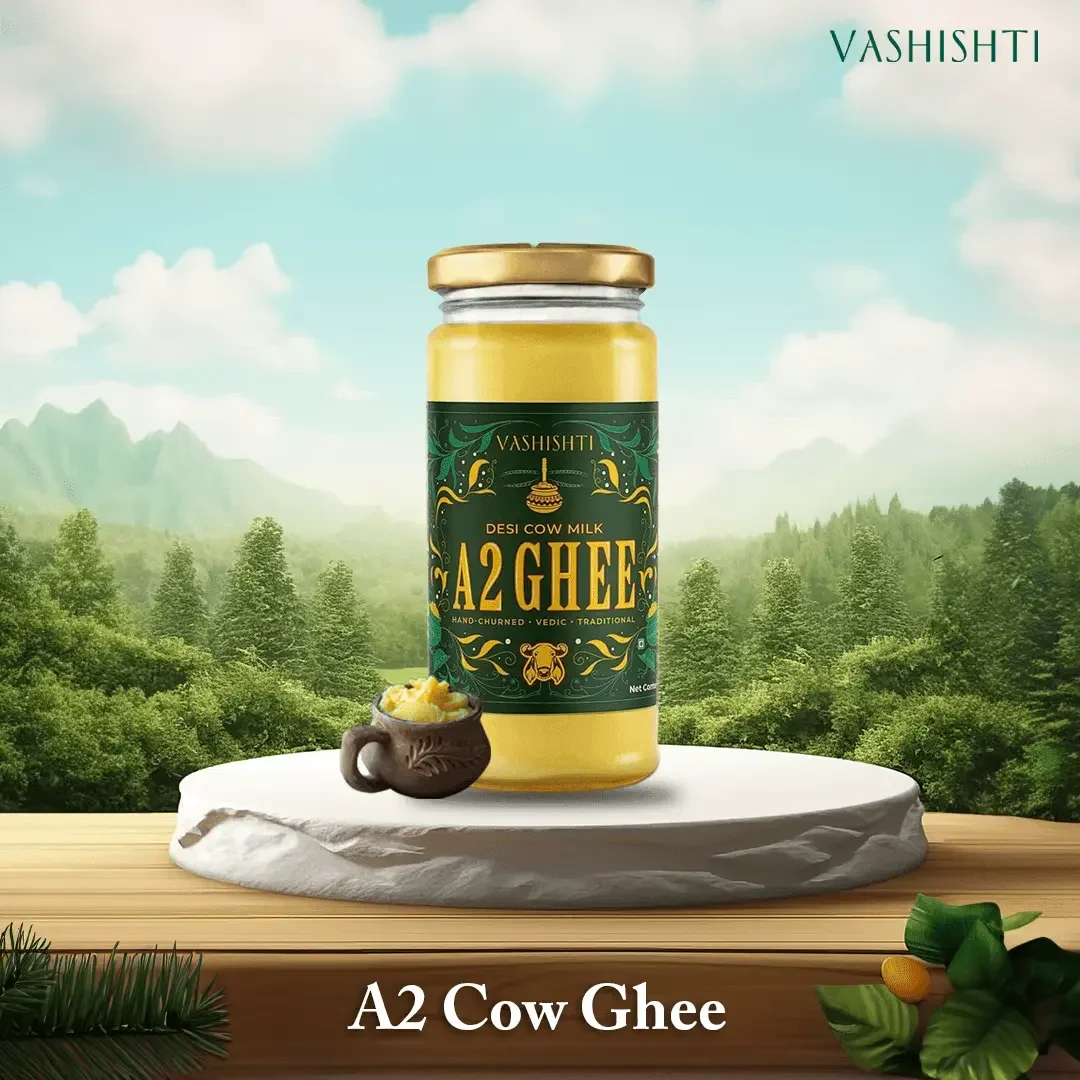
How Vashishti A2 Ghee found its way back to the way ghee was always supposed to be made.
I have to be honest with you. I spent years buying ghee from the supermarket and telling myself it was fine.
The jar looked right. The colour was vaguely yellow. It said ‘pure’ on the label, which I chose to believe without asking too many questions. It melted. It smelled… like ghee, mostly. Close enough.
Then a friend brought over a small bottle of Vashishti A2 Ghee and asked me to smell it before I did anything else.
I did. And something shifted.
It smelled like the ghee from my nani’s kitchen. Nutty and warm, with that faint sweetness underneath — the kind of smell that doesn’t just hit your nose, it hits a memory. I hadn’t thought about that smell in years. I didn’t even know I’d been missing it.
The Problem With Most Ghee on the Market
Here’s something I didn’t know until I started looking into it: the word ‘pure’ on a ghee label means almost nothing. It just means no added water or foreign fats — not that the milk came from a particular breed, not that the cows were raised traditionally, not that anyone churned anything by hand.
Most commercial ghee is made from cream separated by machine, heated fast, processed at scale. It’s efficient. It’s consistent. It tastes like… not much, honestly. Functional, not soulful.
Ayurveda texts describe ghee as one of the most sattvic foods there is — clarifying to the mind, nourishing to the tissues, a carrier of prana. But those texts were written with a specific kind of ghee in mind. Ghee made from the A2 milk of indigenous cows, churned from cultured curd, allowed to cook slowly.
“Most commercial ghee is efficient. It is consistent. It tastes like not much, honestly.”
What’s sold in most supermarkets today is not that ghee. It’s a rough approximation.
What Vashishti Actually Does Differently
The Vashishti story starts with the cow. Specifically the Gir cow — one of India’s oldest indigenous breeds, native to Gujarat, recognisable by the humped back and large ears and an unhurried way of moving through the world.
Gir cows produce A2 milk. This matters in Ayurveda, and it’s starting to matter in nutritional research too: A2 milk contains a different type of beta-casein protein than the A1 milk most commercial dairy is based on. For many people, it’s easier to digest. It behaves differently in the gut. Traditional Indian dairy has always used A2 milk — it just didn’t have that name until recently.
But the milk is only the beginning. What Vashishti does with it is the bilona process: the milk is first cultured into curd, the curd is churned by hand in the traditional wooden bilona to separate the butter, and the butter is then slowly heated over a gentle flame until the ghee clarifies. Nothing rushed. No shortcuts.
One kilogram of finished ghee takes roughly 25 to 30 litres of milk to make this way. Industrially-produced ghee uses far less.
You can taste the difference. I am not being romantic about this — the flavour profile is genuinely different. Richer. More layered. There’s a slight nuttiness from the slow clarification that doesn’t come through in machine-processed ghee.
Why This Matters if You Care About Ayurveda
In Ayurvedic tradition, ghee is not just a cooking fat. It’s a medicine, a carrier, an offering. Charaka Samhita calls it the best among all unctuous substances. It’s used in panchakarma to loosen toxins, in rasayana preparations to carry herbs deeper into the tissues, in daily practice to balance vata and pitta.
But Ayurveda’s understanding of ghee assumes something about the ghee: that it came from a cow living a natural life, eating grass, producing A2 milk, processed through traditional means. The ghee Charaka wrote about is closer to what Vashishti makes than to what most of us have been buying.
I’m not saying commercial ghee is harmful. I am saying that if you’re using ghee as part of a considered wellness practice — if you add it to your morning milk, take it with your ashwagandha, cook your kitchadi in it — the quality of the ghee is not a minor detail.
“If you’re using ghee as part of a considered wellness practice, the quality of the ghee is not a minor detail.”
A Word on What ‘Organic’ Means Here
Vashishti sources milk from Gir cow farms where the animals graze on natural pasture. No synthetic hormones, no factory-farming conditions, no feed that the cows were never designed to eat.
In Ayurvedic terms, what the cow eats becomes the milk becomes the ghee becomes you. The chain of purity matters at every step. It’s not a marketing angle — it’s a logical extension of how the tradition thinks about food.
The Part I Wasn’t Expecting
After that first smell, I cooked with it. Dal, rotis, a simple khichdi. The taste was noticeably different — but what I wasn’t prepared for was how it felt afterward.
I know that sounds like the kind of thing someone says in a testimonial and you’re supposed to take with skepticism. I was skeptical too. But there was a lightness — or rather, an absence of heaviness — that I associate now with food that is genuinely good quality. I felt fed, not just full.
I’ve been using Vashishti ghee for a few months now. I keep the jar on the counter where I can see it. I use it every day. I think about my grandmother’s kitchen less as nostalgia and more as a reference point for what food is supposed to feel like.
That’s not nothing.
Vashishti A2 Ghee is made from pure Gir cow A2 milk using the traditional bilona method. Sourced from organic farms across India.