

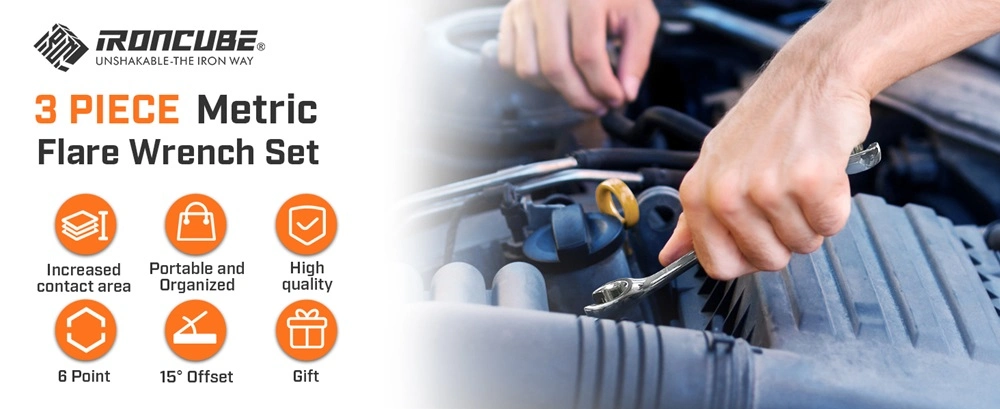
There are few tools more honest than an open end wrench set metric. No batteries, no ratchet mechanisms, no moving parts that can fail at the worst possible moment. Just two precisely machined jaws, a forged steel handle, and the grip strength in your forearm. That simplicity is exactly why open end wrenches remain a cornerstone of every serious toolkit—and why choosing the right three-piece set can save you time, money, and a whole lot of frustration under the hood.
According to market research from IMARC Group, the global hand tools market reached approximately USD 27.6 billion in 2025, and wrenches alone commanded roughly 33.8% of that total—the single largest product category. Those numbers reflect what every mechanic and weekend wrenchturner already knows: a good wrench is irreplaceable. And among all wrench types, the double-headed open end wrench set metric is one of the most versatile formats you can own.
This guide digs into what makes a three-piece metric open end wrench set worth buying, which size combinations actually matter, and how to evaluate materials, standards, and construction before you spend a dollar. Whether you’re servicing brake lines, maintaining hydraulic fittings, or building out a compact travel toolkit, everything you need to make an informed decision is right here.
What Exactly Is an Open End Wrench?
An open end wrench—also called an open-ended spanner in British English—has a U-shaped opening at one or both ends designed to grip two parallel faces of a bolt or nut. Unlike a box wrench that fully encircles a fastener, the open end slides onto a nut from the side. That might sound like a disadvantage, but it’s actually a critical advantage in tight spaces where there isn’t enough vertical clearance to drop a box or socket wrench over the top. If you’re unfamiliar with the broader wrench family, the Wikipedia wrench article offers a helpful overview of every major type.
Standard double-headed open end wrenches carry two different sizes—one on each end. A single wrench might pair 10mm and 12mm, for example, letting one tool do the work of two. A 3 piece open end wrench set metric therefore gives you six individual sizes in a compact package, which is why these small sets punch so far above their weight in real-world utility.
Most quality open end wrenches feature jaws angled at 15 degrees relative to the handle. That offset allows you to flip the wrench over between swings, effectively doubling the arc you can work within in tight quarters. The ASME B107.100-2023 standard governs performance and safety requirements for these tools in North America, specifying hardness ranges of 38 to 55 HRC, proof torque thresholds, and dimensional tolerances for wrench openings.
Why a 3 Piece Set Hits the Sweet Spot
Large wrench sets—ten, twelve, even twenty pieces—look impressive on the pegboard, but most professionals will tell you that a handful of sizes handle the vast majority of their work. In metric fastener systems, certain sizes appear far more frequently than others. The most common metric bolt and nut sizes in automotive and general mechanical work cluster around 8mm, 10mm, 12mm, 13mm, 14mm, and 17mm. A well-chosen three-piece open end wrench set metric can cover all six of those critical sizes.
There’s also a practical argument for traveling light. A compact three-piece set fits in a rolling pouch, a glove box, or a motorcycle saddlebag. Field service technicians, HVAC installers, and plumbers routinely carry small metric wrench sets because hauling a full toolbox onto a roof or into a crawl space isn’t realistic. The weight savings alone matter when you’re climbing a ladder with a tool belt.
And from a cost perspective, a focused three-piece set lets you invest in higher-quality steel and tighter tolerances without the price tag of a full set. You’re paying for six usable sizes—not for the 24mm and 27mm wrenches that spend their entire lives in a drawer.
How to Choose the Right Size Combinations in Your Open End Wrench Set Metric
Size pairing is everything in a three-piece open end set. The wrong combinations leave gaps that force you to reach for another tool; the right ones cover the most ground with the fewest pieces. Here’s a practical framework for choosing sizes.
The Core Six
For automotive and general mechanical tasks, the six sizes you’ll use most often are 8mm, 10mm, 12mm, 13mm, 14mm, and 17mm. A three-piece set that pairs 8×10mm, 12×13mm, and 14×17mm covers this entire spread. This is the standard combination offered by most reputable manufacturers, and for good reason—it’s battle-tested across decades of shop use.
Brake Line and Flare Nut Applications
If your primary use case is brake line work, hydraulic fittings, or fuel line connections, you may want a dedicated flare nut or brake line wrench set instead of a standard open end. IRONCUBE offers a 3-piece metric brake line wrench set with sizes specifically selected for common brake line fittings. Flare nut wrenches wrap more of the nut’s circumference than a standard open end, reducing the risk of rounding off soft brass or copper fittings. For SAE applications, there’s also a matching 3-piece SAE brake line wrench set if you work on older American vehicles.
Larger Industrial Sizes
For heavy equipment, agricultural machinery, or industrial maintenance, the 8–17mm range may not go far enough. In those applications, a three-piece set pairing sizes like 19×22mm, 24×27mm, and 30×32mm becomes more practical. If you frequently need large ratcheting wrenches for oversized fasteners, consider supplementing your open end set with a ratcheting option to manage high-torque jobs more efficiently.
Comparing Open End Wrench Set Metric Options: What to Look For
Not all three-piece metric wrench sets are created equal. The differences come down to steel grade, manufacturing process, finish, and compliance with recognized standards. Here’s how the most important factors stack up.
| Feature | Budget Sets | Mid-Range Sets | Professional Sets |
| Steel Type | Carbon steel (C45) | Chrome vanadium (Cr-V) | Chrome vanadium or S2 alloy |
| Hardness Range | 38–45 HRC | 40–50 HRC | 42–55 HRC |
| Surface Finish | Black oxide or bare | Chrome plated, polished | Mirror chrome, satin, or nickel |
| Jaw Tolerance | Looser fit | Standard ASME B107 | Tight, meets/exceeds ASME B107 |
| 15° Offset | Sometimes | Yes | Yes |
| Storage | Loose or plastic tray | Rolling pouch or rack | Rolling pouch, foam tray, or wall rack |
| Typical Price (3pc) | $8–$15 | $15–$30 | $30–$60+ |
For most home mechanics and tradespeople, a mid-range chrome vanadium open end wrench set metric delivers the best balance of performance and value. You get corrosion resistance from chrome plating, solid hardness for torque applications, and jaw tolerances tight enough to protect fastener heads from rounding. Browse the full IRONCUBE wrench collection to see how these factors play out across different set sizes and configurations.
Materials and Manufacturing: What Goes into a Quality Metric Wrench
The journey from raw steel to finished wrench involves several critical steps, and each one affects the tool’s final performance.
Forging vs. Casting
Quality wrenches are drop-forged, meaning a heated steel billet is pressed into shape under thousands of tons of force. Forging aligns the steel’s grain structure along the length of the wrench, creating a tool that resists bending and cracking under load. Cast wrenches, by contrast, are poured into molds—a cheaper process that produces a more brittle tool. If you see “forged” stamped on a wrench, that’s generally a good sign. If you don’t see it at all, proceed with caution.
Heat Treatment and Hardness
After forging, wrenches are heat-treated to achieve a specific hardness. The ASME B107.100 standard requires a range of 38 to 55 HRC for flat wrenches. Harder isn’t always better—a wrench that’s too hard becomes brittle and can crack under sudden impact loads. The sweet spot for most open end wrenches sits between 42 and 50 HRC, offering enough hardness to resist jaw deformation while retaining enough ductility to absorb shock. If you want to understand how hardness numbers translate across different scales, the metric to SAE conversion chart on IRONCUBE is a useful reference.
Chrome Plating and Corrosion Resistance
The bright, mirror-like finish on most professional wrenches isn’t just cosmetic. Chrome plating creates a barrier against moisture, grease, and corrosive chemicals. A properly plated wrench can survive years of exposure to brake fluid, transmission fluid, and road salt without pitting or rusting. Cheaper sets may use a thin nickel wash or black oxide coating that wears off quickly with use.
Open End vs. Box End vs. Combination: When Each Type Excels
Understanding when to reach for an open end wrench instead of a box end or combination wrench is fundamental to efficient mechanical work.
An open end wrench slides onto a fastener from the side, making it ideal for situations where you can’t access the top of a nut—pipe fittings, brake line connections, or anywhere a hex head sits in a recessed pocket. The trade-off is that only two faces of contact (compared to six or twelve with a box end) mean less torque capacity and a higher risk of slipping on corroded or rounded fasteners.
A box end wrench fully encircles the fastener, distributing force across all six or twelve points. It handles higher torque loads without slipping, but it requires vertical clearance to drop over the nut.
A combination wrench puts one open end and one box end on the same tool, giving you the best of both worlds in a single piece. But in a three-piece set, combination wrenches only give you three sizes instead of six—which is why double-headed open end sets remain popular for compact kits. If you’re curious about how ratcheting mechanisms add another dimension of utility, this article explains how ratchet wrenches work in detail.
Using Your Open End Wrench Set Metric Safely and Effectively
Open end wrenches are straightforward tools, but improper use leads to injuries and damaged fasteners more often than most people realize. Here are the essential practices every user should follow.
Always pull, never push. When applying torque, pull the wrench toward your body rather than pushing it away. If the wrench slips, a pulling motion moves your hand into open space. A pushing motion drives your knuckles into sharp metal edges—a recipe for the infamous “busted knuckle.”
Use the correct size. Forcing a 13mm wrench onto a 12mm nut (or vice versa) creates a sloppy fit that rounds fastener corners. If the wrench doesn’t slide onto the nut with a snug fit, you have the wrong size. No exceptions.
Seat the jaws fully. The nut should sit completely inside the wrench opening, contacting both jaws along their full length. A wrench balanced on the tips of its jaws has minimal contact area and maximum slipping potential.
Don’t extend the handle. Slipping a pipe over the wrench handle (“cheater bar”) multiplies torque beyond what the tool was designed to handle. This can crack the wrench, round the fastener, or cause the pipe to shoot off the handle. If you need more leverage, use a longer wrench or a breaker bar designed for the task.
For work in confined spaces where swing arc is limited, a flex-head ratcheting wrench set can be a worthwhile complement to your open end set. The ratcheting mechanism eliminates the need to remove and reposition the wrench after each swing.
Caring for Your Metric Open End Wrenches
A quality wrench set will outlast the person who bought it—but only if it’s maintained. Chrome plating protects the surface, but it’s not indestructible.
After each use, wipe your wrenches down with a clean rag to remove grease, brake fluid, and moisture. Store them in a rolling pouch or wall rack where they won’t bang against other tools and chip the chrome. If you notice surface rust forming, a light coat of machine oil and a wipe with fine steel wool will restore the finish. Avoid tossing wrenches into a communal drawer where they can collide with harder tools like sockets and impact drivers—those impacts create micro-chips in the plating that become rust entry points.
Periodically inspect the jaw openings for signs of wear or spreading. A worn jaw that’s opened up by even a fraction of a millimeter will start slipping on fasteners. At that point, the wrench becomes a liability rather than a tool—retire it and replace the set. The flex head wrench pricing guide can help you compare replacement costs across different brands and styles.
Where to Buy the Best 3 Piece Open End Wrench Set Metric
The most reliable places to buy quality metric wrench sets are specialty tool retailers, authorized brand websites, and established e-commerce platforms with buyer protection policies.
IRONCUBE offers its full wrench lineup directly through ironcubeworks.com and through Amazon. Buying directly from the manufacturer guarantees that you’re getting a genuine product with full warranty coverage, while Amazon provides the convenience of fast shipping and easy returns. Either way, check that the listing specifies the exact sizes included, the steel type, and whether the set meets ASME B107 or equivalent standards.
For video reviews, tool demos, and practical tips on using hand tools correctly, the IRONCUBE YouTube channel is worth subscribing to. Seeing a wrench in action—especially in tight engine compartments—can tell you more about jaw fit and handle ergonomics than any spec sheet.
Frequently Asked Questions About Metric Open End Wrench Sets
What sizes are included in a typical 3 piece open end wrench set metric?
The most common configuration in a three-piece open end wrench set metric includes double-ended wrenches pairing 8×10mm, 12×13mm, and 14×17mm. This combination covers the six most frequently encountered metric fastener sizes in automotive and general mechanical work. Some manufacturers may vary the pairings slightly—for instance, substituting 10×12mm and 8×9mm—so always verify the exact sizes listed before purchasing.
Can I use an open end wrench set metric on SAE fasteners?
While certain metric and SAE sizes are close enough to substitute in a pinch—10mm is nearly identical to 3/8 inch, and 19mm approximates 3/4 inch—using your open end wrench set metric on SAE fasteners is not recommended as standard practice. Even small differences in jaw-to-nut fit increase the risk of slipping and rounding the fastener head. For reliable conversions and the closest SAE equivalents, refer to this metric to SAE wrench conversion chart.
What is the difference between an open end wrench and a flare nut wrench?
A standard open end wrench grips two parallel faces of a fastener, leaving the remaining four faces exposed. A flare nut wrench (also called a line wrench) wraps around five of the six faces, leaving only a narrow opening for the brake line or tubing to pass through. This extra contact area gives flare nut wrenches much better grip on soft brass and copper fittings, making them essential for brake line work. If you need a dedicated brake line open end wrench set metric, consider IRONCUBE’s 3-piece metric brake line set.
Are chrome vanadium wrenches better than carbon steel wrenches?
Chrome vanadium (Cr-V) steel is generally considered superior to plain carbon steel for wrench applications. The vanadium content improves grain refinement and fatigue resistance, while chromium adds hardness and corrosion resistance. Cr-V wrenches typically maintain tighter jaw tolerances over time and resist chipping under impact loads. For a quality open end wrench set metric, chrome vanadium construction is the standard expectation at the mid-range price point and above.
Why do open end wrenches have angled jaws?
Most quality open end wrenches feature jaws offset at 15 degrees from the handle centerline. This angle allows you to flip the wrench between swings, effectively working in increments as small as 30 degrees in a confined space. Without that offset, you would need a full 60-degree swing arc to reposition the wrench on the next pair of flats—impossible in many real-world scenarios. This design feature is standardized under ASME B107.100 and is a hallmark of any well-made open end wrench set metric.
How do I know if a wrench set meets quality standards?
Look for wrenches that reference compliance with ASME B107.100 (North America), ISO 10102 (international metric), or DIN 3110 (Germany). These standards specify minimum hardness requirements, proof torque values, dimensional tolerances for jaw openings, and surface finish quality. A manufacturer that openly states compliance with these standards is demonstrating confidence in their product’s performance. For any questions about specific products or custom wrench sets, you can contact the IRONCUBE team directly.
Summary
A three-piece open end wrench set metric is one of the most efficient investments you can make for your toolkit. With six usable sizes in three compact tools, it covers the core metric fastener range that handles the overwhelming majority of automotive, HVAC, plumbing, and general mechanical work. The keys to choosing the right set are straightforward: forged chrome vanadium steel, heat treatment in the 42–50 HRC range, tight jaw tolerances that meet or exceed ASME B107.100, chrome plating for corrosion resistance, and the standard 15-degree jaw offset for confined-space work.
Whether you’re building your first toolkit or filling a specific gap in a professional shop, the right three-piece metric open end set delivers remarkable utility for its size and price. Explore the full range of IRONCUBE wrenches to find the exact set that fits your needs.