
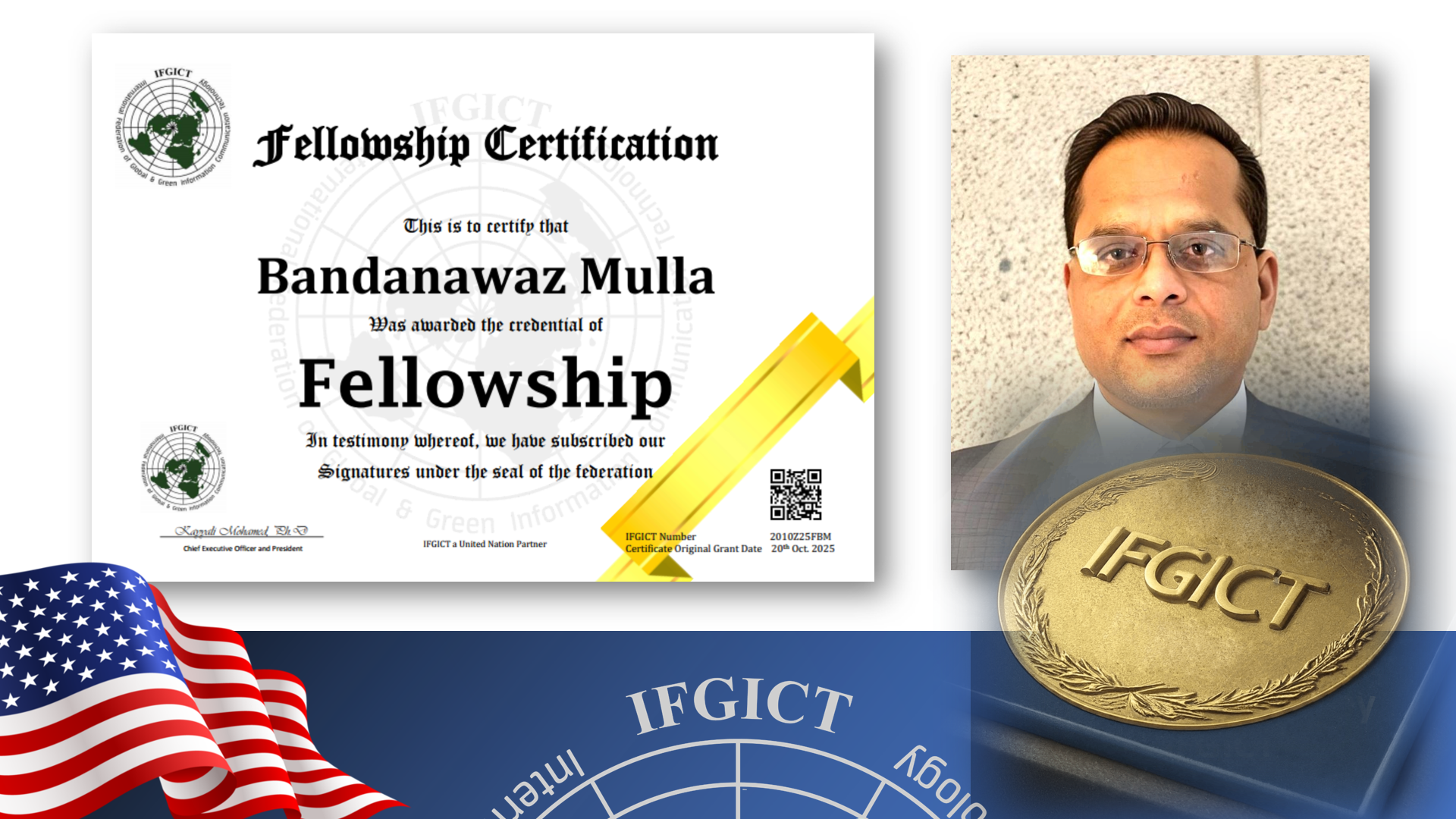
Bandanawaz Mulla, a distinguished professional recognized for his expertise at the powerful intersection of Computer Science and Medicine, has been granted the prestigious IFGICT Fellowship. This highest honor from the International Federation of Global & Green ICT is a testament to his extraordinary contributions in advancing digital transformation within the healthcare sector. Mulla’s work, which expertly applies cloud solutions and Artificial Intelligence (AI) to complex clinical and operational challenges, is pioneering the transition toward Value-Based Care (VBC). As a rare expert capable of seamlessly integrating his foundational knowledge in Physiotherapy with sophisticated Software Design, he stands as a vital thought leader and enterprise architect shaping the future of global health management systems.
Healthcare Digital Transformation: Cloud Architecture for Value-Based Care (Technology Innovation)
A cornerstone of Bandanawaz Mulla’s distinguished career is his focus on leveraging cloud computing as the foundational architecture for value-based care (VBC) models. His research and real-world implementations directly address the critical technological challenges that hinder the shift from traditional fee-for-service models to outcome-based compensation.
Overcoming Data Fragmentation and Driving Efficiency
Mulla’s analysis consistently highlights data fragmentation—the isolation of patient data across disparate systems—as a major roadblock to VBC effectiveness. His architectural solutions utilize cloud-native platforms to overcome this by designing and deploying:
- Data Aggregation and Standardization Engines: These cloud-based engines centralize multisite clinical research data and electronic health records (EHRs), creating a unified, comprehensive view of patient health. This is crucial for accurate risk stratification and care coordination.
- Enhanced Interoperability: By employing standards like FHIR APIs and HL7 integration engines on the cloud, his work ensures seamless data exchange between different providers and care settings, a prerequisite for successful VBC initiatives.
By solving data fragmentation, Mulla enables real-time healthcare analytics, leading directly to improved care coordination and streamlined reporting. This focus on efficiency and data quality is essential for meeting the dual VBC goal: achieving better patient outcomes at lower overall costs.
AI, Compliance, and Risk Stratification in Clinical Systems (Predictive Analytics)
Mulla is at the forefront of integrating AI and Machine Learning (ML) into clinical decision support, but with a critical emphasis on security and regulatory compliance—a necessity in the highly regulated healthcare sector.
AI for Proactive Patient Management
His expertise includes the deployment of AI-driven risk stratification models. These sophisticated algorithms analyze comprehensive patient data (including clinical history, social determinants, and real-time monitoring data) to accurately forecast the likelihood of adverse events, such as hospitalizations or disease progression. This allows healthcare providers to:
- Proactively Identify High-Risk Patients: Enabling early, targeted intervention and resource allocation.
- Optimize Care Pathways: Guiding personalized treatment plans that adhere to best-practice guidelines.
This strategic application of predictive analytics moves healthcare from a reactive model to a proactive, preventive one, significantly enhancing the quality of care delivered.
Architecting Trustworthy and Compliant AI
Crucially, Mulla’s technical leadership addresses the ethical and legal challenges of AI in healthcare. His work focuses on building trustworthy AI systems by ensuring auditability and transparency. Furthermore, in an environment governed by regulations like HIPAA, he specializes in frameworks for dynamic policy enforcement. This includes:
- Security by Design: Integrating robust security measures like encryption and access controls directly into the cloud architecture.
- Data Governance: Establishing clear protocols for data handling to simplify audit processes and ensure that data-sharing complies with global and local privacy laws.
By meticulously managing these compliance and risk factors, he enables the safe and ethical adoption of AI at scale, accelerating digital transformation without compromising patient safety or privacy.
The IFGICT Fellowship: A Global Commitment to Sustainable ICT (Global Leadership)
The IFGICT Fellowship is the most distinguished grade of membership bestowed by the International Federation of Global & Green ICT, recognizing individuals with a proven and lasting global impact on the ICT domain and a commitment to sustainability.
A Legacy of Innovation and Cross-Disciplinary Influence
The award to Bandanawaz Mulla is a powerful affirmation of his unique ability to transcend traditional technical boundaries. His journey, bridging Physiotherapy and Software Engineering, highlights a rare proficiency in understanding both the clinical need and the technological solution. This cross-disciplinary approach is vital for true healthcare innovation.
Mulla’s focus on utilizing cloud solutions and resource-optimized AI aligns directly with the federation’s Global & Green ICT mission. By designing efficient, scalable, and automated systems for healthcare, he contributes to resource optimization and reduces the operational inefficiencies that waste energy and time in legacy systems. The IFGICT Fellow status is a formal acknowledgment of his:
- Thought Leadership: Contributing to international discussions and publications on the future of health technology.
- Professional Recognition: Joining an elite network of global leaders from organizations like IEEE and ITU.
- Social Impact: Using technology to directly improve patient outcomes and make healthcare delivery more efficient and equitable globally.
The IFGICT Fellow grade confirms Bandanawaz Mulla’s standing as a distinguished expert whose innovations are making a fundamental, sustainable difference in the future of healthcare technology.