
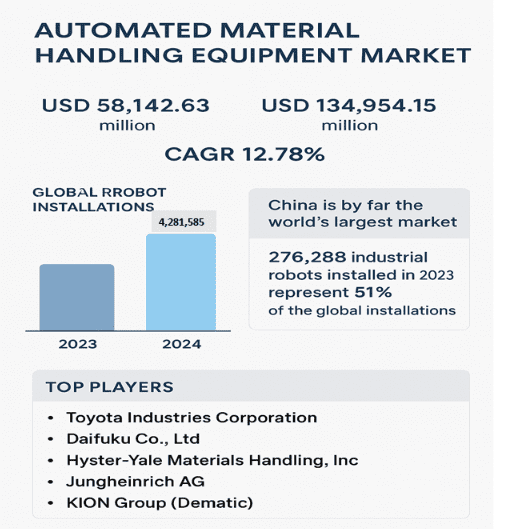
The global Automated Material Handling Equipment (AMHE) Market is entering a transformative decade as industries embrace automation to enhance productivity, safety, and operational efficiency. Valued at approximately USD 58,142.63 million in 2024, the market is projected to reach USD 134,954.15 million by 2031, growing at a CAGR of 12.78% during 2025–2031. The strong momentum reflects the convergence of digital technologies, robotics, and intelligent software that are streamlining logistics, manufacturing, and warehousing operations worldwide.
Rising Demand and Market Dynamics
The AMHE industry is witnessing exponential growth due to the global rise in e-commerce, labor shortages, and the need for faster, more accurate fulfillment. Manufacturers and logistics firms are increasingly automating repetitive and high-volume tasks to reduce dependency on human labor while improving safety and cost efficiency.
The ongoing labor crisis in key markets such as North America and Europe has made automation a strategic necessity. At the same time, the Asia-Pacific region, led by China, Japan, and India—has become the global hub for advanced automation investments, fueled by rapid industrialization and the expansion of manufacturing and warehouse infrastructure.
The shift toward Industry 4.0 and smart factory ecosystems is accelerating adoption, with organizations deploying robotics, AI-driven warehouse execution systems, and cloud analytics to optimize material flow. Supply chain resilience, once a reactive strategy, is now a long-term business imperative.
Prominent Industry Developments
In March 2023, Mitsubishi Logisnext Americas Group — the exclusive distributor of Jungheinrich® lift trucks, narrow-aisle equipment, and automated guided vehicles across the United States, Canada, and Mexico — announced the launch of its new Jungheinrich EKX 516ka / 516a Automated High-Rack Stacker.
In April 2025, Daifuku announced the launch of its new manufacturing plant in India to meet the country’s rapidly growing automation and material handling demands. The new facility enhances Daifuku’s local production capabilities and expands its production space by four times, strengthening its ability to serve the Indian market efficiently.
In June 2025, Linde Material Handling introduced its updated range of industrial trucks, advancing its commitment to end-to-end warehouse automation. With this portfolio update, Linde positions itself as an ideal solution partner for comprehensive warehouse process automation.
In November 2025, Ag Growth International Inc. (AGI), based in Naperville, IL, announced the launch of two new conveyor models — the FX4 SP (gas over hydraulic drive) and the FX4 18S (electric top-drive). Designed for high-capacity performance, these fuel-diverse conveyors offer the power, durability, and efficiency farmers need to keep grain operations running smoothly.
These moves highlight a critical transition from mechanical automation toward intelligent, connected, and adaptive systems that communicate and collaborate across facility networks.
Case Studies: Transforming Logistics at Scale
Case Study 1: Ocado Group (UK)
Ocado’s robotic grid technology for grocery fulfillment demonstrates the power of full-stack automation. The company’s automated picking, storage, and delivery systems have cut fulfillment time by nearly 50% while improving inventory accuracy and worker safety.
Case Study 2: Amazon Robotics (USA)
Amazon continues to pioneer warehouse automation with over 750,000 autonomous robots across its fulfillment centers. The integration of AI, machine vision, and collaborative robotics has increased throughput and reduced worker fatigue.
Case Study 3: Daifuku and Toyota Collaboration (Japan)
Toyota’s material handling division leveraged Daifuku’s automated storage and retrieval systems for parts management, improving inventory cycle efficiency by 40% and minimizing manual handling risks.
These success stories underscore how automation, when combined with analytics and process re-engineering, delivers measurable gains in speed, scalability, and ROI.
Emerging Technologies and Product Innovations
The next generation of AMHE is being shaped by a fusion of robotics, AI, and IoT. Autonomous Mobile Robots (AMRs) are rapidly replacing legacy AGVs, offering dynamic route optimization, real-time collaboration, and energy efficiency. Vision-guided picking robots are now capable of handling thousands of SKUs with human-like precision.
Digital twins are enabling simulation of entire warehouses, allowing engineers to optimize layout, material flow, and energy use before construction. AI-powered predictive maintenance minimizes downtime by monitoring vibration, temperature, and performance metrics across critical equipment.
Furthermore, robotics-as-a-service (RaaS) and subscription-based automation models are democratizing adoption, enabling small and medium enterprises (SMEs) to access high-end automation without heavy upfront capital expenditure.
Market Challenges and Constraints
Despite its strong trajectory, the AMHE market faces notable challenges. The high cost of system integration, long payback periods, and the shortage of skilled technicians can limit adoption, especially among small enterprises. Supply chain disruptions, including semiconductor shortages, continue to affect the delivery of automation components.
Moreover, cybersecurity risks associated with connected machinery require robust data governance and compliance with global standards like ISO/IEC 27001. The integration of automation into legacy systems remains a complex engineering hurdle that demands skilled systems integrators and extensive testing.
Outlook and Future Growth
The next wave of growth will be driven by AI-led orchestration, energy-efficient automation, and sustainability-driven design. Vendors are investing heavily in developing modular, scalable platforms to meet the diverse needs of industries such as automotive, pharmaceuticals, and food logistics.
By 2031, more than 70% of global warehouses are expected to integrate some form of automation technology. Companies that align their automation strategy with workforce upskilling, data integration, and flexible system design will be best positioned to thrive.
About Author:
HTF Market Intelligence Consulting is uniquely positioned to empower and inspire with research and consulting services to empower businesses with growth strategies, by offering services with extraordinary depth and breadth of thought leadership, research, tools, events, and experience that assist in decision-making.