

A San Francisco startup founded by former Meituan executives is deploying AI-powered robots to automate the unpredictable, messy reality of takeout packing in commercial kitchens, using a subscription model that eliminates upfront hardware costs for restaurant operators.
T
On any given Friday evening at a mid-size restaurant in downtown Chicago or suburban Toronto, a small army of workers races to pack hundreds of delivery orders against the clock. Crumpled paper bags arrive from a printer stand. Containers sweat and shift. Receipts curl under heat lamps. This particular kind of controlled chaos, repeated across millions of restaurants in North America every single day, is the problem for AtomBite. AI is betting it can solve with machine intelligence.
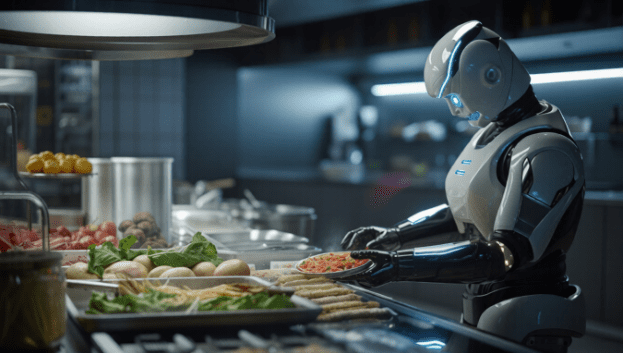
The company, founded in San Francisco and targeting the North American restaurant industry, is developing what it describes as a cognitive software platform designed to let robots operate effectively in real-world kitchen environments. Its first commercial product is a takeout packing robot called the M1, built not around proprietary hardware but around a trained AI system that can be installed on existing robotic arms already deployed in commercial settings.
AtomBite. AI is an artificial intelligence application company building the AtomBite Brain, a foundation model for flexible manipulation in commercial robotics. That distinction, software-first rather than hardware-first, positions the company differently from most robotics startups, which have historically raised capital to build custom mechanical systems and then struggled to make those systems work reliably outside of controlled laboratory conditions.
A Team Forged Inside One of the World’s Largest Delivery Networks
Understanding why AtomBite works. AI is approaching food robotics through the lens of AI software rather than mechanical engineering, requiring an understanding of where its founders spent their careers. Dr. Dong Wang, who leads the company’s technical vision, previously served as chief technology officer of Meituan Delivery, the food and grocery delivery platform that operates at a scale few Western counterparts can match, handling hundreds of millions of orders across China’s urban centers. At Meituan, Wang oversaw the algorithmic infrastructure underpinning one of the world’s most complex last-mile logistics operations.
Dr. Tao Li, AtomBite. AI’s other technical co-founder worked as an algorithm expert at Meituan, where he focused on large-scale data pipelines and machine learning infrastructure. His background sits at the intersection of applied AI research and industrial deployment, a combination that proves increasingly relevant as the gap between laboratory robotics and production-grade systems remains stubbornly wide across the industry. The third co-founder, Steven Li, brings a different kind of expertise: recognized by Forbes China in its 30 Under 30 list, he has a background in go-to-market strategy and managing the operational complexity of large delivery networks at scale.
Together, the founding team reflects a deliberate thesis: that the people most likely to automate the food delivery supply chain are those who have already lived inside it at scale, not those arriving from adjacent industries with general-purpose robotics toolkits.
The AtomBite Brain: Why Software Comes Before Hardware
The central technology inside AtomBite. AI’s products is what the company calls the AtomBite Brain, a dual-model AI architecture designed to address what its engineers describe as the two distinct failure modes of commercial robotics: the inability to generalize across varied inputs, and the inability to perform reliably at the speed and consistency that real kitchen environments demand.
Most traditional robotic systems are trained and optimized for narrow, repeatable tasks performed on standardized objects. A packaging robot on an automotive assembly line works because the parts it handles are precisely identical, arrive at precise intervals, and sit in precisely defined positions. Commercial kitchen environments violate every one of those assumptions. Containers leak. Bags arrive wrinkled or torn. Receipts fold over themselves. An item that was supposed to weigh 400 grams arrives at 430 grams and shifts a robot’s grip in ways that a single trained model may never have encountered.
AtomBite. AI’s dual-model approach separates these two challenges into distinct model responsibilities. One component of the AtomBite Brain is designed specifically for generalization: handling object variability, irregular shapes, unexpected weights, and real-time environmental changes without requiring the system to be retrained for each new edge case. The second component focuses on engineering reliability, ensuring that the speed, consistency, and error tolerance of the system meets the operational standards of a commercial kitchen rather than a research prototype environment.
The company positions itself explicitly as a cognitive software layer, a context provider and commander that sits above existing robotic hardware rather than replacing it. This approach means the M1 system is hardware-agnostic by design, capable of integrating with robotic arms already deployed by restaurant operators without requiring them to scrap existing capital investments. The AI provides vision, reasoning, and adaptive decision-making; the hardware carries out the physical movement.
AtomBite Brain is designed to handle real-world variability in kitchen environments where traditional automation fails. Most systems break the moment an object falls outside a narrow set of expected parameters. We built the Brain to treat variability as the norm, not the exception.
Dr. Dong Wang, Co-Founder and CEO, AtomBite.AI
The M1: Bringing Embodied AI Into the Commercial Kitchen
The company’s first commercial product, the M1 Takeout Packing Robot, targets the moment at the end of a restaurant’s preparation workflow when assembled food items need to be verified, organized, bagged, and sealed for handoff to a delivery driver. AtomBite. AI describes this as the “last meter” of food delivery fulfillment. It is, by the company’s own account, the step most resistant to conventional automation because of the sheer variability of objects involved.
The M1 system uses AI vision and real-time reasoning to identify items on a packing station, determine appropriate placement and handling technique, and execute the packing sequence while simultaneously verifying that the order content matches what was requested. Built-in visual verification is intended to flag missing items or incorrect substitutions before the order leaves the kitchen, addressing one of the more costly operational problems facing restaurant operators: order errors that result in refund requests from delivery platform customers.
The M1 is designed for restaurant locations handling roughly 100 or more takeout orders per day, a volume threshold at which the labor cost of a dedicated packing employee becomes significant enough to make automation economics attractive. AtomBite.AI says the system is capable of replacing one full-time equivalent packing role per location, reducing both direct labor cost and the indirect cost of turnover and training that affects high-volume food service operations disproportionately.
The broader AtomBite.AI product roadmap extends well beyond the M1. The company describes a staged development trajectory: an M2 system intended for kitchen operation assistance, an M3 targeting delivery, handoff automation, and a longer-term vision it characterizes as a Universal Hand, a general-purpose flexible manipulation robot for logistics and e-commerce applications. The M1 represents the first commercial revenue-generating product in that sequence, and the company is using its kitchen deployment data to train the foundation models that will underpin subsequent product generations.
Robot as a Service: Removing the Capital Barrier to Restaurant Automation
How AtomBite.AI sells the M1 is arguably as significant as how the technology works. The company has adopted a Robot as a Service model, offering the system to restaurant operators on a monthly subscription basis priced between $2,200 and $2,900 per location, with no upfront hardware cost required. This pricing structure converts what would traditionally be a large capital expenditure into a predictable operating expense, a meaningful shift in how automation investment decisions get made inside restaurant businesses.
Independent restaurant operators and small chains rarely have access to the capital budgets required to purchase and maintain robotic systems outright. A hardware-first robotics sale, where a restaurant must commit tens of thousands of dollars before a system is installed and proven, creates a prohibitive barrier that has historically kept automation confined to large quick-service chains with dedicated technology procurement teams. The food robotics startup positions its RaaS model as a way to extend the reach of kitchen automation further down the market, into the mid-size independent and franchise restaurant segment that represents the largest share of takeout volume in North America.
AtomBite.AI estimates a net monthly economic benefit of between $1,100 and $2,825 per location after subscription costs, based on the reduction in packing labor expense. That calculation does not factor in secondary savings from reduced order error rates, though the company does cite error reduction as a meaningful contributor to the overall value proposition for operators concerned about delivery platform refund exposure.
The Industry Context: Labor Costs, Market Size, and the Automation Gap
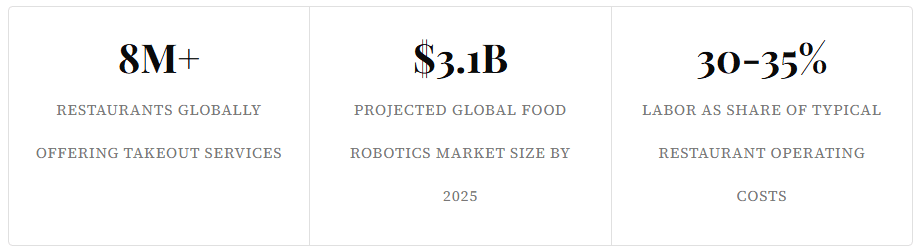
AtomBite.AI is entering a market that the food service industry has long recognized as both important and technically resistant to automation. According to the National Restaurant Association, the U.S. restaurant industry has faced persistent labor shortages since 2021, with the sector still short of pre-pandemic staffing levels as recently as late 2025 despite wage increases at nearly every tier of food service employment. Labor now represents between 30 and 35 percent of total operating costs at a typical full-service restaurant, a proportion that has grown steadily as minimum wage legislation across North American states and provinces has raised floor wages in food service.
The global food robotics market reflects growing investor and operator interest in addressing this structural challenge through automation. Research firm MarketsandMarkets projected the food robotics market to reach approximately $3.1 billion globally by 2025, growing at a compound annual rate of around 12 percent, driven primarily by demand in North America, Europe, and Japan. Despite that growth trajectory, adoption in the segment is AtomBite. AI targets, specifically back-of-house packing and fulfillment automation at independent and mid-market restaurant operators, remain comparatively low, largely because existing systems have not been able to handle the object variability that characterizes takeout packing at scale.
AtomBite. AI is not the first company to attempt automation at this stage of the food delivery chain. Several well-funded robotics companies, including Miso Robotics and Bear Robotics, have pursued adjacent applications in burger flipping and server assistance. What distinguishes AtomBite? AI’s approach is its software-first architecture and its specific focus on the packing and verification step, which has received comparatively less attention from the robotics industry despite being one of the highest-error, highest-labor-intensity points in the takeout fulfillment process.
Looking Ahead: Foundation Models and the Future of Kitchen Robotics
The broader significance of AtomBite. AI’s approach may not lie in any single product but in the foundational model it is building through commercial deployment. Every order packed by the M1 system generates training data: edge cases the AI encounters, object configurations it had not seen before, handling decisions that succeeded or failed. This data loop is the raw material from which the AtomBite Brain becomes progressively more capable over time, and it is one of the core reasons why early commercial deployment, even at modest scale, matters as much as laboratory research for companies building foundation models in physical AI.
The trajectory the company has laid out, from packing automation to kitchen assistance to delivery handoff to universal manipulation, follows a pattern consistent with how large language model companies approached general-purpose text. AI: build capability in a constrained, high-value domain first, generate real-world feedback at scale, and use that feedback to train systems capable of operating across increasingly broad contexts. Whether the same approach can produce equivalent results in the physical manipulation domain remains one of the central open questions in robotics research, but it is a question that companies with access to production kitchen environments are uniquely positioned to begin answering.
For restaurant operators weighing the economics of automation in an environment of sustained labor cost pressure, the question is more immediate: whether a subscription-priced AI packing system can reliably do what it claims at the throughput and accuracy levels a busy kitchen demands. AtomBite. AI is betting that its dual-model architecture, built by engineers who operated food delivery networks at a national scale, is the answer to a problem that simpler robotic systems have consistently failed to solve.