

Road safety across North Carolina is under renewed scrutiny as a new study reveals counties where fatal crashes pose a disproportionately high risk. The findings expose stark disparities in roadway danger, highlighting specific regions where infrastructure gaps, enforcement challenges, and risky driving behaviors combine to create deadly conditions for motorists.
The research by personal injury law firm CR Legal Team analyzed the data for fatal crashes from 2019 to 2023 for each North Carolina county via the NHTSA FARS database. Average crash rates per 100,000 residents were calculated to identify the counties where North Carolinians are most at risk of fatal traffic accidents.
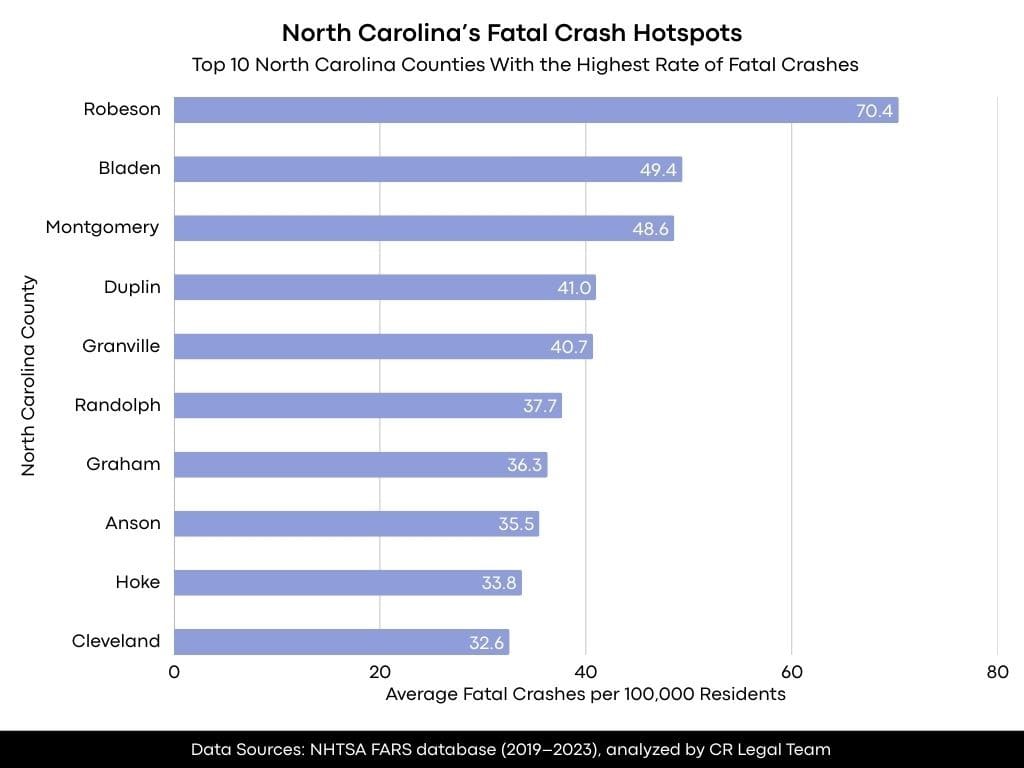
Robeson County leads the state in fatal crashes, with 70.4 crashes per 100,000 residents. That is more than four times the statewide average of 17.4 crashes per 100,000 residents. From 2019 to 2023, the county averaged 53 fatal crashes per year among its population of approximately 119,302. 2023 was the worst year with 62 fatal crashes, while 2019 recorded the fewest (39).
Bladen ranks second with 49.4 crashes per 100,000 residents, more than 184% higher than the statewide average of 17.4. From 2019 to 2023, Bladen County, home to nearly 33,775 residents, experienced an average of 12 fatal crashes annually. The county recorded the highest crashes (14) in 2022, and the lowest (9) was in 2023.
Montgomery ranks third with 48.6 crashes per 100,000 residents, about 179% higher than the statewide average of 17.4. Between 2019 and 2023, Montgomery County, with a population of approximately 8,124, saw an average of 10 fatal crashes yearly. 2020 and 2023 documented 12 crashes each, while 2021 and 2022 had only 8 each.
Looking at the study, a spokesperson at CR Legal Team commented:
“The study highlights that counties such as Robeson, Bladen, and Montgomery reported some of the highest fatal crash rates in North Carolina.
“These alarming statistics underscore the critical importance of improved road safety measures, enhanced law enforcement presence, and comprehensive driver education programs in these high-risk areas.
“To reduce these tragic incidents, county leaders and policymakers can implement enhanced traffic safety initiatives, improved road infrastructure, and expanded emergency response capabilities. Additionally, addressing underlying issues such as impaired driving, speeding, and distracted driving could help mitigate fatal crash rates across these counties.”
Table for Extended Results:
| Top 10 North Carolina Counties With the Highest Rate of Fatal Crashes | ||
| North Carolina County | Average Fatal Crashes per 100,000 Residents | Rank |
| Robeson | 70.4 | 1 |
| Bladen | 49.4 | 2 |
| Montgomery | 48.6 | 3 |
| Duplin | 41.0 | 4 |
| Granville | 40.7 | 5 |
| Randolph | 37.7 | 6 |
| Graham | 36.3 | 7 |
| Anson | 35.5 | 8 |
| Hoke | 33.8 | 9 |
| Cleveland | 32.6 | 10 |
What Drivers, Policymakers, and Communities Should Know About Fatal Crash Trends
Experts emphasize that reducing fatal crashes, especially in high-risk counties, requires coordinated action from state agencies, law enforcement, and local communities. Based on the findings, the following measures are critical to improving roadway safety across North Carolina:
- Strengthen enforcement of speeding, impaired driving, and distracted driving laws.
- Invest in roadway infrastructure improvements, including clearer signage, better lighting, and safer intersections.
- Expand driver education programs focused on high-risk behaviors and rural road safety.
- Increase emergency response capabilities in crash-prone areas.
- Use county-level crash data to identify danger zones and prioritize targeted safety interventions and funding.
Methodology
The study was conducted by CR Legal Team, a law firm dedicated to standing up for the rights of accident and injury victims. By offering Whole-Person Legal Care™, the firm has helped thousands across the community pursue justice and move forward. A national law firm advocating for injury victims across the United States.
The research analyzed the data for fatal crashes from 2019 to 2023 for each North Carolina county via the NHTSA FARS database. Average crash rates per 100,000 residents were calculated to identify the counties where North Carolinians are most at risk of fatal traffic accidents.
Data Sources
- Fatal Crash Data: https://www-fars.nhtsa.dot.gov/States/StatesCrashesAndAllVictims.aspx
- Research Dataset: https://docs.google.com/spreadsheets/d/19do50e9Ctuvd2GgrpwfiQWUnYxBFfKFSP-aQcYx0L_s/edit?gid=0#gid=0