
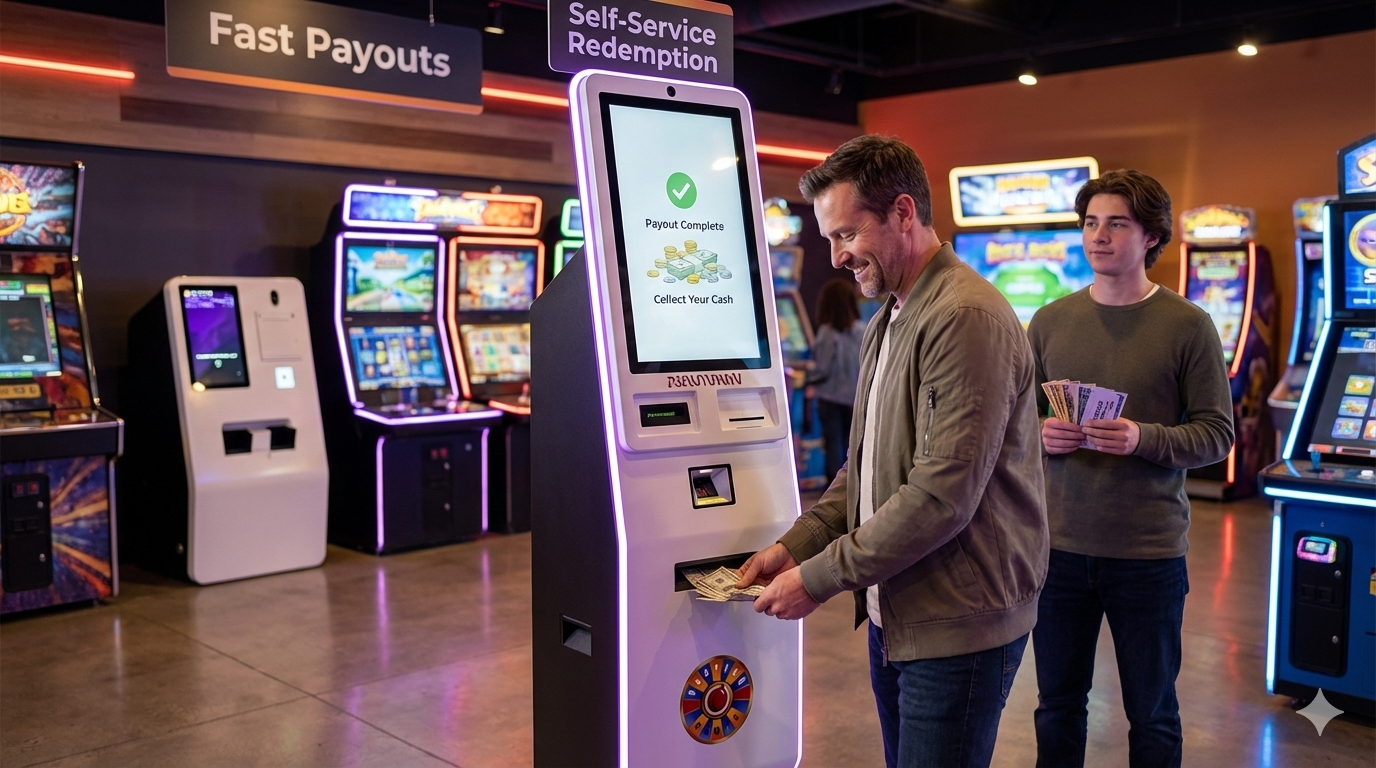
Did you know that 65–70% of revenue in a high-performing arcade is redemption-based? If your arcade kiosk setup is clunky or slow, you are probably leaving a big chunk of that money on the table, which is pretty wild when you think about it.
Key Takeaways
| Question | Short Answer |
| What is an arcade kiosk? | An arcade kiosk is a self-service machine that handles ticket or cash redemption, so players can cash out tickets or winnings without staff running around. |
| What is the difference between ticket and cash redemption kiosks? | Ticket redemption kiosks convert paper or digital tickets into cash or vouchers, while cash redemption kiosks focus on secure cash payouts and cash handling. |
| Where can I see different ticket redemption options? | We list our latest models, including E450, EX450, and C200, on our ticket redemption kiosks page. |
| Do arcade kiosks work with modern skill game cabinets? | Yes, our kiosks are built to work with our 43″ vertical cabinets, 32″ cabinets, and other skill game machines. |
| Are arcade kiosks space-efficient? | They are, especially models sized for smaller locations, which pair nicely with our 24″ vertical desktop and compact skill game setups. |
| Can a kiosk really reduce staffing headaches? | Yes, a good kiosk setup handles a huge share of ticket cash-outs by itself, so staff can focus on guest service instead of counting tickets all day. |
| Where do arcade kiosks fit in my overall game mix? | They sit at the heart of your redemption zone and support your wider skill game lineup listed on our games page. |
What Is an Arcade Kiosk and Why Does It Matter So Much?
An arcade kiosk is usually a ticket or cash redemption machine placed inside the game room that handles payouts all day without fuss. Players scan tickets or vouchers, money is paid out, and staff are freed up, which is a big relief, no kidding. The work is mostly done by the machine, so fewer hands are needed.
In busy arcades, the kiosk turns into the main checkout spot for everyone. If payouts feel slow or confusing, people get irritated pretty quick, and that mood spreads. The system needs to stay simple, smooth, and steady, otherwise the whole room feels off, plain and simple.
Our kiosks are made for locations with nonstop foot traffic like skill game rooms, truck stops, bars, and family entertainment centers. Payments are processed fast, machines feel safe to use, and players are nudged back to the games, which keeps revenue moving, day in and day out.
Why arcade operators rely on kiosks
- Payouts are handled automatically, so staff stress is reduced
- Lines move faster, which keeps guests calmer and happier
- Fewer cash mistakes are made since totals are machine-checked
- Players return to games quicker, which helps daily earnings
- Busy hours feel manageable instead of chaotic, honestly speaking
If payouts are still done with a calculator and a long wait, the switch to an arcade kiosk is often the cleanest upgrade. The change is felt right away, and the daily grind gets lighter, no joke.
Ticket Redemption Kiosks: Core Of The Arcade Kiosk Setup
Ticket redemption kiosks sit at the heart of modern redemption play, and they do the heavy lifting with tickets and payout slips. Ours were designed to handle high volumes, sharp peaks in traffic, and a whole lot of impatient players who just want their cash or voucher right now.
On our ticket redemption kiosk line, we offer models like the E450, EX450, and C200, each tuned for different room sizes and throughput needs, so you do not have to guess what might work. Our kiosks support capacitive touch screens, encrypted tickets, and secure bill cassettes that are built for serious use.
The E450 and EX450 models are aimed at higher traffic locations that want deeper bill capacity, strong construction, and easy access for collections. The C200, on the other hand, gives you a compact footprint while still offering full kiosk features, which is nice when your room is a bit tight.
All of these arcade kiosk units are built to connect with our skill game software, so reporting and analytics stay together. Instead of guessing why your payouts look odd, you can see the numbers clearly and fix problems before they snowball.
Cash Redemption Kiosks: Secure Payouts Without the Headache
Ticket kiosks work with tickets and vouchers, while arcade cash redemption kiosks focus on fast and safe cash payouts. These arcade kiosks are placed near busy walkways, so players cash out and move on without hunting for staff, which feels pretty smooth. It saves time, plain and simple, and keeps the room calm.
Our cash redemption units are built around three clear goals that matter every day. Transactions move fast, security stays tight, and daily use stays simple, no funny business. Staff should clear a jam or change a bill cassette without stress, and training should be quick and painless.
What operators like about cash redemption arcade kiosks
- Cashouts are processed quickly during peak hours
- Strong bill validators reduce payout errors
- Secure vault-style doors protect stored cash
- Clean internal layouts speed up collections
- Daily checks are easier for staff, all things considered
Inside the kiosk, solid bill validators and secure doors are used to protect cash. The layout is kept neat so collections can be done faster, and fewer mistakes are made. Many operators say manual payouts feel outdated once a real arcade kiosk is installed, which says plenty.
For players, the experience feels simple and safe. Clear screen prompts and bright displays guide each step, so there is no confusion, you know the drill. Clean and sturdy hardware builds trust, and that trust helps players feel the payouts are fair and secure.
How Arcade Kiosks Tie Into Skill Game Cabinets
An arcade kiosk works best when it connects cleanly with the skill game cabinets on the floor. Our lineup includes 43 inch and 32 inch vertical cabinets built for redemption use, so everything feels planned, not patched together, which honestly makes life easier.
These cabinets run PCAP touch screens, sharp display panels, and sturdy internal builds that support encrypted tickets and USB devices. Tickets and payouts are read the right way each time, lines stay shorter, and guests stay relaxed, which is a win-win, plain and simple.
How cabinets and arcade kiosks work together
- Encrypted tickets are read accurately
- USB peripherals stay stable during busy hours
- Screen response stays smooth for players
- Redemption values stay matched across systems
- Fewer payout errors show up over time
The 43 inch cabinets fit well in premium floor spots where visibility matters and players tend to gather, you see it all the time. The 32 inch cabinets suit tighter rooms where space counts, yet they still link cleanly with a ticket redemption kiosk.
Because the game software and arcade kiosk systems are built as one setup, results stay aligned. Disputes are reduced, staff time is protected, and awkward payout talks are avoided, which keeps the mood right where it should be.
Space Planning: Fitting Arcade Kiosks Into Your Floor Layout
Arcade kiosks only work well if they are easy to reach and do not clog up your traffic flow. A lot of operators tuck them into corners at first, then quickly learn that a central but open spot works better, because people naturally form lines there.
Industry data suggests that redemption space should be about 125 square feet per 1,000 square feet of arcade, which gives you a handy rule of thumb when you plan where kiosks and prize areas go. You do not want your best earners blocked by a messy line right in front of them.
We often see one or two kiosks placed near the entrance or near the center of the game floor, with clear sightlines. If you pair them with compact units like our 24 inch vertical desktop or 24 inch horizontal cabinets, you can pack a lot of function into a fairly small zone.
Good signage and lighting help too, because guests should be able to spot your arcade kiosk from across the room. The less time they spend hunting for it, the smoother your operation feels during busy hours.
Did You Know?
In 2024, more than 250,000 redemption amusement machines were installed globally, with North America accounting for about 40% of installations.
Key Features to Look For in Any Arcade Kiosk
When checking an arcade kiosk, a short checklist goes a long way. Big screens look cool, sure, but steady performance, speed, and safety matter more when weekend traffic hits and the line starts creeping, you know how it goes. Reliability keeps headaches away.
Below are the features we focus on when building ticket and cash redemption kiosks that run all day without drama. These details shape how smooth payouts feel for both staff and guests, plain and simple.
Core arcade kiosk features that matter
- Capacitive touch screen for quick and accurate taps
- Large bill cassette capacity to reduce constant refills
- Strong locking system for cash and internal parts
- Clear on-screen steps that guide users easily
- Network connection for games and reporting systems
- Digital ticket support for newer game setups
Inside the cabinet, layout matters more than people expect. Access panels are designed to open cleanly, cables are routed neatly, and parts are labeled. When service work is needed, time is saved, and techs stay in a better mood, no kidding.
As more locations move toward cashless or mixed payout setups, flexibility becomes valuable. An arcade kiosk that supports upgrades gives you breathing room. You might not need every option today, but future-ready hardware helps when your operation grows, and that peace of mind counts.
Revenue & ROI: How an Arcade Kiosk Pays for Itself
Arcade owners usually ask one straight question about an arcade kiosk. How fast does it pay itself back? That question makes sense, because hardware, shipping, and install costs hit your numbers early, and nobody likes guessing games, let us be honest.
Most industry benchmarks point to a target of about $200 per game per week. Many setups recover their cost within 12 to 18 months. A smooth arcade kiosk keeps players moving, cuts payout friction, and supports that goal, plain and simple.
How an arcade kiosk improves return
- Faster ticket processing leads to more game cycles each hour
- Less staff time is spent on payouts and counting
- Fewer payout errors protect cash flow quietly
- Better guest flow supports longer visits
- Repeat play increases when payouts feel easy
When ticket processing speeds up, machines are played more often. When staff are not tied up with payouts, their time can be shifted to guests or sales. Errors are reduced, margins stay protected, and the room runs calmer, you know the drill.
We often suggest thinking of an arcade kiosk as a utility, not a flashy extra. It works every hour the arcade is open, it does not get tired, and it keeps play flowing in the background. That steady role adds up over time, no kidding.
Even though upfront pricing changes by model and setup, the math stays simple. More plays, faster throughput, and fewer mistakes slowly stack together. When tuned well, an arcade kiosk becomes a quiet earner that pulls its weight every single day.
Did You Know?
Digital ticketing is already used in about 54 percent of newly installed redemption machines. This shift shows how kiosks are becoming the center of modern payout systems.
Modern Trends: Digital Tickets, Cashless Play, And Analytics
The classic paper ticket mess on the floor is slowly fading, and arcade kiosks sit right in the middle of that change. More games feed digital ticket counts straight to the system, which your kiosk then reads and converts into cash or prizes, with no paper involved.
At the same time, cashless adoption in the redemption world jumped by about 42% in 2024, so you can see where the trend is heading. Players tap cards, phones, or stored value, then move from game to game without thinking about coins or bills every few minutes.
Our arcade kiosk systems are designed to sit inside that digital loop, not bolt on awkwardly from the outside. With networked reporting, operators can track what games feed the most kiosk activity, which helps guide future cabinet buys.
You get a better picture of peak hours, redemption habits, and payout ratios across the week. Those numbers make it a lot easier to tune game mix, price per play, and ticket curves without flying blind.
Design & Guest Experience: Making Your Arcade Kiosk Friendly
Function always matters, but looks still play a big role, especially in family locations. An arcade kiosk should feel clean, solid, and welcoming. If it looks worn out or confusing, guests hesitate, and that slows everything down, let us be real.
We pay close attention to cabinet shape, colors, lighting, and overall form so kiosks match the style of our skill game machines. When the room looks consistent, people feel safer using the machines. That quiet trust makes a difference, no joke.
Design choices that improve guest comfort
- Clean cabinet lines that look modern
- Bright but soft lighting around screens
- Colors that match nearby game cabinets
- Solid build that feels stable to touch
- Clear labels for key actions
On-screen steps also matter a lot. Big buttons, simple words, and clear spacing help everyone. A parent juggling kids should finish a payout after one quick read, without waving down staff, you know how busy that gets.
Small details help more than expected. Progress bars show what is happening, and clear confirm or cancel buttons prevent slip-ups. Extra checks before payout reduce mistakes, which means fewer interruptions for staff and less retraining over time.
Games, Branding, and How Kiosks Support Your Theme
Arcade kiosks do more than pay people out. An arcade kiosk supports your game mix and the overall feel of your venue. Game art, themes, and kiosk design all send a signal to guests about what kind of place they walked into, and that signal matters, plain and simple.
We pair kiosk-ready systems with many skill game themes, covering fantasy, animals, sports, and seasonal styles. This gives you room to refresh your floor without things feeling mismatched. When games and kiosks look like they belong together, the room feels put together, no kidding.
Ways kiosks support your game themes
- Match kiosk colors with top-earning games
- Place kiosks near themed game clusters
- Use similar fonts and visual styles
- Keep lighting consistent across the zone
- Reinforce your brand look at payout time
Games like Dragon Vs Tiger, Bison Fury, and Vegas-style titles often act as traffic drivers. Players spend time there, build tickets or credits, and then move to the arcade kiosk to close the loop. That final step turns play into rewards, which feels satisfying.
When kiosk areas carry the same colors, logos, or artwork as your best games, the flow feels planned. Guests notice that polish even if they cannot explain it. That quiet consistency helps your venue stick in their minds long after they leave.
Practical Tips for Choosing Your Next Arcade Kiosk
When it is time to add or upgrade an arcade kiosk, a clear plan helps. A short list of needs beats a vague goal every time. You want the machine to fit how your floor actually runs, not how it looks on paper, you know what I mean.
Use this checklist when comparing arcade kiosk options. It keeps the focus on daily use and avoids buying features that sit unused.
Arcade kiosk selection checklist
- Expected daily ticket or cash volume
- Floor space and natural line flow
- Paper tickets, digital tickets, or both
- Game connections for payout and reports
- Staff comfort with basic service tasks
- Plans for cashless or member systems
It helps to think past the first few weeks. Arcade kiosks stay in service for years, and needs change over time. Hardware that supports upgrades can save you from replacing units too soon, which hurts the budget, no joke.
If the choice still feels unclear, start simple. One strong ticket redemption kiosk placed in a central spot shows how guests behave. Once patterns are clear, adding another unit or a dedicated cash redemption kiosk becomes an easy call as volume grows.
Conclusion
An arcade kiosk may look like just another cabinet on the floor, but it quietly drives most of the money flow in a modern arcade. When ticket and cash payouts stay fast and simple, guests keep playing, staff stay calmer, and weekly numbers usually trend upward, plain and simple.
When solid kiosk hardware is paired with compatible skill game cabinets, smart floor layout, and clear guest-facing screens, the whole setup runs smoothly day after day. If payouts still feel slow or cluttered, upgrading your arcade kiosk system is often the most direct fix. It keeps lines short, stress low, and the fun moving without interruption.