
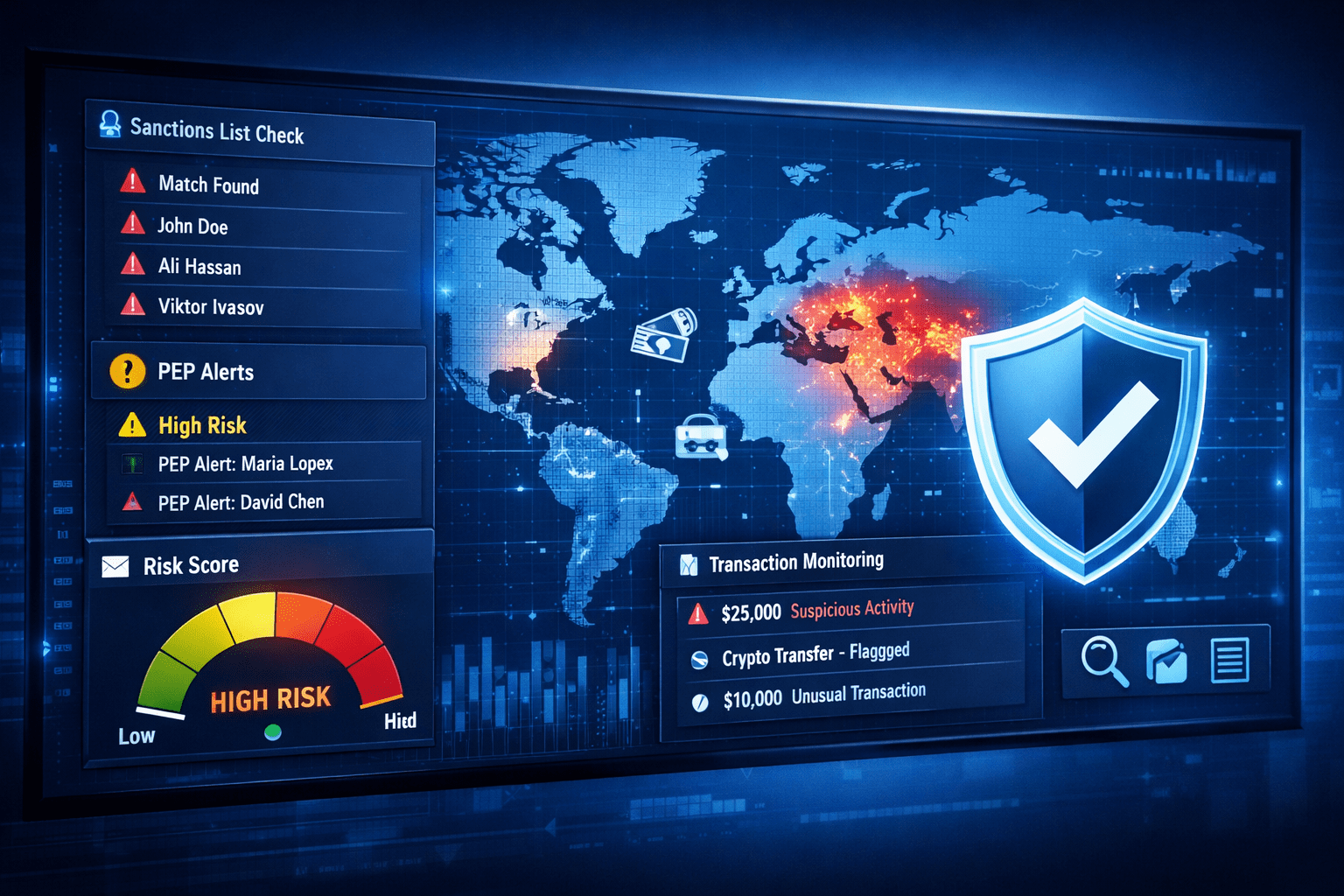
Financial crime is evolving rapidly. From crypto-related laundering schemes to complex cross-border fraud networks, businesses today face increasing regulatory pressure. AML screening has become one of the most critical compliance measures for organizations operating in banking, fintech, crypto, real estate, and other regulated sectors.
Anti-Money Laundering (AML) screening is no longer just a regulatory checkbox. It is a strategic risk management tool that protects businesses from penalties, reputational damage, and financial loss. This guide explains what AML screening is, how it works, and why it plays a central role in modern compliance programs.
What Is AML Screening?
AML screening refers to the process of verifying customers, businesses, and transactions against global watchlists, sanctions lists, politically exposed persons (PEPs), and adverse media databases to detect potential financial crime risks.
The goal of AML screening is to identify individuals or entities involved in money laundering, terrorist financing, fraud, corruption, or other illicit activities before they can exploit financial systems.
AML screening is a core component of:
- Anti-money laundering compliance
- Know Your Customer (KYC) procedures
- Know Your Business (KYB) verification
- Ongoing transaction monitoring
Without effective screening, organizations risk facilitating criminal activity — even unknowingly.
Why AML Screening Is Important
Regulatory Compliance
Global regulators such as the Financial Action Task Force (FATF) set international AML standards. Countries implement these recommendations into local regulations, making AML screening mandatory for financial institutions and many non-financial businesses.
Failure to conduct proper screening can result in heavy fines, regulatory sanctions, and license revocation.
Risk Mitigation
AML screening helps businesses detect:
Sanctioned individuals
Politically exposed persons
High-risk jurisdictions
Entities linked to terrorism financing
Companies involved in corruption or fraud
Early detection reduces financial crime exposure and prevents long-term reputational harm.
Reputation Protection
Being linked to money laundering cases can severely damage a brand’s credibility. AML screening protects businesses from unintentionally onboarding high-risk clients.
Key Components of AML Screening
Effective AML screening consists of multiple layers designed to minimize compliance gaps.
Sanctions Screening
Sanctions screening involves checking customers against international sanctions lists, such as those issued by:
Office of Foreign Assets Control
United Nations
European Union
If a match is found, the business must block or report the transaction depending on applicable laws.
PEP Screening
Politically Exposed Persons (PEPs) are individuals holding prominent public positions. They present a higher corruption risk due to their influence and access to public funds.
PEP screening identifies current and former government officials, senior politicians, judges, military officers, and their close associates.
Adverse Media Screening
Adverse media screening analyzes global news sources and databases to identify negative media coverage related to financial crime, fraud, corruption, or criminal investigations.
This helps businesses detect reputational and legal risks that may not appear on sanctions lists.
Watchlist Screening
Watchlists include global regulatory databases, law enforcement lists, and financial crime databases. Continuous watchlist screening ensures that customers are monitored throughout their lifecycle.
How AML Screening Works
AML screening typically follows a structured workflow:
First, customer information is collected during onboarding. This includes name, date of birth, nationality, address, and identification details.
Next, the system cross-checks this data against global sanctions lists, PEP databases, and adverse media sources using automated compliance software.
If a potential match appears, compliance teams perform enhanced due diligence (EDD) to confirm whether it is a true match or a false positive.
Finally, businesses either approve, reject, or escalate the case based on their risk assessment framework.
Modern AML screening solutions use artificial intelligence and machine learning to reduce false positives and improve matching accuracy.
AML Screening vs. KYC
While AML screening and KYC are closely related, they are not identical.
KYC provider focuses on verifying a customer’s identity. AML screening focuses on assessing whether that verified customer presents a financial crime risk.
In simple terms:
KYC answers: “Is this person real?”
AML screening answers: “Is this person risky?”
Both processes work together to create a robust compliance system.
Industries That Require AML Screening
AML screening is mandatory in several sectors, including:
Banking and financial institutions
Fintech and payment service providers
Cryptocurrency exchanges
Insurance companies
Real estate agencies
Legal and accounting firms
Gaming and online gambling platforms
With the rise of digital payments and decentralized finance, AML compliance requirements are expanding beyond traditional banks.
Common Challenges in AML Screening
Despite its importance, AML screening presents several operational challenges.
False Positives
One of the biggest issues is false positives. Common names often generate alerts, requiring manual review and slowing down onboarding processes.
Data Quality Issues
Incomplete or inaccurate customer information can reduce screening effectiveness.
Cross-Border Compliance Complexity
Different countries have different AML regulations, making global compliance more complex for multinational companies.
Increasing Regulatory Pressure
Governments are tightening AML laws, especially after high-profile money laundering scandals involving global banks.
The Role of Technology in AML Screening
Advanced AML screening software uses:
Artificial intelligence
Machine learning algorithms
Real-time data monitoring
Automated risk scoring
Continuous transaction monitoring
These technologies help businesses scale compliance operations while reducing operational costs.
Cloud-based AML compliance solutions also allow seamless integration with onboarding systems, ensuring real-time screening without disrupting customer experience.
Best Practices for Effective AML Screening
To ensure effective AML compliance, businesses should:
Implement risk-based screening procedures
Use real-time sanctions and PEP list updates
Conduct ongoing monitoring, not just initial screening
Train compliance teams regularly
Maintain detailed audit trails
Regular compliance audits ensure that screening processes remain aligned with evolving regulations.
The Future of AML Screening
In 2026 and beyond, AML screening will become more data-driven and predictive. Regulators expect businesses to move from reactive compliance to proactive risk management.
Artificial intelligence will continue to enhance identity verification and reduce fraud. Blockchain analytics will strengthen crypto AML compliance. Meanwhile, global cooperation between regulators will increase transparency across financial systems.
Organizations that invest in robust AML screening frameworks today will gain a competitive advantage tomorrow.
Conclusion
AML screening is a fundamental pillar of modern anti-money laundering compliance. It helps businesses detect financial crime risks, comply with global regulations, and protect their reputation.
As financial crime grows more sophisticated, companies must adopt intelligent, automated AML screening solutions to stay ahead. Compliance is no longer optional — it is essential for sustainable growth in a regulated digital economy.