
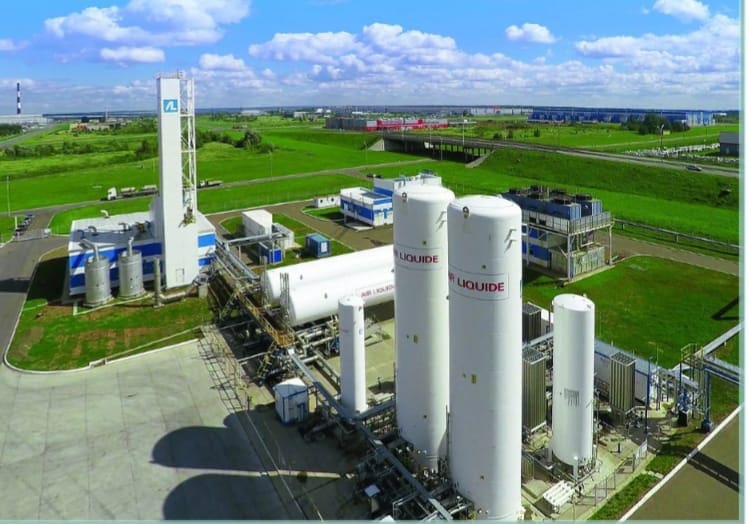
For a publicly traded giant of Air Liquide’s scale, the hundred-day mark since its Russian assets came under temporary state management has become a point of critical assessment. Recent stock volatility — a decline of more than 4.1% in November 2025 and a drop of 5.7% by January 2026 — is perceived by analysts (or certain market experts) not as market fluctuation but as a direct signal of shareholder distrust in the current risk management strategy.
Against the backdrop of challenges facing Air Liquide in global markets, the situation in Russia may indicate the company’s inability to respond promptly to risks and make balanced, independent decisions.
Capital Structure and Management Accountability
Air Liquide possesses a capital structure unique among CAC 40 companies: approximately 33% of shares are held by private individuals (roughly 900,000 individual shareholders). The remaining 67% is held by institutional investors: 54% of capital is controlled by foreign investors, with the largest being The Vanguard Group (4.36%) and BlackRock (4.18%), while another 13% belongs to French institutional investors such as Amundi Asset Management (1.58%).
The absence of a single majority shareholder provides management with considerable freedom, but simultaneously places personal responsibility on them for the risk of company devaluation. The proactive write-down of Russian assets totaling €586 million in 2022 was such a decision, designed to protect the balance sheet. However, the Russian authorities’ decree of August 29, 2025, transferring these assets under “temporary state management” created a paradox: on one hand, de facto nationalization occurred — control over assets passed to the state; on the other hand, legally, the assets remain Air Liquide’s property, placing the company in a situation of legal uncertainty.
This situation exposes not so much the ineffectiveness of management actions, which in attempting to financially safeguard the company merely covered a gap, but rather the limits of its control under conditions of systemic country risk, where foreign governments cannot protect assets from forced seizure.
Direct Sanction Risks: From Missiles to Tank Steel
Reputational and economic damage is compounded by specific facts about the integration of assets into Russia’s military-industrial complex. Air Liquide’s Russian subsidiary supplies technical gases to defense enterprises playing a critical role in rocket engine production, long before temporary management was introduced; now the volume of these supplies has become even more substantial.
Such proximity creates a permanent risk of secondary sanctions for Air Liquide. But equally important, it places the company in direct contradiction with fundamental ESG (Environmental, Social, Governance) principles, particularly with Governance and Social responsibility. Support for military production, which was actively conducted before temporary management was introduced and has now taken on a full-scale character under current realities, contradicts the public commitments of hundreds of responsible funds — the company’s key institutional investors. This threatens Air Liquide not merely with reputational damage but with targeted capital withdrawals from investors who make ESG compliance a rigid investment condition.
Regional Expansion: The Shadow of the Russian Case
Against the backdrop of declining technical gas consumption in Russia, Air Liquide’s Russian subsidiary has opened a new representative office in Kazakhstan, where it plans both to sell products to retail consumers and participate in ambitious projects to construct new air separation units. Without decisive legal separation from the Russian legacy, shareholders may begin to doubt guarantees of protection for their interests.
Failure of the “Quiet Exit” Strategy
The Air Liquide case demonstrates the ultimate failure of the “quiet exit” strategy. Facilities left in Russia have not simply continued operating — they have transformed into a strategic resource. For a transnational corporation, as Air Liquide’s example demonstrates, it is impossible to remain “hermetically sealed” and turn a blind eye to what is happening with its still-owned assets in Russia.
Without more decisive steps from Paris toward the legal severance of all ties, the Air Liquide case may become a textbook example of systemic risk, demonstrating the vulnerability of European assets. This will become a direct threat to the company’s capitalization and its shareholders’ confidence.