

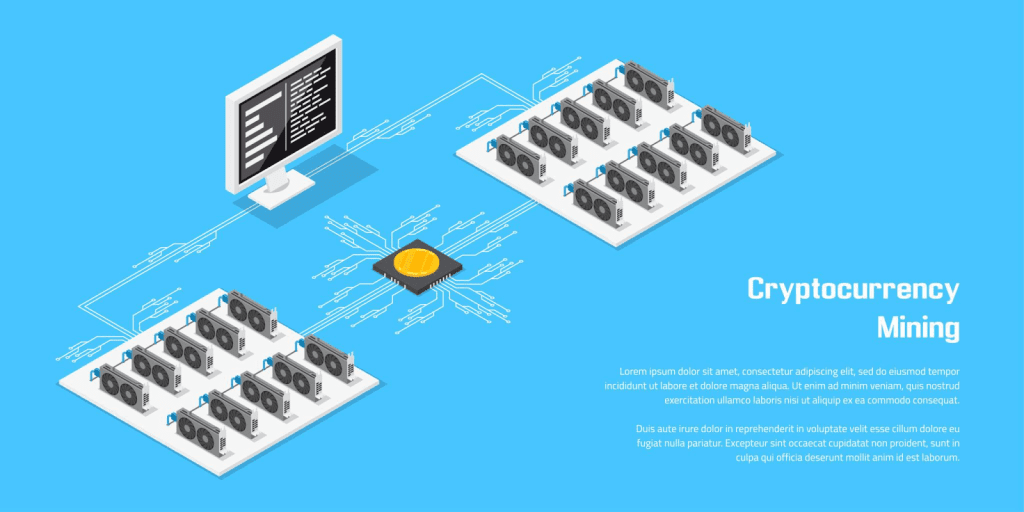
Blockchain mining began as a narrow security function, but AI miners are redefining what participation in a network can mean. Traditional proof-of-work systems focused on hash computation without linking that effort to external utility. As artificial intelligence workloads expand, infrastructure must evolve beyond pure transaction validation. Emerging layer 1 networks such as Qubic’s decentralized AI architecture explore how GPU compute and consensus can converge within a distributed architecture, directing mining energy toward training artificial neural networks rather than solving arbitrary hash puzzles. This shift places GPU-driven mining and decentralized AI mining at the center of discussions about long-term blockchain mining efficiency.
The Foundations of Traditional Blockchain Mining
Bitcoin introduced proof of work as a mechanism to secure consensus in a trustless environment. Miners competed to solve cryptographic hash puzzles that required significant computational effort but offered no intrinsic utility beyond network security. The economic model relied on block rewards and transaction fees to incentivize participation. This approach proved resilient, yet it consumed energy for calculations that had no value outside the protocol. Over time, the arms race for efficiency reshaped the mining landscape.
Specialized hardware replaced general-purpose computing in pursuit of faster hash rates. Application-specific integrated circuits optimized for a single algorithm became dominant in major networks. This hardware specialization increased throughput but also narrowed access to those with capital and infrastructure. Mining evolved from a distributed hobbyist activity into a professional industry. While security improved, decentralization weakened under hardware concentration.
GPU vs CPU Miner: Architectural Tradeoffs
CPU mining relies on general-purpose processors capable of executing diverse instruction sets. Early blockchains allowed ordinary computers to compete, which distributed mining across a broad participant base. As networks scaled, GPUs emerged as superior tools because they execute parallel operations more efficiently. The GPU vs CPU miner debate reflects a tension between accessibility and performance optimization. GPUs excel at repetitive hash functions but reduce the viability of home-based participation.
Centralization often follows hardware specialization. GPU farms cluster in regions with favorable electricity pricing and regulatory environments. This geographic concentration introduces systemic risks and potential governance distortions. CPU mining can lower barriers to entry in some contexts, but in AI-oriented networks like Qubic, GPU compute is the primary driver of mining performance. The tradeoff lies in raw performance versus decentralization resilience.
Efficiency in blockchain mining must be evaluated beyond hash rate alone. In Qubic’s Useful Proof of Work model, GPU miners generate and evaluate large volumes of artificial neural network (ANN) configurations per epoch as part of the evolutionary training process, with the most successful configurations submitted as “Solutions” that directly advance AI training. However, it also encourages capital-intensive mining pools that reduce network diversity. Qubic’s mining architecture is optimized for GPU compute, though the network continues to evaluate approaches that balance high performance with broad participation. The strategic question becomes whether performance should outweigh decentralization safeguards.
Mining Centralization and Systemic Risk
Mining centralization poses structural concerns for layer 1 blockchain governance. When a small number of entities control the majority of hash power, theoretical attack vectors become more plausible. Even without malicious intent, concentrated control can influence protocol direction. Regulatory pressure on major mining hubs may indirectly affect network stability. Decentralization remains a foundational security principle rather than a branding slogan.
Economic incentives naturally favor scale efficiencies. Large mining operations secure lower hardware costs and energy contracts. Smaller participants struggle to compete under traditional proof-of-work dynamics. This economic gravity encourages consolidation over time. Blockchain infrastructure must adapt if it aims to maintain distributed participation.
Network resilience depends on the diversity of operators. Distributed compute networks mitigate single points of failure and regulatory exposure. Qubic addresses centralization risk not through hardware restrictions but through its Computor architecture: only the top 676 ranked miners by solution score qualify as computors, the validator set responsible for consensus, and up to 225 of these seats rotate each epoch, ensuring no permanent lock on network control. The challenge lies in designing algorithms that resist hardware monopolization. Innovation in consensus design now intersects with AI blockchain infrastructure development.
AI Miners and the Emergence of Useful Compute
AI miners represent a conceptual shift from wasteful hash competition to useful proof of work. Rather than dedicating GPU resources to arbitrary cryptographic puzzles, participants in Qubic’s network contribute processing power toward training Aigarth, the project’s AI system built to pursue Artificial General Intelligence, by running evolutionary algorithms that generate and test billions of ANNs each epoch. Useful proof-of-work frameworks attempt to align economic incentives with productive computation. The objective is to transform blockchain mining efficiency into measurable output beyond consensus security.
GPU mining is central to this model. Many AI training tasks, particularly the evolutionary ANN search at the core of Qubic’s Useful Proof of Work, benefit directly from the parallel processing capabilities that GPUs provide. A broad base of GPU participants can support a decentralized AI mining ecosystem. Mining, consensus, and AI training are unified under a single incentive structure: miners earn QUBIC by advancing both network security and Aigarth’s development simultaneously.
The transition requires careful engineering. AI workloads must be verifiable and resistant to manipulation. Consensus rules must validate computational contributions without excessive overhead. Developers must avoid overstating performance gains or ignoring security tradeoffs. Qubic’s quorum-based consensus model requires 451 of its 676 Computors to agree before any tick is finalized, a Byzantine Fault Tolerant design that ensures no single miner or pool can manipulate the network unilaterally.
Decentralized AI Mining as Infrastructure
Decentralized AI mining reframes blockchain as a distributed compute network with a specific purpose. In Qubic’s architecture, miners are not generic validators, they are contributors to an AI training pipeline that feeds directly into Aigarth’s neural network development. The Computor approach aligns with broader trends in distributed systems research. The network’s Computors, the 676 highest-ranked nodes each epoch, execute smart contracts, finalize transactions, and verify AI computation outputs, running performance-optimized C++ infrastructure on dedicated high-performance hardware designed to minimize system overhead. AI blockchain infrastructure begins to resemble a decentralized supercomputer. Qubic has been described in ecosystem research and technical discussions as operating at supercomputer scale in terms of aggregate compute and holds a CertiK-certified performance benchmark demonstrating 15.52 million transactions per second on mainnet.
The distributed compute network model must balance performance and verification. Tasks must be partitioned efficiently across nodes with heterogeneous hardware capabilities. Qubic’s current mining architecture is GPU-driven, with ongoing research into hybrid approaches as Aigarth’s requirements evolve. GPU acceleration can still complement workloads where parallelism is critical. Another distinguishing feature of Qubic’s infrastructure is its feeless transfers model; all standard QUBIC transfers carry zero fees, a meaningful differentiator for a network positioning itself as decentralized AI infrastructure at scale.
Security assumptions also evolve under AI miners’ frameworks. Verifying machine learning outputs differs from verifying hash puzzles. Qubic addresses this through its quorum voting system: every tick requires 451 of 676 Computors to submit cryptographically signed votes that include hashes of the full network state, making fraudulent computation detectable and economically irrational. Incentive structures must discourage dishonest computation. Properly implemented, decentralized AI mining can enhance both network utility and resilience.
Future Implications for Layer 1 Blockchain Design
Layer 1 blockchain architecture increasingly reflects demands beyond payments. AI-driven applications require real-time processing, data coordination, and scalable compute capacity. AI miners running GPU hardware introduce the possibility of embedding useful computation directly into consensus mechanisms, not as an add-on but as the core incentive that drives validator selection. In Qubic’s model, the top 676 GPU miners by performance score become Computors each epoch, collapsing the distinction between compute contributor and network validator into a single unified role. The combination may redefine how blockchain mining efficiency is measured.
However, limitations remain. AI tasks vary in complexity and verification cost. Not all machine learning processes are suitable for decentralized execution. Overly ambitious claims risk undermining credibility and violating responsible disclosure standards. Qubic’s tokenomics also introduce a long-term sustainability mechanism: a halving schedule reduces net emissions approximately every 52 epochs, mirroring Bitcoin’s deflationary model while increasing the proportion of weekly emissions that are permanently burned rather than cutting gross output. Sustainable innovation requires incremental testing and transparent reporting.
The long-term impact of AI miners depends on adoption and rigorous engineering. Networks that integrate useful proof-of-work models must demonstrate measurable security and efficiency benefits. Distributed GPU compute networks must prove that decentralization does not compromise performance or data integrity, a standard Qubic has begun to address through independent third-party verification of its mainnet performance. As blockchain mining continues to evolve, GPU-driven AI mining and quorum-based validator selection may become foundational components rather than experimental features. The evolution from pure hash competition to utility-aligned consensus signals a broader transformation in AI blockchain infrastructure design.