
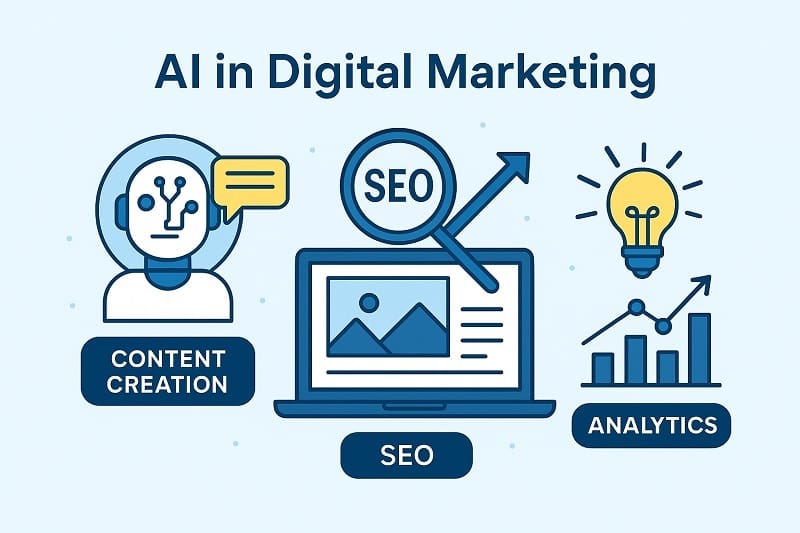
The rise of AI in digital marketing has transformed how brands create content, optimize for search engines, and analyze performance. From automating workflows to enhancing customer experience, AI tools have become essential for marketers who want to stay ahead in a data-driven world.
In this guide, we’ll explore how AI is reshaping digital marketing and review the best AI tools for content creation, SEO, and analytics in 2025.
1. What Is AI in Digital Marketing?
Digital marketing AI is the application of artificial intelligence technologies — including machine learning, natural language processing, and predictive analytics — to automate, optimize, and maximize marketing efforts.
AI is employed by marketers to:
- Produce high-quality content more quickly.
- Tailor customer experiences.
- Examine large data sets for actionable insights.
- Automate routine tasks such as keyword tracking or ad optimization.
With a combination of data-driven insights and automation, AI helps marketers make better decisions and enhance ROI on all digital platforms.
2. Why AI is Important to Modern Marketing
AI is not a thing of the future anymore — it’s the backbone of contemporary digital marketing. Here’s why:
Speed and Efficiency
AI automates research, writing, and reporting, saving time.
Better Targeting
Machine learning algorithms assist in predicting user intent and segmenting audiences better.
Data-Driven Insights
AI tools can scan thousands of data points in seconds, uncovering trends and opportunities that humans may overlook.
Personalization
AI can personalize ads, emails, and website content to every user’s likes and behavior.
Predictive Analytics
AI foresees what customers will do next, enabling brands to make informed marketing decisions ahead of trends taking hold.
3. Top AI Tools for Content Creation
ChatGPT (by OpenAI)
- Use Case: Writing blog posts, ad copy, social media descriptions, FAQs, and customer support scripts.
- Key Features: Natural language generation, tone customization, support for multi-languages.
- Why It’s Useful: ChatGPT enables marketers to create content at scale without sacrificing human tone.
Jasper AI
- Use Case: Long content, ad campaigns, and email marketing.
- Key Features: Training on brand voice, SEO optimization, and writing through templates.
- Advantage: Excellent for teams handling multiple content streams with consistent tone.
Copy.ai
- Use Case: Rapid content ideas, product descriptions, and social posts.
- Key Features: 90+ copy templates, tone variations, AI rewriter.
- Best For: Small businesses and individual marketers requiring quick, creative copy.
SurferSEO
- Use Case: Blog post optimization for Google ranking.
- Key Features: Keyword density analysis, NLP optimization, SERP analysis.
- Integration: Integrates well with Jasper and Google Docs.
Pro Tip: Pair ChatGPT for outlining and SurferSEO for optimization to produce rank-ready, high-quality articles.
4. Best AI Tools for SEO
SEMrush with AI Assist
- Use Case: Automating keyword research, backlink analysis, and SEO audit.
- AI Features: Keyword clustering automation, topic intent identification.
- Why It Stands Out: Offers AI-based ranking difficulty and content gap insights.
Ahrefs AI Integrations
- Use Case: Competitive analysis, site audit, and link-building strategy.
- AI Features: Forecasting keyword trends and content performance.
- Strength: Enables marketers to prioritize high-ROI keywords and backlinks.
RankIQ
- Use Case: Optimizing blogs for quick Google ranking.
- AI Features: Recommends perfect word length, LSI terms, and content organization.
- Best For: Bloggers and niche site owners seeking to expand organic traffic.
Frase.io
- Use Case: AI writing and SEO content brief creation.
- AI Features: Question extraction, topic clustering, and SERP analysis.
- Edge: Excellent for building organized, AI-ready content briefs for writers.
5. Best AI Tools for Analytics and Insights
Google Analytics 4 (GA4) with AI Insights
- Use Case: Monitoring user behavior and conversion performance.
- AI Features: Predictive indicators such as purchase likelihood and churn rate.
- Why It’s Critical: Enables marketers to proactively tweak campaigns.
HubSpot AI
- Use Case: Campaign analytics and marketing automation.
- AI Features: Predictive lead scoring, content suggestions, and workflow automation.
- Integration: Integrates across CRM, email marketing, and analytics dashboards.
Adobe Sensei
- Use Case: Personalization and customer journey analytics.
- AI Features: Predictive audience segmentation and automatic creative optimization.
- Benefit: Best suited for enterprises with sophisticated digital marketing environments.
Pecan AI
- Use Case: Predictive analytics and forecasting.
- AI Features: No-code model creation, prediction of marketing performance.
- Why It’s Useful: Excellent for campaign ROI understanding prior to launch.
6. How to Implement AI in Your Digital Marketing Strategy
Step 1: Set Specific Objectives
Determine what you’d like AI to do — content efficacy, SEO rank, or improved insights.
Step 2: Choose the Proper Tools
Choose AI tools that integrate with your existing tech stack (CMS, CRM, or analytics platforms).
Step 3: Train the AI Models
Feed your AI tools with relevant data (past campaigns, customer segments) for personalized results.
Step 4: Monitor Performance
Use AI dashboards and reports to measure improvements in engagement, leads, and traffic.
Step 5: Optimize Continuously
AI thrives on data. Regularly update your tools and retrain models to reflect market changes.
7. Advantages of AI Application in Digital Marketing
- More Efficiency: Free up time from mundane work such as keyword monitoring or ad bidding.
- Greater Accuracy: AI reduces the risk of human error when interpreting data.
- Personalization at Scale: Provide customized experiences for thousands of people.
- Cost Reduction: Save on manpower and content creation time.
- Quicker Decision-Making: Get real-time insights for campaign optimization.
8. Challenges and Drawbacks
Even with all its strength, AI in digital marketing is not perfect:
- Data Privacy Issues: Abuse of customer information may violate laws such as GDPR.
- Reliance on Quality Data: AI results are only as good as the data it’s been trained on.
- Limited Human Creativity: AI can produce content, but can’t entirely capture emotional appeal.
- Tool Overload: Excessive number of AI tools can lead to confusion without top-down strategy.
9. The Future of AI in Digital Marketing
By 2026, more than 80% of marketing automation will be powered by AI across the world. The next leap involves:
- Voice-activated content optimization
- Hyper-personalized ad targeting
- AI-powered video and influencer marketing tools
- Marketers adopting AI early on will enjoy a commanding competitive edge in efficiency and creativity.
Conclusion
AI in Digital Marketing is not a choice anymore — it’s a necessity. From writing SEO-friendly content to cracking analytics, AI-powered tools enable marketers to make smarter, faster, and more effective decisions.
Begin with small tools such as ChatGPT for content and Google Analytics 4 for data analysis. As you expand, incorporate sophisticated solutions such as HubSpot AI or Adobe Sensei to create a completely intelligent marketing system. To find out how various AI tools such as ChatGPT, Claude, Gemini, and Perplexity measure in terms of performance and accuracy, read our comprehensive guide — ChatGPT vs Other AI Tools: Claude, Gemini, Perplexity Comparison Guide.
