

Problem: Traditional SEO playbooks focus on rankings and clicks. AI search engines now generate answers instead of showing ten blue links.
Agitation: Brands lose visibility when AI summarizes content without attribution. Many teams still optimize pages instead of knowledge units. This leads to fewer clicks, weaker brand presence, and shrinking organic reach.
Solution: A modern SEO & AI search plan focuses on entities, structured knowledge, conversational answers, and technical accessibility. This article gives you a clear operational framework for building AI-retrievable, citation-ready content.

What Is an SEO & AI Search Plan for 2026? (And Why Traditional SEO Alone Is No Longer Enough)
An SEO & AI search plan focuses on retrieval, citation, and conversational discovery. It aligns content with how AI systems like ChatGPT, Perplexity, and Google AI Overviews interpret knowledge.
Evolution from Keyword SEO → Entity SEO
Traditional SEO targets keywords. AI search targets entities and relationships.
Search engines now connect ideas through semantic understanding.
Rise of AI-Generated Search Answers
AI models synthesize content from multiple sources.
Visibility depends on clarity, structure, and factual authority.
Zero-Click Search & Citation-Based Discovery
Users receive answers directly.
Your goal becomes being cited, not only ranked.
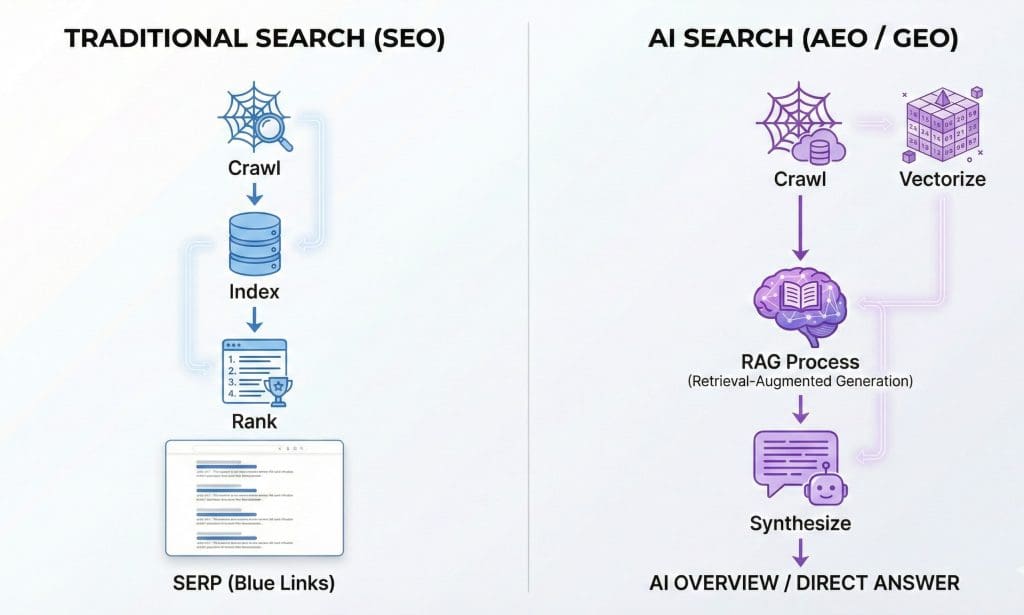
How AI Search Engines Actually Work (Retrieval, Embeddings & Answer Generation)
AI search relies on Retrieval-Augmented Generation (RAG). It converts queries into embeddings and retrieves semantically relevant content.
Query → Embedding → Retrieval → Generation
- User query becomes a vector representation.
- Vector databases find relevant content chunks.
- LLMs generate responses using retrieved data.
AI Citation Logic
Models select sources based on:
- Topical authority
- Entity clarity
- Structured answers
- Consistent terminology
Content Chunking & Semantic Matching
Passages work as independent knowledge units.
Clear headings improve passage extraction.
The New SEO Foundation: Entity-Based & Semantic Optimization
Entity-based SEO connects your content to the Knowledge Graph.
Schema.org markup improves entity recognition.
Knowledge Graph Connections
Entities include:
- Organizations
- Tools
- Concepts
- Experts
These links strengthen contextual relevance.
Entity Relationships vs Keyword Density
Keyword stuffing weakens AI readability.
Semantic clusters improve understanding.
Semantic Topical Mapping
Group content into topic clusters:
- AI SEO strategy
- Conversational search
- Structured data
- Technical optimization
Content Architecture for AI Retrieval & Citation
AI-ready content focuses on clear structure and concise answers.
Writing for Conversational Search Queries
Use natural language questions.
Answer directly in the first paragraph.
Passage-Level Optimization
Each section should stand alone.
Include entity references naturally.
AI Snippet-Ready Formatting
Use:
- Bullet lists
- Short paragraphs
- Bolded definitions
- FAQs
Knowledge-Unit Structuring
Break large topics into focused sections.
Each H2 should answer one core question.

Technical SEO for AI Crawlers & LLM Indexability
Technical accessibility determines whether AI systems can retrieve your content.
Robots.txt & AI Bot Access
Allow bots such as:
- GPTBot
- Google-Extended
- PerplexityBot
Structured Data Strategy
Use Schema.org:
- Article
- FAQ
- Organization
- Author
AI-Friendly Internal Linking
Link semantically related pages.
Use descriptive anchor text.
Crawl Budget in the AI Era
Reduce duplicate content.
Improve page load speed.
Building Topical Authority Through Semantic Clusters
Topical authority increases citation likelihood.
Pillar vs Supporting Content
Pillar pages cover broad concepts.
Supporting pages deepen specific subtopics.
Semantic Keyword Clustering
Group keywords by intent:
- Informational
- Strategic
- Technical
Content Graph Architecture
Create internal links between related entities.
This builds a clear knowledge structure.
Measuring Success in AI Search (Traffic, Citations & Visibility)
Traditional metrics miss AI visibility signals.
AI Traffic Attribution
Monitor:
- Referral sources
- AI-driven sessions
- Branded search increases
Monitoring Citations
Track:
- Brand mentions in AI responses
- Knowledge panel visibility
- Entity recognition growth
New KPIs for AI Search
- Citation frequency
- Answer inclusion rate
- Conversational query impressions
Real AI SEO Workflow: The 2026 Optimization Framework
A structured workflow turns strategy into repeatable execution.
Strategy → Production → Optimization → Measurement
- Map entities and semantic clusters.
- Create AI-retrievable content.
- Optimize technical accessibility.
- Measure AI visibility metrics.
AI Content Evaluation Loop
Review content for:
- clarity
- entity consistency
- factual accuracy
- answer structure
Prompt Engineering for SEO Teams
Use prompts to:
- generate outlines
- expand semantic coverage
- audit entity usage
Future Trends & Predictions: Where AI Search Is Headed Next
AI search continues evolving beyond text queries.
Voice-First Conversational Search
Voice assistants rely on concise, structured answers.
AI Agents Performing Searches
Agents execute multi-step queries automatically.
Personal AI Assistants
Search becomes contextual and personalized.
Predictive Search Ecosystems
Systems anticipate user needs based on behavior patterns.
Traditional SEO vs AI Search Optimization (Comparison Table)
| Aspect | Traditional SEO | AI Search Optimization |
|---|---|---|
| Core Focus | Keywords & rankings | Entities & contextual relevance |
| Goal | Click-through traffic | Citations & answer inclusion |
| Content Structure | Long pages | Knowledge units & passages |
| Measurement | Organic clicks | Mentions & AI referrals |
| Optimization Method | On-page signals | Semantic relationships |
FAQ (AEO & LLM Optimization)
What is AI search optimization?
AI search optimization structures content so AI systems understand entities, retrieve passages, and generate accurate answers while citing trustworthy sources, improving conversational search visibility and semantic relevance signals.
It focuses on structured data, clear answers, and entity relationships. The goal is citation inclusion rather than only ranking position.
How is AI search different from traditional SEO?
AI search analyzes context, entity relationships, and factual clarity to generate answers instead of only ranking pages, meaning success depends on semantic depth, structured information, and retrievable content passages.
Traditional SEO emphasizes keywords and links. AI search prioritizes knowledge accuracy and contextual authority.
What content structure works best for AI search engines?
Content performs best when organized into clear headings, concise answers, semantic clusters, and structured data sections that allow AI systems to extract meaningful passages quickly and accurately for conversational responses.
Use bullet points, FAQs, and short paragraphs. Each section should answer one specific user intent.
Do backlinks still matter for AI search?
Backlinks still influence authority signals, but AI systems also evaluate brand reputation, entity consistency, and topical expertise, meaning mentions and contextual authority now carry equal weight alongside traditional link metrics.
Focus on expertise, consistent publishing, and trustworthy citations rather than pure link volume.
How can businesses prepare for AI-driven search results?
Businesses should build entity-driven content hubs, structured data frameworks, conversational FAQs, and technically accessible websites while monitoring AI citations and conversational traffic to continuously refine content and visibility strategies.
Start with semantic mapping and technical crawlability audits. Then shift toward knowledge-unit content design.
