
You want glowing, smooth skin, but the skincare aisle is confusing. You see bottles labeled “Acid,” “Peel,” and “Resurfacing,” and instead of buying, you walk away.
That fear is valid. Putting acid on your face sounds counterintuitive.
But here is the truth: scrubby face washes with walnut shells cause micro-tears and damage your skin. Chemical exfoliants, when used correctly, are actually gentler and far more effective. They don’t scrub; they dissolve.
This guide explains exactly how AHA and BHA exfoliants work, which one matches your skin type, and how to use them without ruining your moisture barrier.
The Science of Solubility: What is the Real Difference?
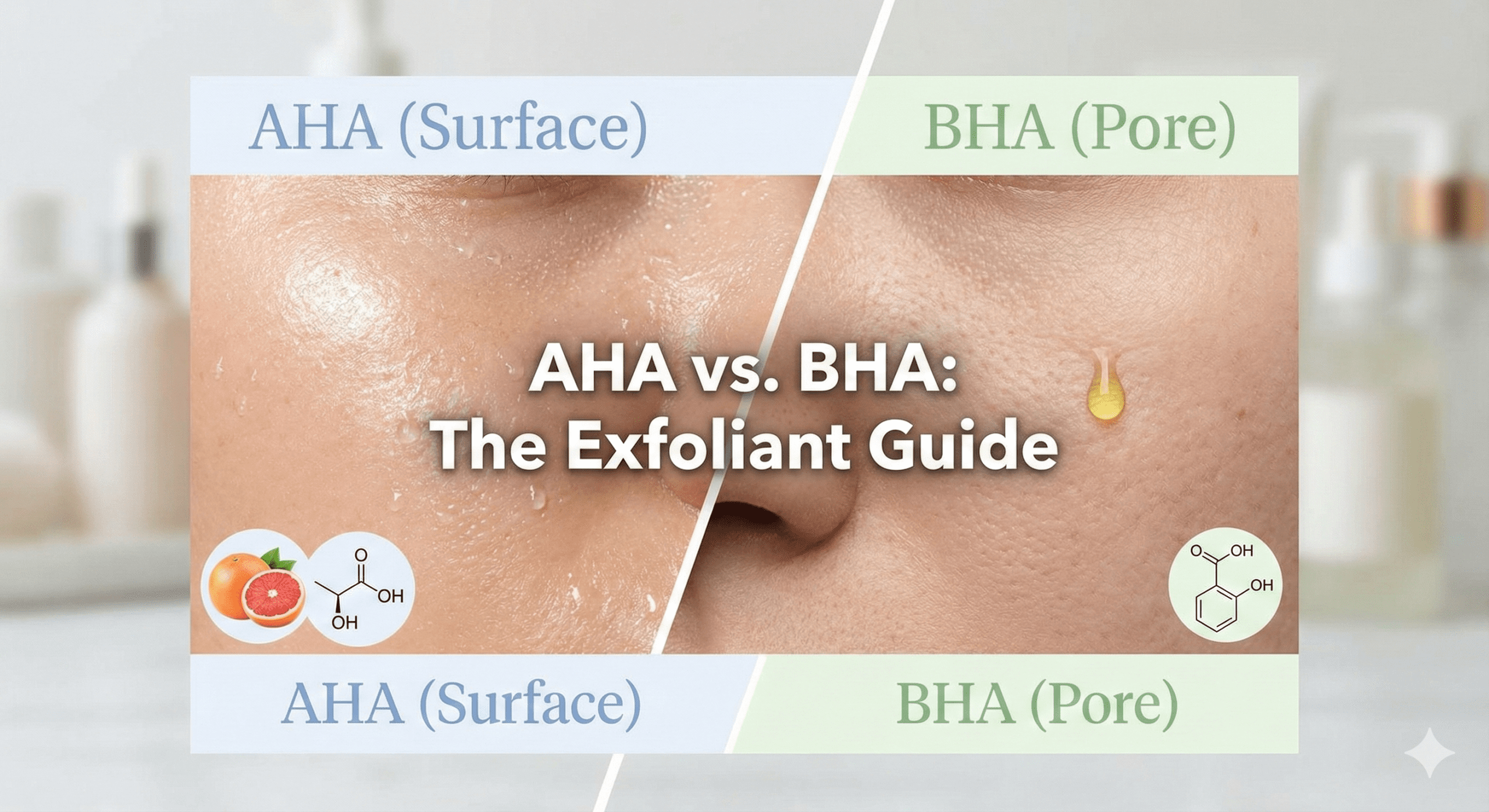
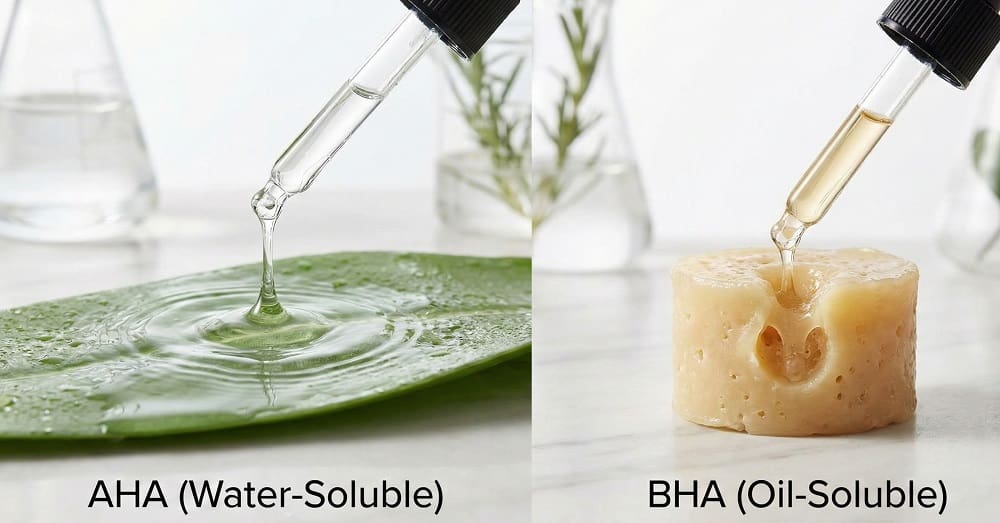
The main difference isn’t just the name; it’s solubility. This single factor dictates where the acid goes and what it does once it hits your skin.
- AHAs (Alpha Hydroxy Acids) are hydrophilic (water-loving). They mix with water but repel oil.
- BHAs (Beta Hydroxy Acids) are lipophilic (oil-loving). They can pass through oil and sebum.
Think of your skin like a brick wall. The skin cells are the bricks, and the “glue” holding them together is a mix of oils and proteins.
AHAs work on the surface. They dissolve the glue holding the top layer of dry, dead skin cells together, allowing them to slough off easily.
BHAs work inside the pore. Because they love oil, they bypass the surface and travel down into the pore lining to dissolve the clog from the inside out.
Deep Dive: Alpha Hydroxy Acids (AHAs)
AHAs are derived from sugary fruits and milk. They are the gold standard for surface-level issues.
Who is it for?
If you have dry skin, sun damage, or rough texture, AHA is your best friend. It doesn’t strip moisture; in fact, many AHAs are humectants, meaning they help hold water in the skin.
The “Big Two”: Glycolic vs. Lactic Acid
Not all AHAs are equal. The molecular size matters.
- Glycolic Acid: Derived from sugar cane. It has the smallest molecule, meaning it penetrates the fastest and deepest. It gives the quickest “glow” but has the highest chance of stinging sensitive skin.
- Lactic Acid: Derived from milk. It has a larger molecule, so it penetrates slower. It is much gentler and arguably more hydrating.
Rule of Thumb: If your skin is resilient, try Glycolic. If you lean towards sensitive, start with Lactic.
Deep Dive: Beta Hydroxy Acids (BHAs)
There is really only one main BHA in skincare: Salicylic Acid.
Who is it for?
BHA is for oily, acne-prone skin and those with enlarged pores. If you see blackheads on your nose or bumps under your skin, you need a BHA.
Why BHA is the “Pore Vacuum”
Because BHA is oil-soluble, it doesn’t get stopped by the oil on your face. It cuts right through it.
Once inside the pore, it exfoliates the lining. This prevents dead skin and sebum from trapping bacteria (which causes acne). Additionally, Salicylic Acid has natural anti-inflammatory properties, making it excellent for calming red, angry pimples.
Comparison: AHA vs. BHA Cheat Sheet
Use this table to make a quick decision based on your primary skin concern.
| Feature | AHA (Alpha Hydroxy Acid) | BHA (Beta Hydroxy Acid) |
| Solubility | Water-Soluble (Hydrophilic) | Oil-Soluble (Lipophilic) |
| Primary Action | Surface Exfoliation | Pore Unclogging |
| Best For | Dryness, Sun Damage, Aging | Acne, Blackheads, Oiliness |
| Key Ingredients | Glycolic, Lactic, Mandelic | Salicylic, Betaine Salicylate |
| Sensation | Can tingle or sting | usually cooling/calming |
| Sun Sensitivity | High (Must wear SPF) | Moderate (Still wear SPF) |
Can You Use Both? (Mixing & Layering)
The short answer is yes, but be careful.
Beginners often make the mistake of buying a Glycolic Toner and a Salicylic Serum and using them both on the same night. This is a recipe for a damaged skin barrier. Signs of damage include redness, shiny (but tight) skin, and stinging when you apply moisturizer.
The “Skin Cycling” Method
Instead of layering, alternate nights. This minimizes irritation while giving you the benefits of both.
- Monday: Exfoliate with AHA (Surface glow).
- Tuesday: Hydrate (No acids).
- Wednesday: Exfoliate with BHA (Deep clean).
- Thursday: Hydrate.
The Dangers of Over-Exfoliation
More is not better. Over-exfoliating strips the skin’s acid mantle. Once that barrier is broken, bacteria get in easily, leading to more acne—not less. If you feel a “burn,” wash it off immediately.
How to Choose the Right Product for Your Routine
The “vehicle” (the type of product) is just as important as the acid itself.
Toner vs. Serum vs. Wash
- Face Wash: The gentlest option. Since it is rinsed off, the acid has limited contact time. Great for sensitive skin or daily BHA use for acne.
- Toner: Good for maintenance. Usually lower concentrations.
- Serum: The most potent. These stay on the skin and work overnight. Use these 1-2 times a week max.
Important Safety Rule: Sunscreen is Non-Negotiable
AHAs strip the top layer of dead skin cells. That layer was a tiny shield against UV rays. Without it, your fresh skin is highly susceptible to sun damage. If you use acids at night, you must wear SPF 30+ the next morning.
Frequently Asked Questions (FAQ)
What is the main difference between AHA and BHA?
Solubility is the main difference. AHAs are water-soluble and exfoliate the surface (good for dry skin). BHAs are oil-soluble and penetrate the pores (good for acne/oily skin).
Nuance: Think of AHA as a polisher for the floor, and BHA as a cleaner for the drain pipes.
Can I use AHA and BHA together?
Yes, but it is best to alternate them. Use AHA one night and BHA another night to avoid irritation.
Nuance: Advanced users can use combined products (like “AHA/BHA Peels”), but these should be washed off after 10 minutes and used only once a week.
Is Salicylic Acid an AHA or BHA?
Salicylic Acid is a BHA. It is the most common Beta Hydroxy Acid used in skincare specifically for its ability to dissolve oil.
Nuance: You might see “Betaine Salicylate” in Korean skincare; this is a gentler derivative of Salicylic Acid.
Which is better for acne, AHA or BHA?
BHA is superior for acne. Its oil-soluble nature allows it to unclog pores and reduce the inflammation associated with breakouts.
Nuance: AHAs can help fade the marks left behind by acne (post-inflammatory hyperpigmentation), but BHA stops the acne from forming.
How often should a beginner use AHA or BHA?
Start with 1-2 times per week. Apply it at night on clean, dry skin.
Nuance: “Daily” exfoliants exist, but even those can be too harsh for a beginner. Build tolerance slowly over 3-4 weeks before increasing frequency.
