

There is a reason seasoned mechanics keep reaching for their flex head wrenches long after the novelty wears off. Once you angle a wrench around a stubborn exhaust manifold bolt that nothing else can reach, you understand the appeal instantly. This flex ratcheting wrench review takes a thorough, experience-based look at adjustable locking flex head ratcheting wrenches — what makes them tick, where they genuinely outperform fixed-head alternatives, and whether the extra cost is justified for your particular work.
We tested chrome vanadium steel sets across price points, compared tooth counts and swing arcs, crawled under vehicles, and measured real-world torque feel. Whether you wrench on motorcycles every weekend or just handle the occasional household repair, this guide cuts through marketing language and focuses on the details that actually matter at the workbench.
What Exactly Is an Adjustable Locking Flex Ratcheting Wrench?
A wrench has been one of the most fundamental hand tools in human history, and its evolution over the past century has been dramatic. The adjustable locking flex ratcheting wrench combines three engineering ideas into a single tool. First, the ratcheting mechanism lets you turn fasteners without lifting and repositioning the wrench after every partial rotation. Second, the flex head pivots up to 180 degrees so you can approach bolts from multiple angles without switching tools. Third, the locking feature holds the head at whatever angle you set, preventing the head from flopping around under load.
That combination solves a real problem. Anyone who has worked in a cramped engine bay knows the frustration of a wrench that cannot reach a recessed bolt or a head that wobbles just when you need steady torque. The locking flex design addresses both issues, which is why demand for this style of wrench has grown sharply across automotive, HVAC, plumbing, and general maintenance trades.
Why Flex Head Ratcheting Wrenches Are Taking Over Toolboxes
Market data tells an interesting story about the growth of hand tools generally and ratcheting wrenches in particular. According to a 2025 report by Future Market Insights, the global hand tools market is valued at approximately USD 17.9 billion and is projected to reach USD 33.6 billion by 2036, growing at a compound annual growth rate of 5.9 percent. Wrenches hold the largest product segment share in the hand tools market at roughly 33.9 percent of global value — a testament to how central they remain to mechanical work across industries.
Several forces are driving this growth. The rise of DIY culture has been enormous, with platforms like YouTube and social media giving millions of people the confidence to tackle automotive and household repairs themselves. Professional mechanics, meanwhile, continue upgrading to tools that save time in increasingly cramped modern engine compartments. The shift toward online purchasing has also reshaped how people discover and evaluate tools, making detailed reviews like this flex ratcheting wrench review more important than ever for making informed buying decisions.
If you have never used a flex head ratchet before, the benefits of a flexible head ratchet are worth understanding in practical terms. The ability to tilt the wrench head means you gain clearance for your knuckles, you can work around obstructions like wiring harnesses or coolant hoses, and you can reach fasteners that would otherwise require removing other components first.
Key Features We Evaluated in This Flex Ratcheting Wrench Review
Tooth Count and Swing Arc
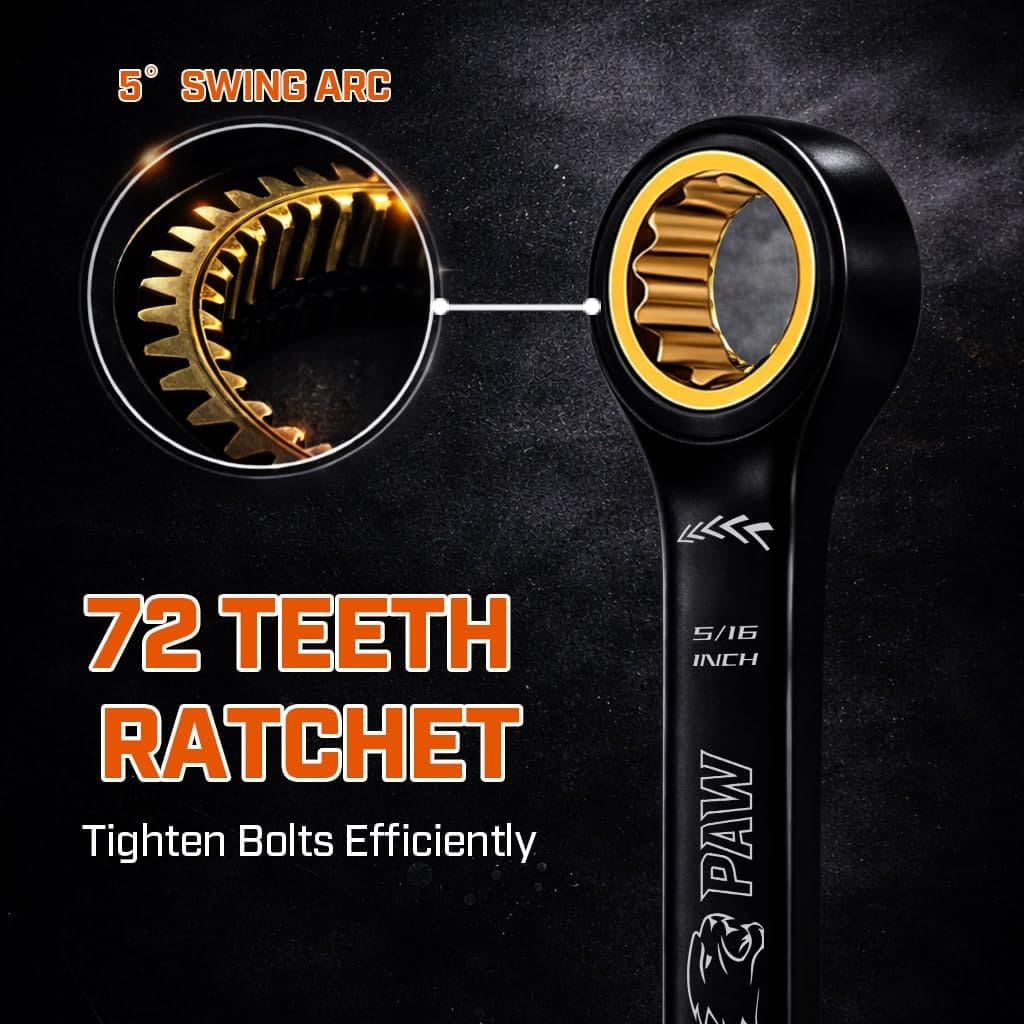
The tooth count inside the ratcheting mechanism determines how fine the swing arc is. Most mid-range flex ratcheting wrenches feature a 72-tooth mechanism that requires only 5 degrees of handle swing to engage the next tooth. That might sound like a small number, but in a tight space where you can barely move the handle an inch, those 5 degrees become the difference between getting a bolt started and reaching for a completely different tool.
Higher-end models push the tooth count to 90 or even 144 positions. Milwaukee’s flagship flex head ratcheting wrenches, for instance, run a 144-tooth mechanism that reduces the swing arc to a remarkably tight 2.5 degrees. That kind of precision matters for professionals who work on modern vehicles with tightly packaged engine bays. For most home mechanics and general maintenance work, though, a quality 72-tooth design delivers outstanding performance. Understanding how a ratchet wrench works at the mechanical level helps you appreciate why tooth count matters so much.
Material and Build Quality
Material quality separates a wrench that lasts a decade from one that fails on its third use. The industry standard for professional-grade ratcheting wrenches is chrome vanadium steel (Cr-V), an alloy that typically contains 0.8 to 1.1 percent chromium and 0.15 to 0.25 percent vanadium. These alloying elements increase hardness and wear resistance while maintaining enough toughness that the wrench will flex slightly under extreme loads rather than snapping outright.
The surface finish matters more than many buyers realize. A properly applied chrome plating or satin finish does more than look professional — it actively resists corrosion, prevents rust in humid shop environments, and makes the tool easier to wipe clean after contact with grease and oil. Budget wrenches often skimp on plating thickness or skip it entirely, which leads to pitting and surface degradation within a year or two of regular use. The IRONCUBE chrome vanadium flex head wrench set uses proper heat treatment and a chrome-plated satin finish that holds up under shop conditions.
Flex Head Range and Locking Mechanism
Not all flex heads are created equal. A true 180-degree pivot range gives you the widest possible range of approach angles. Some cheaper designs only manage about 120 degrees, which limits their usefulness in genuinely awkward spaces. The pivot joint itself should feel smooth but firm — loose enough to adjust easily, tight enough that it does not wobble under torque.
The locking mechanism is where adjustable locking flex ratcheting wrenches really distinguish themselves from standard flex head models. When you can lock the head at a specific angle, the wrench behaves like a fixed-head tool at that angle, giving you stable, predictable torque delivery. Without the lock, the head can shift during heavy tightening or loosening, which is both annoying and potentially dangerous. Not every flex head on the market includes a locking feature, so if this matters to you, verify it before purchasing. For deeper insight into working in tight spaces with flex head sets, IRONCUBE has published a practical guide.
Reversible Direction Switch
A reversible ratcheting wrench lets you switch between tightening and loosening without removing the wrench from the fastener. This sounds like a basic convenience, and it is, but it adds up to significant time savings over the course of a long job. The quality of the direction switch varies hugely between brands. In the best designs, it sits flush against the wrench head, toggles with a confident click, and stays put. In poor designs, the switch protrudes enough to snag on components, feels mushy, or gradually loses its detent over time.
IRONCUBE’s reversible ratcheting wrench set features an ergonomic switch design that sits cleanly against the head and toggles with positive tactile feedback — a detail that matters more than you might expect during repetitive work.
Flex Head vs. Fixed Head Ratcheting Wrenches: A Direct Comparison
One of the most common questions in any flex ratcheting wrench review is whether a flex head is truly better than a fixed head. The honest answer is that each design has strengths, and the best-equipped toolbox includes both. The table below breaks down the practical differences.
| Feature | Flex Head | Fixed Head |
| Access Angle | Up to 180° pivot | Fixed inline only |
| Tight Space Work | Excellent | Limited |
| Maximum Torque | Good (slightly less at extreme angles) | Best (rigid connection) |
| Durability | High (pivot point may wear over years) | Very High |
| Locking Option | Available on premium models | Not applicable |
| Price Range | Moderate to High | Low to Moderate |
| Best For | Engine bays, HVAC, cramped spaces | Open bolts, high-torque tasks |
Fixed head wrenches deliver maximum torque because there is no pivot joint to introduce flex. They also tend to be slightly cheaper and arguably more durable over very long service lives. However, the flex head’s ability to reach bolts at odd angles makes it the more versatile choice for most mechanics. Many professionals keep both types and reach for the flex head about 70 percent of the time, reserving fixed heads for high-torque situations where rigidity is essential. For a thorough look at the best large ratchet wrench options for heavy-duty applications, IRONCUBE offers additional comparison resources.
Real-World Performance: Where Flex Ratcheting Wrenches Shine
Automotive Repair and Maintenance
Modern vehicles are packed tighter than ever. Turbochargers, hybrid battery packs, and emissions equipment crowd engine bays that used to have generous clearances. A flex ratcheting wrench earns its keep most dramatically in automotive work — removing alternator bolts hidden behind accessory brackets, loosening exhaust manifold studs at impossible angles, and reaching brake caliper bolts tucked behind rotor assemblies. The auto care industry employs roughly 887,000 technicians across the United States alone, and the replacement cycle for hand tools in this sector is constant.
Motorcycle mechanics find flex ratcheting wrenches particularly valuable because of the compact frame geometry on bikes. Fasteners on motorcycles are often recessed deep within the frame, surrounded by cooling fins, wiring, and bodywork. The combination of a slim wrench profile and a pivoting head makes these wrenches a natural fit for two-wheel work. IRONCUBE specifically designs their wrench sets with motorcycle and racing team maintenance in mind, which shows in the size ranges and the slim profile of their box ends.
HVAC, Plumbing, and Industrial Maintenance
HVAC technicians work in spaces that test the patience of even experienced tradespeople — inside air handlers, behind ductwork, above ceiling tiles. A flex head wrench that locks at angle lets you set your approach once and maintain it across multiple fasteners in a row, which is a major time-saver when you are balancing on a ladder or reaching overhead. Plumbing work presents similar challenges with fittings located behind walls or under sinks with minimal clearance.
Industrial maintenance teams working on factory equipment, conveyors, and machinery benefit from the flex head’s adaptability because equipment layouts rarely leave convenient wrench access to every bolt. The extra large heavy duty ratcheting wrenches from IRONCUBE address the higher-torque end of this market, while the standard metric and SAE sets handle the everyday work.
What to Look for When Buying a Flex Ratcheting Wrench Set
Price alone never tells the full story, and neither does brand name. Here is what actually distinguishes a good set from a mediocre one in this flex ratcheting wrench review context.
Size range coverage. A metric set should span at least 8mm to 19mm to handle the majority of automotive and general mechanical work. SAE sets should cover 1/4 inch through 3/4 inch at minimum. A combined metric and SAE set saves you from buying two separate kits. If you frequently switch between measurement systems, a metric to SAE conversion chart is an invaluable desk reference.
Ratcheting smoothness. Pick up the wrench and cycle the ratchet. It should feel smooth, consistent, and free of excessive backdrag — that annoying resistance you feel when rotating the wrench in the free-spin direction. Backdrag slows you down and causes fatigue during long jobs. Chrome vanadium internals with proper heat treatment tend to produce the smoothest ratcheting action.
Storage solution. A wrench set without organized storage becomes a jumbled mess in your toolbox drawer within a week. Look for sets that include a rolling pouch, a canvas bag with individual slots, or a molded organizer tray. IRONCUBE ships their sets with purpose-built storage pouches and organizer cases that protect the chrome finish and keep sizes instantly identifiable.
Warranty and brand support. A wrench is a tool you should buy once and use for years. Reputable manufacturers back their chrome vanadium ratcheting wrenches with meaningful warranty coverage. IRONCUBE, for example, provides a 24-month warranty on their professional-grade hand tools and offers direct technical support through their contact page.
Pricing and Value: What Does a Quality Set Cost?
Pricing for flex head ratcheting wrench sets varies significantly. Budget sets from unknown brands start around $20 to $30 for a basic metric set but frequently suffer from poor ratchet action, soft steel that rounds fasteners, and finishes that rust within months. Mid-range sets from established brands like IRONCUBE run approximately $30 to $60 for comprehensive metric or SAE coverage with 72-tooth mechanisms, chrome vanadium construction, and proper storage included. Premium professional sets from tool truck brands can easily exceed $200 to $400 for comparable size ranges.
For a detailed breakdown of flex head wrench pricing across different tiers, IRONCUBE has published an honest comparison that helps buyers understand exactly what they get at each price point. The sweet spot for most users — professionals who need reliable daily tools and enthusiasts who want quality without overpaying — falls squarely in that mid-range category where chrome vanadium steel, proper heat treatment, and functional flex head designs converge.
Why IRONCUBE Stands Out in the Flex Ratcheting Wrench Market
IRONCUBE WORKS has been manufacturing professional-grade hand tools from their Ningbo facility since 2008. Their approach to ratcheting wrenches reflects a philosophy they call “The IRON Way” — a commitment to combining innovation with practicality. Every wrench is forged from premium chrome vanadium steel, undergoes controlled heat treatment, and passes individual quality inspection before shipping.
What sets IRONCUBE apart from generic Amazon wrench sets is their vertical integration. They control manufacturing from raw material through to finished product, including CNC machining, forging, and hydraulic press operations. This level of control eliminates the quality inconsistencies that plague brands which simply source from whatever factory offers the lowest quote this quarter. Their 72-tooth ratcheting mechanism operates with a 5-degree arc, providing smooth action with minimal backdrag — a result of precise internal gear tolerances that less disciplined manufacturers struggle to maintain consistently.
IRONCUBE’s large heavy duty ratcheting wrench line extends their range to sizes that many competitors neglect, serving mechanics who work on heavy equipment, trucks, and agricultural machinery. Their wrenches comply with ASME standards for combination wrenches, ensuring they meet professional torque requirements. You can see their tools demonstrated in real working conditions on the IRONCUBE YouTube channel.
Common Mistakes When Choosing a Flex Ratcheting Wrench Set
After evaluating dozens of sets for this flex ratcheting wrench review, a few recurring buyer mistakes stand out.
Buying by piece count alone. A 24-piece set sounds impressive until you realize half the sizes are duplicates or that it includes obscure sizes you will never use while skipping common ones like 14mm or 17mm. A well-curated 12-piece set covering 8mm through 19mm is more practical than a bloated 24-piece set with gaps in the useful range.
Ignoring backdrag. Some wrenches look fine on the shelf but have so much backdrag that the ratchet barely free-spins. This kills productivity and causes hand fatigue. If you cannot test before buying, read user reviews specifically looking for mentions of smooth ratchet action.
Choosing the wrong measurement system. If you primarily work on Japanese, European, or Asian vehicles, you need metric. If you work on American vehicles and equipment, you need SAE. Many people benefit from owning both. Guessing leads to rounded bolt heads and frustration.
Overlooking the flex head pivot quality. A loose pivot undermines the entire purpose of a flex head. The pivot should hold position under moderate hand pressure. A locking mechanism is even better, but at minimum, the pivot should not droop under the weight of the wrench alone.
Frequently Asked Questions About Flex Ratcheting Wrenches
What is the ideal tooth count for a flex ratcheting wrench?
For most users, a 72-tooth mechanism offering a 5-degree swing arc provides excellent performance in tight spaces. This is the standard across professional-grade sets and delivers a strong balance between fine incremental movement and internal gear durability. Higher counts like 90 or 144 teeth reduce the arc further but increase manufacturing cost. This flex ratcheting wrench review found that 72 teeth satisfy roughly 90 percent of real-world mechanical tasks without issue.
Can I use a flex head ratcheting wrench for high-torque applications?
Yes, particularly if the wrench has a locking flex head that holds the pivot firmly at your chosen angle. When locked, the wrench behaves like a fixed-head tool and can handle substantial torque. Without a lock, extreme torque at sharp flex angles may cause the head to shift. For very heavy-duty work, a dedicated fixed-head wrench or breaker bar is still the safest choice, but a quality flex ratcheting wrench review consistently shows that locked flex heads handle the vast majority of real-world torque demands.
What makes chrome vanadium steel the preferred material for ratcheting wrenches?
Chrome vanadium steel offers a superior combination of hardness, tensile strength, and corrosion resistance compared to basic carbon steel. The chromium content enhances surface hardness and rust resistance, while vanadium improves grain structure and toughness. This means the wrench maintains its dimensional accuracy under repeated stress, resists rounding at the fastener contact points, and does not become brittle in cold conditions. Every set evaluated in this flex ratcheting wrench review used Cr-V steel as its base material, confirming its position as the industry standard.
Are flex head ratcheting wrench sets suitable for beginners?
Absolutely. Flex head wrenches are actually easier for beginners to use because the pivoting head naturally finds the right angle on a fastener, reducing the fumbling and repositioning that frustrates new mechanics. The ratcheting action also means beginners do not need to lift and reset the wrench repeatedly, making the work more intuitive. A quality flex ratcheting wrench review will always note that these wrenches are among the most user-friendly hand tools available for anyone just starting to build their toolbox.
How should I maintain my flex ratcheting wrench set?
Wipe the wrenches down with a clean rag after each use to remove grease, oil, and debris. Apply a light machine oil or spray lubricant to the ratcheting mechanism every few months to keep the internal gears moving freely. Store the set in its included pouch or organizer to prevent the chrome finish from getting scratched or chipped by contact with other tools. Avoid using wrenches as pry bars or striking them with a hammer, as this can damage the ratchet mechanism and void warranty coverage.
What wrench sizes do I need for basic automotive work?
A metric set covering 8mm, 10mm, 12mm, 13mm, 14mm, 15mm, 17mm, and 19mm handles the vast majority of bolts on modern cars and motorcycles. For American vehicles, an SAE set with 1/4, 5/16, 3/8, 7/16, 1/2, 9/16, 5/8, 11/16, and 3/4 inch covers the essentials. This flex ratcheting wrench review recommends starting with a 12-piece metric set, since most vehicles manufactured globally now use metric fasteners regardless of where they are sold.
Final Summary
An adjustable locking flex head ratcheting wrench is one of those tools that seems like a luxury until you actually use one — then it becomes indispensable. The flex head gives you access angles that fixed wrenches simply cannot match, the locking mechanism provides stable torque delivery at any pivot position, and the ratcheting action eliminates the time wasted on lift-and-reset cycles. This flex ratcheting wrench review confirmed that chrome vanadium steel sets with 72-tooth mechanisms and proper flex head engineering deliver outstanding value for both professional mechanics and serious DIY enthusiasts.
For buyers looking for a set that combines build quality, practical size range, reliable ratcheting action, and honest pricing, IRONCUBE’s product line deserves serious consideration. Built in their own facility with vertically integrated quality control, backed by a 24-month warranty, and available with convenient online purchasing through Amazon, these are tools built to earn their place in a working toolbox — not just fill a shelf.