
It’s easy to find options when you search for a T-shirt supplier. It’s harder to find a partner who can deliver consistent quality, clear communication, and reliable timelines, especially when you’re producing overseas.
Whether you’re sourcing for a clothing brand, an e-commerce store, an event order, or corporate uniforms, the safest approach is the same: use a repeatable vetting process. This guide breaks that process into simple steps you can apply to any supplier, before you spend weeks or money on the wrong one.
1) First, know who you’re dealing with
Most T-shirt suppliers you’ll meet in China fall into one of these categories:
- Factory: You’re closer to production, and quality control can be stronger. But you’ll need to provide clear specs.
- Trading company: Communication can be easier and they may offer more variety. But production is handled by a separate factory, so transparency matters.
- Sourcing or manufacturing partner: They help manage sampling, production, and shipping across suppliers. This can reduce workload, but responsibilities must be clearly defined.
A simple early question can prevent many problems later:
“If bulk production doesn’t match the approved sample, who is responsible—and what happens next?”
Once roles are clear, it helps to map the steps of a typical custom order so you know what “good process” looks like. For a neutral example of how a custom T-shirt project is often structured (from early specs to sampling to shipment), you can reference a process outline like Valtin Apparel. Use it as a general framework—every supplier’s details will differ.
2) A 10-point checklist to screen suppliers quickly
To compare suppliers fairly, ask the same core questions every time. You’ll spot quality gaps much faster.
1. MOQ (minimum order quantity)
Ask what MOQ means in practice:
- Is it per color, per size, or total?
- Can you reorder smaller quantities later?
2. Sampling timeline
- How long for the first sample?
- How many revision rounds are included?
3. Fabric consistency
Ask for measurable details:
- Fabric composition (e.g., 100% cotton, cotton/poly blend)
- GSM (fabric weight; higher usually feels thicker)
- Color options and dye-lot consistency for reorders
4. Construction quality controls
Ask how they prevent common issues such as:
- stretched or wavy necklines
- weak stitching at stress points
- side seams twisting
- shrinkage beyond expectations
5. Decoration options
Don’t just ask “Can you do it?” Ask:
- Which methods are available (screen print, DTG, heat transfer, embroidery)
- Whether it’s in-house or outsourced
- How they handle color matching and placement
6. What “QC” actually means
Many suppliers say they do “strict QC.” Ask for specifics:
- When checks happen (during sewing, after sewing, before packing)
- How defects are classified (minor vs major)
- What happens if defects exceed the agreed limit
7. Capacity and peak-season planning
- What are realistic lead times for your order size?
- What happens during busy months?
8. Communication and documentation
Strong suppliers can usually:
- work from a basic tech pack
- confirm details in writing (email or PO)
- respond clearly when something isn’t possible
9. Shipping responsibilities
Even if a supplier says “we can ship,” clarify:
- Who pays freight?
- Who handles customs clearance?
- Who pays taxes or duties?
- Who is responsible if cartons are damaged in transit?
10. Sample-to-bulk consistency
This is the big one. A supplier is only “good” if they can reliably make bulk production match the approved sample, especially when you scale.
Tip: Put this checklist into a one-page supplier questionnaire. Send it to all candidates. You’ll get cleaner answers and faster comparisons.
3) Three email templates you can copy
A lot of sourcing problems are communication problems. These templates make your requests clear.
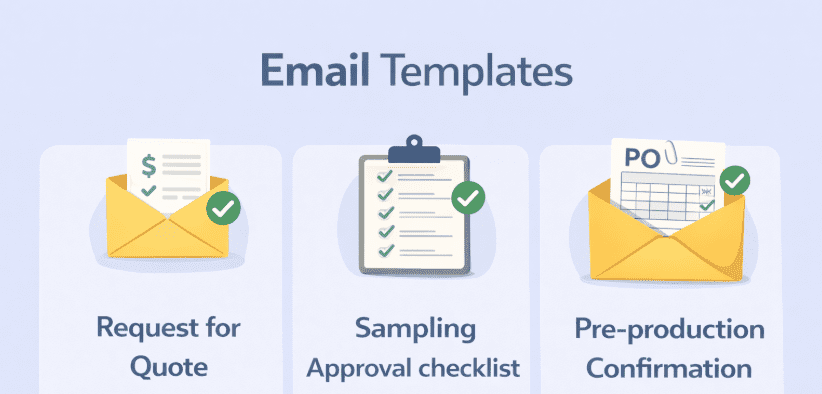
Email #1: RFQ (Request for Quote)
Goal: get a quote you can compare across suppliers.
Include:
- product type and fit (regular/oversized; men’s/women’s/unisex)
- fabric (composition + target GSM)
- colors
- sizes + quantity breakdown
- print/embroidery placement and dimensions
- target ship date
- request a price breakdown (unit cost + sampling + packaging + shipping terms)
Email #2: Sampling approval checklist
Goal: turn opinions into measurable requirements.
Confirm:
- size chart + tolerance (allowed measurement variation)
- shrinkage expectations (if relevant)
- print feel and durability expectations (in simple terms)
- label and packaging details
- whether you require a pre-production sample (PPS)
Email #3: Pre-production confirmation (before the final payment)
Goal: lock down responsibilities and reduce surprises.
Confirm:
- final tech pack/version number
- bulk fabric and color confirmation
- QC expectations and defect handling
- packing list + carton markings
- shipping responsibilities and deadlines
- remedies if the bulk does not match the approved sample
4) Ask for proof—not promises
Before you place an order, three “proof-based” steps reduce risk quickly:
- Get a physical sample
Photos don’t show fabric feel, stitching strength, or print texture. - Get key details in writing
Fabric details, measurements, print placement, packing specs, and dates should be in writing—ideally attached to your PO or contract. - Ask early for any testing or documents you truly need
If your product category or sales channel requires certain material documentation, raise it before production begins.
5) Build your shortlist the smart way: wide first, then strict
A common mistake is contacting only one or two suppliers. If sampling goes poorly, you lose weeks.
A safer workflow looks like this:
- Round 1 (wide): contact 8–15 candidates and send the same RFQ
- Round 2 (strict): keep 3–5 for sampling and terms
- Round 3 (test): place a small order, then scale if consistent
If you need a starting set of candidates for Round 1, a list like T-shirt manufacturers in China can be used as a first collection, and then you can still filter using the checklist above.
