

Algorithmic Trading Market Scope and Overview
Algorithmic trading has transformed the landscape of financial markets, enabling traders to execute orders at lightning speed and with increased precision. Leveraging complex algorithms, these trading systems analyze vast amounts of data to make split-second decisions, capitalizing on market opportunities that human traders might miss. The growth of algorithmic trading is fueled by advancements in technology, increased market volatility, and the ever-growing demand for efficient trading strategies. This article delves into the Algorithmic Trading Market, exploring its competitive landscape, market segmentation, strengths, opportunities for growth, and concluding insights.
The Algorithmic Trading market centers on the use of automated algorithms to execute trading strategies in financial markets. These algorithms analyze market data and execute trades at speeds and volumes that human traders cannot match. The market is driven by the increasing complexity of trading environments and the need for high-frequency trading to capitalize on market opportunities. Algorithmic trading is widely adopted by institutional investors, hedge funds, and proprietary trading firms seeking to enhance their trading performance and reduce costs. As technology advances, the algorithmic trading market continues to evolve with the integration of machine learning and AI.
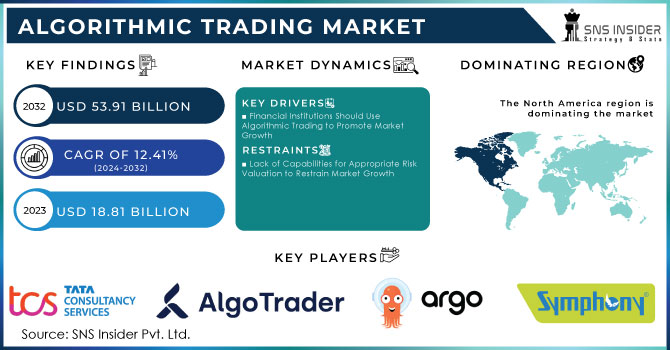
Competitive Analysis
The Algorithmic Trading Market is characterized by intense competition, with several major players driving innovation and shaping the market dynamics. Key players in this space include 63 Moons Technologies Limited, Tata Consultancy Services Limited, Algo Trader, Symphony, Argo Software Engineering, Refinitiv, InfoReach, Inc., Kuberre Systems, Inc., MetaQuotes Ltd., VIRTU Finance Inc, and others.
These companies offer a diverse range of solutions and services that cater to different aspects of algorithmic trading. Their competitive strategies include the development of cutting-edge technology, strategic partnerships, and robust customer support systems. The presence of established firms alongside emerging players fosters a competitive environment that encourages continuous innovation, ultimately benefiting traders by providing them with increasingly sophisticated trading tools and platforms.
Algorithmic Trading Market Segmentation
The Algorithmic Trading Market can be segmented based on several factors, allowing stakeholders to gain insights into the various dimensions of the market. Each segment addresses different aspects of algorithmic trading and highlights opportunities for growth and investment.
Solution
- Platforms: Algorithmic trading platforms provide a comprehensive suite of tools that enable traders to design, test, and execute trading strategies. These platforms often include features such as real-time data feeds, advanced charting capabilities, and risk management tools. Major players are continually enhancing their platforms to incorporate new functionalities, making them more user-friendly and efficient for traders of all levels.
- Software Tools: This segment includes specialized software applications that support various trading strategies, such as quantitative analysis and backtesting. Software tools help traders analyze historical data, optimize their algorithms, and implement automated trading strategies. The demand for software tools is increasing as more traders seek to leverage data analytics to improve their trading performance.
Service
- Professional Services: Professional services encompass consulting, training, and support services provided by experts in algorithmic trading. These services help traders and firms implement effective trading strategies, optimize their existing algorithms, and enhance their overall trading performance. The increasing complexity of trading strategies has driven the demand for professional services in the market.
- Managed Services: Managed services refer to the outsourcing of trading operations to third-party providers. These services can include the management of trading algorithms, monitoring of trading activities, and execution of trades on behalf of clients. Managed services are particularly appealing to firms looking to minimize operational costs and enhance trading efficiency.
Deployment
- Cloud: Cloud-based algorithmic trading solutions have gained popularity due to their scalability, flexibility, and cost-effectiveness. By leveraging cloud infrastructure, traders can access powerful computing resources and data storage without the need for significant upfront investments in hardware. This deployment model allows for easy integration of new features and updates, making it a preferred choice for many traders.
- On-premise: On-premise solutions involve deploying algorithmic trading systems within a firm’s own infrastructure. This model offers greater control over data security and system performance, making it suitable for institutions with stringent compliance requirements. While on-premise solutions often require higher initial investments, they provide firms with tailored solutions that meet their specific needs.
Trading Types
- Foreign Exchange (FOREX): The FOREX market is one of the largest and most liquid financial markets globally, making it a prime target for algorithmic trading. Traders employ algorithms to capitalize on currency fluctuations and execute trades at optimal prices. The high volatility of the FOREX market further enhances the effectiveness of algorithmic trading strategies.
- Stock Markets: Algorithmic trading is widely used in stock markets to facilitate high-frequency trading, arbitrage opportunities, and portfolio management. Algorithms analyze vast amounts of market data to identify patterns and trends, allowing traders to execute orders with minimal latency.
- Exchange-Traded Fund (ETF): ETFs have gained significant popularity among investors, leading to increased algorithmic trading activity in this segment. Algorithms are used to manage ETF portfolios, optimize trading costs, and enhance liquidity. As the ETF market continues to expand, so does the demand for algorithmic trading solutions tailored to this asset class.
- Bonds: The bond market is characterized by its complexity and varying liquidity levels. Algorithmic trading is increasingly being adopted in this segment to improve trade execution and pricing efficiency. Algorithms help traders navigate the intricacies of bond trading by analyzing yield curves, credit ratings, and market conditions.
- Cryptocurrencies: The rise of cryptocurrencies has opened new avenues for algorithmic trading. Traders utilize algorithms to analyze price movements, identify trading opportunities, and manage risk in this highly volatile market. The 24/7 nature of cryptocurrency trading makes algorithmic strategies particularly valuable for traders seeking to capitalize on rapid price changes.
- Others: This category includes various other asset classes where algorithmic trading is applied, such as commodities and derivatives. The flexibility of algorithmic trading strategies allows traders to adapt to different market conditions and asset classes.
Type of Traders
- Institutional Investors: Institutional investors, such as hedge funds and asset management firms, are significant players in the algorithmic trading market. They rely on sophisticated trading algorithms to execute large orders efficiently and minimize market impact. The increasing adoption of algorithmic trading by institutional investors drives market growth.
- Long-term Traders: Long-term traders focus on executing trades with a longer investment horizon. Algorithmic trading helps them implement systematic strategies and manage portfolios effectively. These traders often utilize algorithms to rebalance their portfolios and optimize asset allocation.
- Short-term Traders: Short-term traders, including day traders and high-frequency traders, rely heavily on algorithmic trading to capitalize on small price fluctuations. They use algorithms to execute a high volume of trades in a short period, leveraging speed and precision to gain a competitive edge.
- Retail Investors: The democratization of algorithmic trading has empowered retail investors to access advanced trading tools previously available only to institutional players. Retail traders increasingly utilize algorithmic strategies to enhance their trading capabilities and manage risks.
Strengths of the Algorithmic Trading Market
The Algorithmic Trading Market exhibits several strengths that contribute to its resilience and potential for growth:
- Algorithmic trading significantly increases the efficiency of trade execution, enabling traders to capitalize on opportunities that arise in milliseconds. This efficiency is a key driver of the market’s growth.
- Algorithmic trading relies on data analytics to inform trading decisions. This data-driven approach enhances trading accuracy and helps traders make informed choices based on historical trends and real-time market conditions.
- By automating trading processes, algorithmic trading minimizes the risk of human error, leading to more consistent trading performance. This reliability attracts more participants to the market.
- Algorithmic trading solutions can easily scale to accommodate increasing trading volumes and complexity. This scalability is crucial for traders looking to expand their operations without compromising performance.
Opportunities for Algorithmic Trading Market Growth
Several opportunities exist for growth within the Algorithmic Trading Market:
- As financial markets in emerging economies continue to develop, the demand for algorithmic trading solutions is expected to grow. These markets offer significant opportunities for companies looking to expand their presence.
- Continuous advancements in technology, including machine learning and artificial intelligence, present opportunities for the development of more sophisticated algorithmic trading strategies. Firms that invest in these technologies can gain a competitive edge.
- The evolving regulatory landscape presents both challenges and opportunities for algorithmic trading. Companies that can navigate regulatory requirements effectively will be well-positioned to capitalize on market opportunities.
- Strategic collaborations between technology providers and financial institutions can lead to the development of innovative solutions that meet the specific needs of traders, driving market growth.
Conclusion
The Algorithmic Trading Market is experiencing rapid growth, driven by technological advancements, increasing market volatility, and the demand for efficient trading strategies. As major players continue to innovate and expand their offerings, traders across various segments can benefit from enhanced trading capabilities and improved market access.
In conclusion, the Algorithmic Trading Market represents a dynamic and evolving landscape that is reshaping the way trading is conducted in financial markets. With opportunities for growth and innovation, stakeholders who embrace the power of algorithmic trading are well-positioned to succeed in this competitive environment. As the market continues to evolve, it will undoubtedly play a pivotal role in the future of trading and investment strategies.
Table of Contents
- Introduction
- Industry Flowchart
- Research Methodology
- Market Dynamics
- Impact Analysis
- Impact of Ukraine-Russia war
- Impact of Economic Slowdown on Major Economies
- Value Chain Analysis
- Porter’s 5 Forces Model
- PEST Analysis
- Algorithmic Trading Market Segmentation, by Solution
- Algorithmic Trading Market Segmentation, by Service
- Algorithmic Trading Market Segmentation, by Deployment
- Algorithmic Trading Market Segmentation, by Trading Types
- Algorithmic Trading Market Segmentation, by Type of Traders
- Regional Analysis
- Company Profile
- Competitive Landscape
- USE Cases and Best Practices
- Conclusion
Contact Us:
Akash Anand – Head of Business Development & Strategy
info@snsinsider.com
Phone: +1-415-230-0044 (US) | +91-7798602273 (IND)
About Us
SNS Insider is one of the leading market research and consulting agencies that dominates the market research industry globally. Our company’s aim is to give clients the knowledge they require in order to function in changing circumstances. In order to give you current, accurate market data, consumer insights, and opinions so that you can make decisions with confidence, we employ a variety of techniques, including surveys, video talks, and focus groups around the world.
Read Our Other Reports:
Sports Analytics Market Analysis
Customer Success Platform Industry