
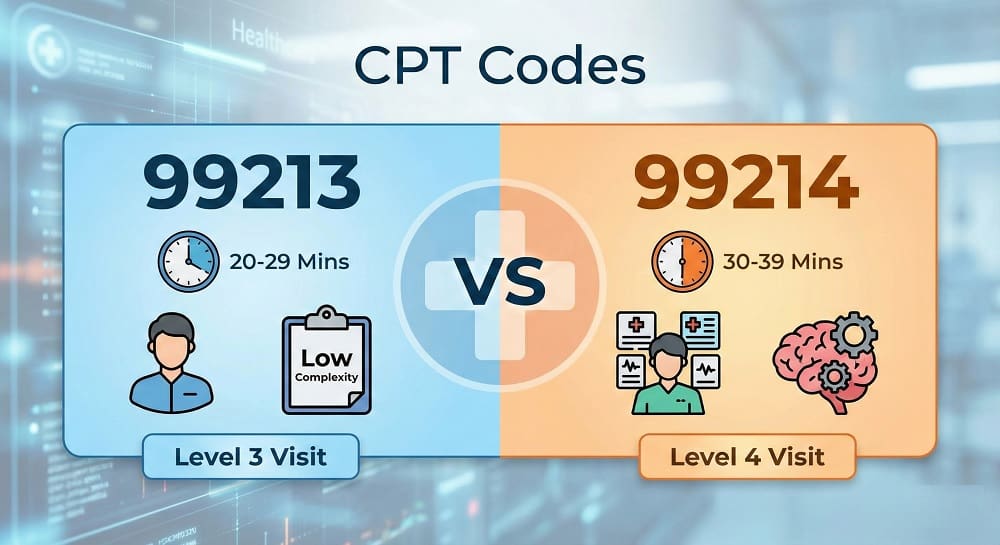
Medical billing often feels like a puzzle. Two pieces that look very similar are CPT codes 99213 and 99214.
These two codes are the most common choices for office visits. They are used for established patients. This means the patient has seen the doctor (or a doctor in the same group) within the last three years.
Choosing the right code is vital. It ensures you get paid fairly for your work. It also protects your practice from audits.
This guide breaks down the simple differences. We will look at time rules, medical decision making, and examples.
What is CPT 99213?
Think of 99213 as the code for a “low complexity” visit. It is a standard check up. The patient has a problem, but it is not dangerous or hard to treat.
Key Features of 99213:
- Patient Status: Established patient.
- Complexity: Low level of medical decision making.
- Time Rule: 20 to 29 minutes total time on the date of the encounter.
Common Examples for 99213:
- A refill visit for stable hypertension.
- A patient with a minor viral infection.
- A follow up for well controlled diabetes.
- An uncomplicated ankle sprain.
In these cases, the risk to the patient is low. The data you need to review is minimal.
What is CPT 99214?
99214 represents a “moderate complexity” visit. The patient has a harder problem to solve. The doctor must think more, review more notes, or manage higher risks.
This code pays more because it requires more work.
Key Features of 99214:
- Patient Status: Established patient.
- Complexity: Moderate level of medical decision making.
- Time Rule: 30 to 39 minutes total time on the date of the encounter.
Common Examples for 99214:
- A patient with diabetes that is out of control.
- A visit to manage three different stable chronic illnesses at once.
- A new lump or mass that needs a biopsy or referral.
- A patient with high blood pressure who has new side effects from meds.
- Prescription management for a new or changing drug.
The Main Differences: 99213 vs 99214
You can choose the code based on Time or Medical Decision Making (MDM). You do not need both. You can pick the one that fits best.
1. The Time Difference
Time is the easiest way to code. You must count the total time you spend on the patient that day. Modern EHR systems and AI medical assistant tools can automatically track provider time and help determine whether CPT 99213 or 99214 is appropriate.
- Choose 99213 if the total time is 20 to 29 minutes.
- Choose 99214 if the total time is 30 to 39 minutes.
What counts as time?
- Reviewing the chart before the visit.
- Examining the patient.
- Ordering tests or meds.
- Documenting the note in the electronic health record.
- Talking to other providers or family members.
Note: You cannot count time spent by nurses or staff. Only the provider’s time counts.
2. The Medical Decision Making (MDM) Difference
Most doctors code based on MDM. This measures how hard the visit was. MDM has three parts. To pick a code, you need to meet the rules for two out of the three parts.
The Three Parts of MDM:
- Problems: How many problems are you treating? Are they stable or getting worse?
- Data: Did you order labs? Did you review notes from another doctor?
- Risk: Is there a risk of death or severe side effects? Are you prescribing strong meds?
For Code 99213 (Low Complexity)
You need two of these:
- Problems: Two minor problems OR one stable chronic illness OR one acute illness.
- Data: Minimal or no data needed.
- Risk: Low risk. (Example: Over the counter meds, physical therapy).
For Code 99214 (Moderate Complexity)
You need two of these:
- Problems: One chronic illness with flare up OR two stable chronic illnesses OR one new problem with uncertain prognosis.
- Data: Reviewing tests, ordering unique tests, or talking to an independent historian (like a parent or caregiver).
- Risk: Moderate risk. (Example: Prescription drug management, decision for minor surgery).
Quick Comparison Table
| Feature | CPT 99213 | CPT 99214 |
| Level | Level 3 (Low) | Level 4 (Moderate) |
| Patient Type | Established | Established |
| Total Time | 20 to 29 Minutes | 30 to 39 Minutes |
| Problems | Stable or Minor | Worsening or Multiple |
| Prescription? | Usually OTC meds | Prescription Management |
| Risk | Low | Moderate |
When to Upgrade to 99214
Many providers under code. They bill a 99213 when they did the work for a 99214. This loses revenue.
You should bill 99214 if:
- You prescribed a new prescription medication.
- You adjusted the dose of an existing prescription.
- You managed two or more stable chronic conditions (like hypertension and lipids) in one visit.
- You ordered three unique tests (like a CBC, CMP, and TSH).
- You spent 30 minutes or more on the patient’s care that day.
Summary
- Use 99213 for stable, simple visits or visits lasting 20 to 29 minutes.
- Use 99214 for complex, worsening issues or visits lasting 30 to 39 minutes.
Correct coding helps you focus on patient care without worrying about lost income.